


For two decades, researchers observed members of the Ngogo chimpanzee group of Kibale National Park in Uganda spend their days eating fruits and leaves, resting, traveling and grooming in their tropical rainforest abode, but this stable community then fractured and descended into years of deadly violence.
The researchers are now describing the first clearly documented example of a group of wild chimpanzees splitting into two separate factions, with one launching a series of coordinated attacks against the other. Adult males and infants were targeted, with 28 deaths.
“Biting, pounding the victim with their hands, dragging them, kicking them — mostly adult males, but sometimes adult females participate in the attacks,” said University of Texas primatologist Aaron Sandel, lead author of the study published on Thursday in the journal Science.
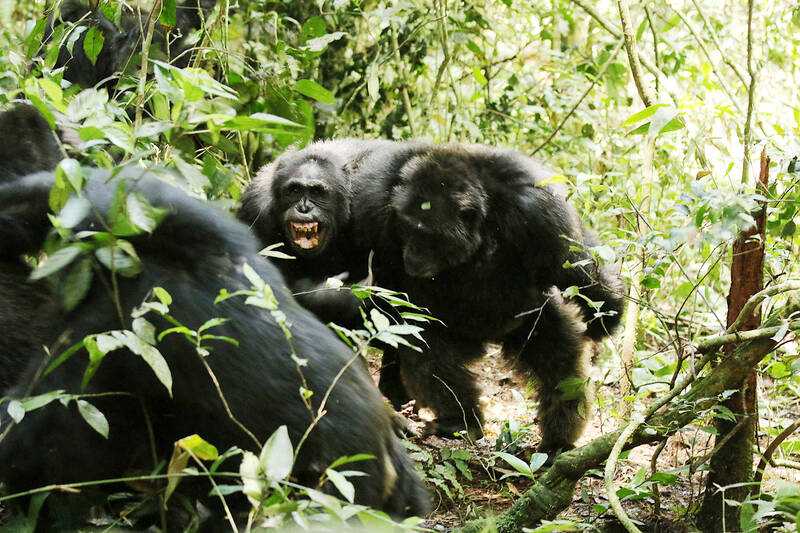
Photo: Aaron Sandel via Reuters
The researchers began studying the Ngogo chimpanzees in 1995. It was the largest known group of wild chimpanzees anywhere, peaking at about 200 members. Chimpanzee groups typically number about 50.
Researchers have long known chimpanzees attack and kill members of neighboring chimpanzee groups — essentially strangers — but this was different.
“It is hard for me to wrap my head around the fact that yesterday’s friend turned into today’s foe. Males in the two groups grew up with each other, knew each other their entire lives, and cooperated and collaborated with each other, benefiting in the process,” said primatologist and study senior author John Mitani, a University of Michigan professor emeritus.
“So why split? Perhaps they became a victim of their own success when the group grew to an intolerably large size,” Mitani said.
The researchers said a combination of factors might have destabilized the group. Its original large size might have intensified feeding competition for everyone and competition among the males to mate with females. The 2014 deaths of seven chimpanzees amid signs of illness might have disrupted social relationships, creating hostilities.
Chimpanzee communities are male-dominated. There was a change in the alpha male — the group’s highest-ranking chimpanzee — at about the time tensions began in 2015, with a chimpanzee called Jackson deposing another male.
Before the split, the group was one cohesive community, although social clusters existed. Members of two clusters began avoiding each other in 2015. Months after an illness in 2017 killed 25 chimpanzees, mostly infants, members of one of the clusters attacked Jackson, although he survived. By the end of 2017, two distinct groups had formed, labeled the western and central groups.
The subsequent violence was perpetrated by the western group against the central group, starting in 2018.
The published study included observations through 2024, with seven adult males and 17 infants killed. The violence has continued. Last year and this year, one adult male, one adolescent male and two infants were killed, raising the death toll to 28. Many chimpanzees have disappeared without a clear cause, suggestive of additional unrecorded killings.
“They just beat and jump on the victim relentlessly. I’ve witnessed cases that take less than 15 minutes. There’s some biting, and if you examine the bodies of victims, you will see cuts, but nothing that looks like it can cause a fatality. Instead, I’ve always thought that mature victims die due to internal injuries,” Mitani said.
“By contrast, a single mature chimpanzee can snatch an infant from its mother and kill it quickly with a few bites or via blunt force trauma. The latter might include slamming it to the ground,” he said.
The western group began as smaller in size and territory, but eventually surpassed the central group in both. The western group apparently has experienced no casualties.
While the scientists preferred not to call these events a civil war, a term with specific meaning in human conflict, they saw important similarities.
The researchers noted one prior example of a chimpanzee community apparently splitting, with lethal aggression by one faction against the other, in Tanzania in the 1970s. In that instance, researchers had regularly fed the chimpanzees, altering natural behavior, and observed them only at the feeding location, leaving many questions unanswered.
Chimpanzees and their close cousins bonobos are our closest evolutionary relatives, but the researchers cautioned against drawing parallels between chimpanzee violence and human behavior.
“We are similar in some ways, due to our shared evolutionary history, but we are also fundamentally different because we have changed during the past 6, 8 million years, after having split off from them,” Mitani said.


Showcasing phallus-shaped portable shrines and pink penis candies, Japan’s annual fertility festival yesterday teemed with tourists, couples and families elated by its open display of sex. The spring Kanamara Matsuri near Tokyo features colorfully dressed worshipers carrying a trio of giant phallic-shaped objects as they parade through the street with glee. The festival, as legend has it, honors a local blacksmith in the Edo Period (1603-1868) who forged an iron dildo to break the teeth of a sharp-toothed demon inhabiting a woman’s vagina that had been castrating young men on their wedding nights. A 1m black steel phallus sits in the courtyard of

JAN. 1 CLAUSE: As military service is voluntary, applications for permission to stay abroad for over three months for men up to age 45 must, in principle, be granted A little-noticed clause in sweeping changes to Germany’s military service policy has triggered an uproar after it emerged that the law requires men aged up to 45 to get permission from the armed forces before any significant stay abroad, even in peacetime. The legislation, which went into effect on Jan. 1 aims to bolster the military and demands all 18-year-old men fill out a questionnaire to gauge their suitability to serve in the armed forces, but stops short of conscription. If the “modernized” model fails to pull in enough recruits, parliament will be compelled to discuss the reintroduction of compulsory service, German
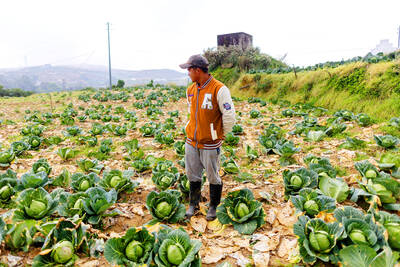
Filipino farmers like Romeo Wagayan have been left with little choice but to let their vegetables rot in the field rather than sell them at a loss, as rising oil prices linked to the Iran war drive up the cost of harvesting, labor and transport. “There’s nothing we can do,” said Wagayan, a 57-year old vegetable farmer in the northern Philippine province of Benguet. “If we harvest it, our losses only increase because of labor, transportation and packing costs. We don’t earn anything from it. That’s why we decided not to harvest at all,” he said. Soaring costs caused by the Middle East

Hungarian Prime Minister Viktor Orban’s officially declared wealth is fairly modest: some savings and a jointly owned villa in Budapest. However, voters in what Transparency International deems the EU’s most corrupt country believe otherwise — and they might make Orban pay in a general election this Sunday that could spell an end to his 16-year rule. The wealth amassed by Orban’s inner circle is fueling the increasingly palpable frustration of a population grappling with sluggish growth, high inflation and worsening public services. “The government’s communication machine worked well as long as our economic situation remained relatively good,” said Zoltan Ranschburg, a political analyst


 RSS
RSS