


Cambodia's King Norodom Sihanouk, after refusing repeatedly to sign a bill to pave the way for a new government, finally agreed yesterday to reappoint Prime Minister Hun Sen, the Information Ministry said.
In a document signed by Sihanouk yesterday and released by the ministry, the King said he had approved a request from Hun Sen's ruling Cambodian People's Party (CPP) to appoint the former Khmer Rouge for another five-year term in office.
Hun Sen has run the nation for nearly 20 years, making him one of the world's longest serving prime ministers.
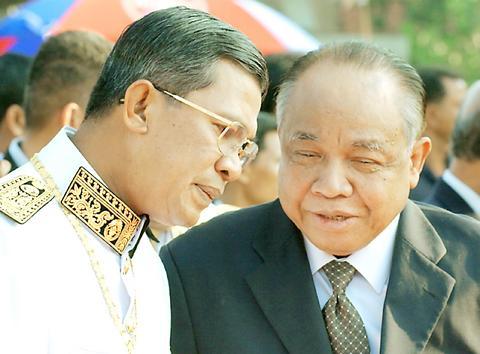
PHOTO: EPA
"[I] appoint Hun Sen as the prime minister of the royal government of Cambodia," the King wrote.
"The Prime Minister has the duty to propose forming of government and seek the approval from the National Assembly."
Sihanouk also rubber-stamped another controversial bill already passed by parliament approving the simultaneous election of prime minister and National Assembly president.
Both Sihanouk and the opposition had questioned the legality of the so-called "package vote" designed to neutralize the inherent distrust and loathing that Cambodia's fractious politicians feel for each other.
The change of heart by Sihanouk, who is in North Korea waiting out a year-long post-election political stalemate, followed confusion on Tuesday in which senate president and acting head of state Chea Sim left the country abruptly "for health reasons."
In Sihanouk's absence, Chea Sim had the authority to sign laws already approved by the National Assembly and Senate.
However, the opposition said troops and police had surrounded Chea Sim's house prior to his departure in what amounted to a "coup" within the ruling party. The "package vote" bill was then signed by the deputy acting head of state.
Thai Prime Minister Thaksin Shinawatra confirmed yesterday that Chea Sim and several other prominent Cambodian politicians had entered Thailand on Tuesday.
Yesterday morning Chea Sim underwent a cardiogram at Bangkok's Bumrungrad Hospital, but was released after a brief stay, hospital officials said.
Chea Sim, president of the CPP and the senate, leads a faction within the CPP that has long been seen as a rival to Hun Sen, although the rift between senior members of the tightly-run former communist party has been kept from public view.
Opposition leader Sam Rainsy was quoted as saying the flight of Chea Sim and his political allies from Cambodia were indications of a "party coup d'etat" within the CPP.
Thailand's prime minister, who has had a stormy relationship with Cambodia's leadership, confirmed that Chea Sim was one of several key Cambodian leaders to have unexpectedly entered Thailand, but he did not name the others.
"This is Cambodia's internal affair. Thailand won't interfere," Thaksin told reporters at his party's headquarters. "We have to pray that the turmoil in Cambodia will end soon and they can form a new government. We want to see Cambodia on the road to development."
The Thai military's Chantaburi Task Force, which handles security along the Thai-Cambodian border, was reported yesterday to have stepped up security, particularly at the crossing point at Koh Kong.
An Immigration Police source said Thai officers had been instructed to allow Cambodian "VIPs" to cross into Thailand regardless of whether they carried visas.
CPP spokesman Khieu Kanharith played down talk of political instability and a rift down the middle of the former communist party, which has ruled Cambodia for the past two decades.
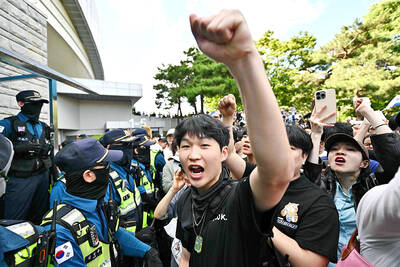
‘ABSURD MISTAKE’: The election commission said that there had been a failure to anticipate turnout after 14 polling stations ran short of ballot papers South Korean riot police yesterday cleared protesters from a Seoul polling station after a 35-hour blockade sparked by a shortage of ballot papers during local elections earlier this week. Wednesday’s election was the first nationwide vote since South Korean President Lee Jae-myung took office following the ouster of Yoon Suk-yeol over his short-lived martial law declaration. Lee’s ruling Democratic Party swept most races, but failed to flip the crucial Seoul mayoral seat. The South Korean National Election Commission apologized, blaming a failure to anticipate turnout after 14 polling stations in Seoul ran short of ballot papers. Some polling stations stayed open until 10pm to

France experienced its hottest spring on record, the French weather service said on Tuesday, after an exceptional early heat wave that also broke highs for the season in England and Wales. Meteo-France said the average nationwide temperature over March to May was 13.8°C — about 1.7°C above the norm, and surpassing records set in 2011 and 2020. “The warmest spring since records began in 1900,” it said in a bulletin. All three months were warmer than average, but the onset of an “unprecedented heatwave” late last month pushed the mercury to highs typically seen at the height of the summer. “Our country had never

A Sherpa guide was found crawling to base camp on Mount Everest a week after he went missing and was reunited with his family, who had given up hope he would return. Dawa Sherpa was last seen on Friday last week descending the mountain, but he did not reach base camp even though his client did. The pair were among the last climbers on the mountain as the climbing season came to an end and the route was dismantled. Dawa was located by a cleaning crew on Thursday morning as he was crawling down the snowy slopes around the Khumbu Icefall, just above
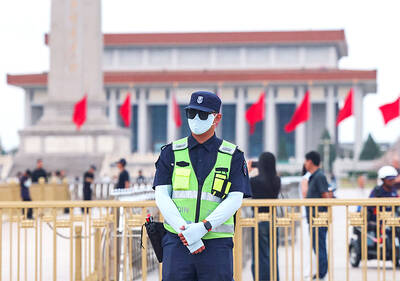
Chinese authorities are snuffing out any remembrance of the deadly 1989 military crackdown on student-led pro-democracy protests in Tiananmen Square, which happened 37 years ago yesterday, in a further tightening of a years-long campaign to erase what happened from public memory. Police told relatives of the victims they would not be allowed to visit a cemetery in Beijing on the anniversary of the crackdown, a person with knowledge of the matter said. Relatives of the victims visited the cemetery on the anniversary for more than 30 years to read memorial statements with police keeping watch, Amnesty International said. Hundreds of people,


 RSS
RSS