


Iraqi insurgents detonated a car bomb and then hammered a military headquarters in the city of Samarra with a massive mortar barrage on Thursday, leveling the building and killing five US soldiers and one Iraqi guardsman, the US military said.
American troops -- backed by attack helicopters -- then fanned out through the city to hunt down the attackers in clashes that lasted into late Thursday afternoon. Tanks deployed in the streets. Smoke rose above a local mosque.
The violence also killed three civilians, medical officials said. As many as 44 people were wounded, including 20 US soldiers and four Iraqi guardsmen, the military and hospital officials said.
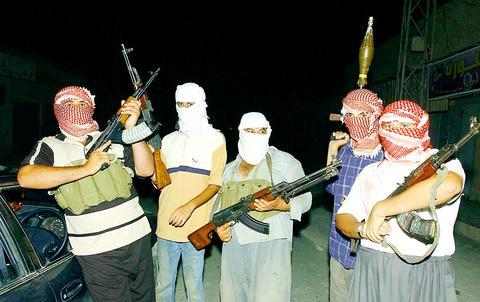
PHOTO: EPA
About 10:30am Thursday, Iraqi insurgents lashed out at US forces in Samarra, a hotbed of anti-coalition resistance 95km north of Baghdad, said Major Neal O'Brien, the spokesman for the 1st Infantry Division.
One witness, Khalid Salih, said the gate of the headquarters building shared by US forces and their Iraqi National Guard allies was open when a sport utility vehicle with a car bomb drove in.
``I saw a GMC entering into the base and immediately exploding,'' he said.
Insurgents then launched 38 mortars at the headquarters, destroying the building, O'Brien said. Some of the rounds landed in surrounding residential neighborhoods.
About 25 minutes after the mortar attack -- once radar determined where it had originated -- US soldiers responded with four mortar rounds of their own.
American troops moved through the streets to flush out the insurgents, and four fighters shot at the soldiers before taking refuge in a building, O'Brien said. US helicopters swooped in and attacked with Hellfire missiles, killing the four attackers.
Elsewhere, four large explosions were heard at an Iraqi base in the town of Mishahda, 40km north of Baghdad. Volleys of gunfire broke out immediately afterward. US military officials had no immediate comment.
Meanwhile, an explosion killed former senior Baath party official, Ali Abbas Hassan, as he left his textile factory in Baghdad, said police Lt. Anmar Yassin. Authorities didn't know the cause of the explosion.
Elsewhere, explosions were heard in Fallujah, the Sunni city considered to be a safe haven for militants seeking to attack US and Iraqi forces. Several airstrikes have been launched at suspected safehouses believed linked to Jordanian-born militant Abu Musab al-Zarqawi.
Early yesterday, the pan-Arab television network al Jazeera broadcast a video showing Zarqawi's Tawhid and Jihad group threatening to execute two Bulgarian hostages if the US military did not release all Iraqi detainees within 24 hours.
The video showed the two unidentified Bulgarians sitting with their hands cuffed, flanked by three masked, armed men. The Foreign Ministry in Sofia later identified them as Ivaylo Kepov and Georgi Lazov, who were in Iraq working as truck drivers for a private company.
The group had previously claimed responsibility for the beheading of US businessman Nicholas Berg and South Korean translator Kim Sun-il.
An Iraqi interpreter working with US forces was also taken hostage in Ramadi, west of Baghdad, a police officer said yesterday.
Omar Abdel Jabbar was forced into a car at gun point after armed men came to his house in the town, 100km west of Baghdad, at about 11 pm on Thursday, said the officer on condition of anonymity.
"I saw four masked men force him into their car, which was a clear blue Opel," he said.
Numerous Iraqis working for the US military or the now dissolved occupation administration have been taken hostage in Iraq by those who regard them as collaborators.
On Thursday, police said that an Iraqi man who owns a laundry and a restaurant on a US military base in the northern city of Mosul was found with his hands cut off and an eye gouged out after being taken hostage.
Ramadi is part of the so-called Sunni Muslim triangle, a stronghold of anti-US insurgents aggrieved by the ouster of former president Saddam Hussein's Sunni-dominated regime.
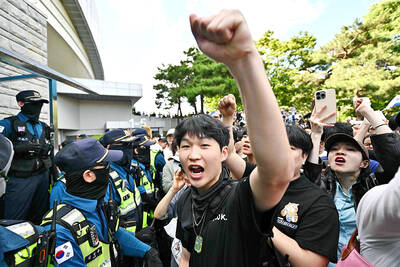
‘ABSURD MISTAKE’: The election commission said that there had been a failure to anticipate turnout after 14 polling stations ran short of ballot papers South Korean riot police yesterday cleared protesters from a Seoul polling station after a 35-hour blockade sparked by a shortage of ballot papers during local elections earlier this week. Wednesday’s election was the first nationwide vote since South Korean President Lee Jae-myung took office following the ouster of Yoon Suk-yeol over his short-lived martial law declaration. Lee’s ruling Democratic Party swept most races, but failed to flip the crucial Seoul mayoral seat. The South Korean National Election Commission apologized, blaming a failure to anticipate turnout after 14 polling stations in Seoul ran short of ballot papers. Some polling stations stayed open until 10pm to

France experienced its hottest spring on record, the French weather service said on Tuesday, after an exceptional early heat wave that also broke highs for the season in England and Wales. Meteo-France said the average nationwide temperature over March to May was 13.8°C — about 1.7°C above the norm, and surpassing records set in 2011 and 2020. “The warmest spring since records began in 1900,” it said in a bulletin. All three months were warmer than average, but the onset of an “unprecedented heatwave” late last month pushed the mercury to highs typically seen at the height of the summer. “Our country had never
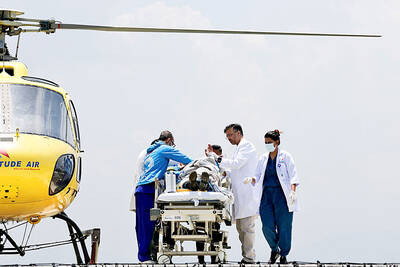
A Sherpa guide was found crawling to base camp on Mount Everest a week after he went missing and was reunited with his family, who had given up hope he would return. Dawa Sherpa was last seen on Friday last week descending the mountain, but he did not reach base camp even though his client did. The pair were among the last climbers on the mountain as the climbing season came to an end and the route was dismantled. Dawa was located by a cleaning crew on Thursday morning as he was crawling down the snowy slopes around the Khumbu Icefall, just above
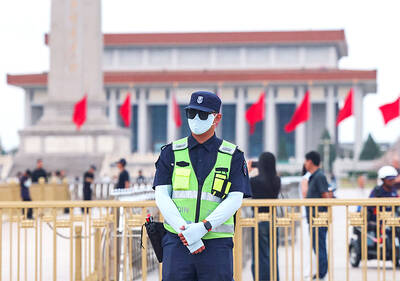
Chinese authorities are snuffing out any remembrance of the deadly 1989 military crackdown on student-led pro-democracy protests in Tiananmen Square, which happened 37 years ago yesterday, in a further tightening of a years-long campaign to erase what happened from public memory. Police told relatives of the victims they would not be allowed to visit a cemetery in Beijing on the anniversary of the crackdown, a person with knowledge of the matter said. Relatives of the victims visited the cemetery on the anniversary for more than 30 years to read memorial statements with police keeping watch, Amnesty International said. Hundreds of people,


 RSS
RSS