


China's government is pledging to intensify the fight against what it considers social evils -- street crime and terrorism, Falun Gong and the corrupt officials that are undermining leaders' claims of putting people first.
The country's top judge and top prosecutor, in reports before the National People's Congress session running through Sunday, acknowledged the many problems that face their changing society, but insisted the government has matters in hand.
Chief prosecutor Jia Chunwang told legislators that in the past year China has "resolutely attacked ethnic separatists, religious extremists, violent terrorists, and Falun Gong and other types of criminal organized movements."
The Falun Gong spiritual movement was banned by the government in 1999 as an "evil cult."
Supreme Court Chief Justice Xiao Yang said bribe-taking and other corruption persists within China's courts, seriously hurting the legal system's reputation, and that officials will "spare no efforts to solve the problem."
Chinese leaders fear growing anger over official corruption might trigger unrest and threaten their grip on power.
"We are paying more and more attention to controlling it," said Yu Baofa, a congressional delegate from Shandong Province. "The government is even willing to deal with high-level leaders.... It will put the person in jail."
Xiao said six ministerial-level officials had been sentenced last year for "job-related crimes," including a judge, a former governor from southwestern China and a top banking official. A total of 22,986 cases of "job-related abuse" by government officials were heard by China's courts last year, Xiao said.
Jia said prosecutors investigated 18,515 major corruption crimes involving 2,728 officials last year.
In some cases, prosecutors failed to deal with local corruption cases quickly or well enough, Jia said, promising to do more in the coming year. He vowed to "earnestly seek a solution."


Through the noise of rushing papers and whirring belts at a print factory in Kyoto, two creators watch their photo essay come to life in broadsheet form — part of an effort to win new audiences in the age of artificial intelligence (AI). Despite the decline of the publishing industry, self-publication and handmade “zine” magazines are growing in popularity in Japan, reflecting the nation’s enduring love of paper in the digital era. While speaking to Agence France-Presse at the plant, his hands black with ink, one of the creators, Kazuma Obara, said: “I think [paper] is a medium that engages all five
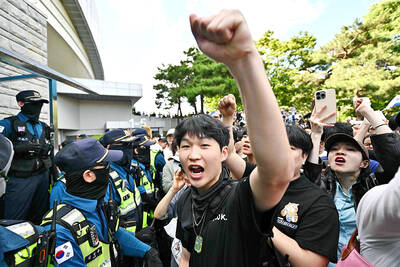
‘ABSURD MISTAKE’: The election commission said that there had been a failure to anticipate turnout after 14 polling stations ran short of ballot papers South Korean riot police yesterday cleared protesters from a Seoul polling station after a 35-hour blockade sparked by a shortage of ballot papers during local elections earlier this week. Wednesday’s election was the first nationwide vote since South Korean President Lee Jae-myung took office following the ouster of Yoon Suk-yeol over his short-lived martial law declaration. Lee’s ruling Democratic Party swept most races, but failed to flip the crucial Seoul mayoral seat. The South Korean National Election Commission apologized, blaming a failure to anticipate turnout after 14 polling stations in Seoul ran short of ballot papers. Some polling stations stayed open until 10pm to

France experienced its hottest spring on record, the French weather service said on Tuesday, after an exceptional early heat wave that also broke highs for the season in England and Wales. Meteo-France said the average nationwide temperature over March to May was 13.8°C — about 1.7°C above the norm, and surpassing records set in 2011 and 2020. “The warmest spring since records began in 1900,” it said in a bulletin. All three months were warmer than average, but the onset of an “unprecedented heatwave” late last month pushed the mercury to highs typically seen at the height of the summer. “Our country had never

A Sherpa guide was found crawling to base camp on Mount Everest a week after he went missing and was reunited with his family, who had given up hope he would return. Dawa Sherpa was last seen on Friday last week descending the mountain, but he did not reach base camp even though his client did. The pair were among the last climbers on the mountain as the climbing season came to an end and the route was dismantled. Dawa was located by a cleaning crew on Thursday morning as he was crawling down the snowy slopes around the Khumbu Icefall, just above


 RSS
RSS