


Global consumption of antibiotics has soared since the year 2000, stoking calls for new policies to rein in usage — and fueling fears that the worldwide threat posed by drug-resistant superbugs will spiral out of control, researchers say.
A study in the Proceedings of the National Academy of Sciences (PNAS) — based on sales data for 76 countries — shows that consumption of antibiotics increased 65 percent from 2000 to 2015, driven by users in low and middle-income countries.
The research team headed by scientists from Johns Hopkins University in Baltimore and the Center for Disease Dynamics, Economics and Policy in the US capital said countries needed to invest in alternative treatments, sanitation and vaccination.
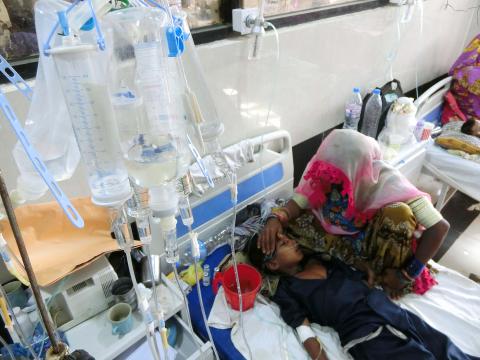
Photo: EPA
照片:歐新社
“With antibiotic consumption increasing worldwide, the challenge posed by antibiotic resistance is likely to get worse,” said the authors of the study, which was published in March 26’s edition of PNAS.
“Antibiotic resistance, driven by antibiotic consumption, is a growing global health threat,” it said. “As with climate change, there may be an unknown tipping point, and this could herald a future without effective antibiotics.”
In the 76 countries studied, the number of so-called “defined daily doses” consumed rose from 21.2 billion in 2000 to 34.8 billion in 2015.
Eili Klein, a researcher at the Center for Disease Dynamics, Economics and Policy and one of the study’s authors, said the jump signifies “increased access to needed drugs in countries with lots of disease that can be effectively treated with antibiotics.”
But, Klein warned: “As more and more countries gain access to these drugs, these rates will only increase and that will drive resistance rates higher.”
One group of experts formed in the UK in 2014 estimates that in 2016, there were at least 700,000 deaths related to drug-resistant infections.
Over the 16-year period studied, the increase in antibiotics consumption was marginal in the three countries with the highest usage — the US, France and Italy.
But it was a different story elsewhere: in Asia, consumption of antibiotics more than doubled in India, skyrocketed 79 percent in China and rose 65 percent in Pakistan.
The three countries are the biggest users of antibiotics among the countries deemed low and middle-income for the purposes of the study.
They are also countries that suffer in some areas from poor sanitation, irregular access to vaccines and a lack of clean drinking water — all conditions that allow infectious diseases and drug-resistant infections to spread.
“Radical rethinking of policies to reduce consumption is necessary, including major investments in improved hygiene, sanitation, vaccination and access to diagnostic tools both to prevent unnecessary antibiotic use and to decrease the burden of infectious disease,” the study says.
For Klein, eliminating overuse of antibiotics should be “a first step and a priority for every country,” especially given the alarming projection that by 2030, consumption may have increased by another 200 percent.
“Estimates are that 30 percent of use in high income countries is inappropriate,” Klein told AFP.
(AFP)
研究人員表示,自二○○○年以來,全球的抗生素使用量急遽增長,引起各界呼籲制定新政策以控管用量,也助長人們的恐懼,擔憂具抗藥性的超級細菌構成的世界性威脅將會失去控制。
一份刊登在《美國國家科學院院刊》的研究指出,根據七十六個國家的銷售數據顯示,在二○○○年到二○一五年之間,抗生素的用量增加了百分之六十五,此成長主要來自於低收入國家和中等收入國家的使用者增加。
這個研究團隊由多位來自巴爾的摩市約翰霍普金斯大學以及華府疾病動態、經濟和政策中心的科學家所率領。該團隊表示,世界各國應致力投資研發替代性的治療方式、加強環境衛生,並普及疫苗接種。
這份研究發表於三月二十六日出版的該期《美國國家科學院院刊》。研究作者群共同指出:「隨著世界各地的抗生素用量持續增加,對抗生素產生的抗藥性威脅只會愈來愈嚴重。」
「使用抗生素產生的抗藥性已是逐漸增強的全球性健康威脅。」作者們說:「就如同氣候變遷一樣,我們不知道未來哪天情況可能會惡化到臨界點,屆時將會出現一個抗生素不再有效的未來世界。」
在這份研究調查的七十六個國家裡,抗生素消耗的「定義每日劑量」從二○○○年的兩百一十二億上升到二○一五年的三百四十八億。
該研究的作者之一──艾里‧克萊恩──是華府疾病動態、經濟和政策中心的研究員,他表示「有些國家深受許多疾病所患,而這些疾病是能藉由抗生素有效治癒的」,抗生素用量的巨大攀升正彰顯出「這些國家愈來愈容易取得他們所需要的藥物。」
不過,克萊恩也對這個現象發出警示:「隨著愈來愈多國家能夠取得這些藥物,抗生素的使用率只會增加,而這將引發更高的抗生素抗藥性機率。」
二○一四年,有一群英國組成的專家估計,在二○一六年,至少會有七十萬個死亡病例與抗藥性導致的感染有關。
世界上抗生素使用量前三高的國家──美國、法國、義大利──在研究進行的十六年間,抗生素用量的增加非常微小。
但在別的地方,情況卻是截然不同:以亞洲而言,印度的抗生素增量超過兩倍,中國則急增百分之七十九,巴基斯坦則成長了百分之六十五。
在這份研究認定的低收入與中等收入國家群體中,這三個國家是最大的抗生素使用者。
在這些國家的某些地區,人們受糟糕的環境衛生條件所苦,疫苗接種頻率並不固定,更欠缺乾淨的飲用水──這些條件讓傳染性疾病以及抗藥性導致的感染病症得以傳播。
研究學者表示:「徹底重新思考政策以減少抗生素用量是必要的,相關措施包括做出重大投資來改善公共衛生、增進環境清潔、疫苗施打,普及診斷所需的醫療工具,以防治不必要的抗生素使用,降低傳染性疾病造成的負擔。」
克萊恩認為,全面削減抗生素的濫用行為應該是「每一個國家的第一步,也是最應該優先採取的措施」,特別是目前的預測讓人憂心忡忡──到二○三○年,抗生素的用量可能會額外增加百分之兩百。
克萊恩向法新社表示:「根據估計,在高收入國家中,也有百分之三十的抗生素使用是不適當的。」
(台北時報章厚明譯)


★ Bilingual Story is a fictionalized account. 雙語故事部分內容純屬虛構。 Lucas was already on the ground before he fully understood what was happening. “Hurry! Kneel down!” someone shouted. The asphalt was warm against his knees. Around him, dozens of people lay flat in the narrow street outside Jenn Lann Temple in Dajia. Some pressed their hands together in prayer. Others closed their eyes. Lucas had only come to look at the temple. An hour earlier he had stepped into the noisy courtyard out of curiosity. Inside the main hall, people held incense sticks, bowed three times,

You might think knitting is only for grandmas, but surprisingly, many young people are embracing so-called “grandma hobbies.” On social media platforms, activities such as home cooking, embroidery and gardening are becoming popular among teenagers and young adults who are drawn to their relaxing and creative nature. “Grandma hobbies” typically refer to activities that are slow-paced, handmade and nostalgic. Common examples include knitting scarves, baking cookies, sewing clothes and growing plants. These hobbies were once part of everyday life for many women in previous generations, but today they provide an escape from the fast-paced digital world. The appeal

A: Isn’t the 2026 Coachella Valley Music and Arts Festival — a massive music event held every April — about to open in California? B: Yeah the festival is set to take place over two weekends, from April 10 to 12 and 17 to 19, US time. A: I heard this year’s main stage headliners include Sabrina Carpenter, Justin Bieber, Karol G and EDM DJ Anyma. B: The K-pop army is also making an appearance, with legendary group BigBang, SHINee member Taemin and girl group Katseye debuting for the first time. A: Isn’t Coachella also live-streamed on its YouTube

Visitors walking down the streets of London and other major English cities might notice a curious sight. Many of the old __1__ have some of their windows boarded up. What’s even stranger is that there doesn’t appear to be any consistent pattern as to which windows get covered. This architectural __2__ dates back over 300 years during a time when “coin clipping” was a common crime in England. Back then, silver coins had simple designs with __3__, unmarked edges. Without any pattern extending to the coins’ rims, it was difficult to tell if the edges had been __4__. This


 RSS
RSS