


Taiwanese scientists have engineered plants that can capture about 50 percent more carbon dioxide and produce more than twice as many seeds as unmodified plants, a breakthrough they hope could one day help mitigate global warming and grow more food staples such as rice.
If applied to major food crops, the new system could cut carbon emissions and raise yields “without additional equipment or labor costs,” Academia Sinica researcher and lead author the study Lu Kuan-jen (呂冠箴) said.
Academia Sinica president James Liao (廖俊智) said that as humans emit 9.6 billion tonnes of carbon dioxide compared with the 220 billion tonnes absorbed through photosynthesis on land and in oceans, he focused on researching ways to enhance photosynthesis.
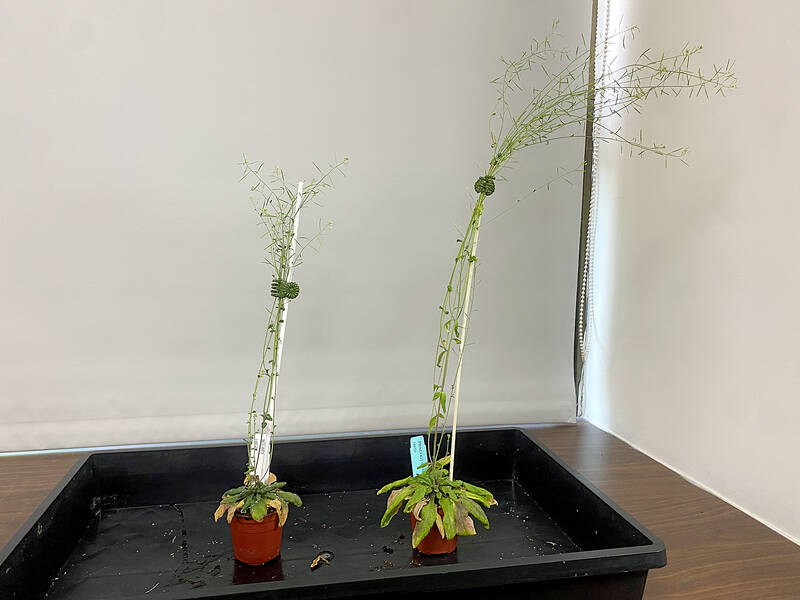
Photo: CNA
“We aim to artificially design a new carbon-fixation system to enhance the efficiency of photosynthesis-based CO2 capture,” he said.
About 20 years ago, Liao’s team began research that led to the introduction of a synthetic biochemical system into thale cress through gene transformation.
Tests showed that the system boosted the plant’s carbon dioxide uptake by about 50 percent compared with unmodified plants.
Lu called the gene-edited plants “magic plants,” because they grow faster than wild plants.
The study’s plants run a second carbon dioxide fixation system alongside their natural one, making them the first plants to have two such systems, and increasing lipid production in their leaves and seeds, she said.
The modified plants “doubled or tripled their biomass, and increased the number of seeds and oil production,” she added.
The advancement could help in food supply challenges for crops such as rice and corn, while also providing a sustainable feedstock for aviation fuel and chemical industries.
Researchers cautioned that how different plant species regulate growth varies, making it difficult to estimate how much additional carbon dioxide crops could capture if the system is applied to them.
However, a 10 percent increase in carbon fixation across crops could already exceed the amount of carbon emitted by human activity, Lu said.
The system could be applied to leafy vegetables, including broccoli, or to grains, such as rice and wheat, to enhance yields and bolster global food security, she added.
Agricultural Biotechnology Research Center director Yeh Kuo-chen (葉國楨) said that Academia Sinica has assembled a team to advance the research, with the next phase focusing on testing the system in major crops, including rice and tomatoes.
Liao said that while the study marks a significant scientific advance, commercial applications remain distant.
“We are not looking at next year — or even the next decade,” he said, citing the need to ensure genetic stability and meet regulatory standards for genetically modified crops.

Fast food chain McDonald's is to raise prices by up to NT$5 on some products at its restaurants across Taiwan, starting on Wednesday next week, the company announced today. The prices of all extra value meals and sharing boxes are to increase by NT$5, while breakfast combos and creamy corn soup would go up by NT$3, the company said in a statement. The price of the main items of those meals, if ordered individually, would remain the same. Meanwhile, the price of a medium-sized lemon iced tea and hot cappuccino would rise by NT$3, extra dipping sauces for chicken nuggets would go up

Yangmingshan National Park’s Qingtiangang (擎天崗) nature area has gone viral after a park livestream camera observed a couple in the throes of intimate congress, which was broadcast live on YouTube, drawing large late-night crowds and sparking a backlash over noise, bright lights and disruption to wildlife habitat. The area’s livestream footage appeared to show a couple engaging in sexual activity on a picnic table in the park on Friday last week, with the uncensored footage streamed publicly online. The footage quickly spread across social media, prompting a tide of visitors to travel to the site to “check in” and recreate the

Minister of Digital Affairs Lin Yi-ching (林宜敬) yesterday cited regulatory issues and national security concerns as an expert said that Taiwan is among the few Asian regions without Starlink. Lin made the remarks on Facebook after funP Innovation Group chief executive officer Nathan Chiu (邱繼弘) on Friday said Taiwan and four other countries in Asia — China, North Korea, Afghanistan and Syria — have no access to Starlink. Starlink has become available in 166 countries worldwide, including Ukraine, Malaysia, the Philippines and Vietnam, in the six years since it became commercial, he said. While China and North Korea block Starlink, Syria is not

GROUNDED: A KMT lawmaker proposed eliminating drone development programs and freezing funding for counterdrone systems, despite China’s adoption of the technology China has deployed attack drones at air bases near the Taiwan Strait in a strategy aimed at overwhelming Taiwan’s air defense systems through saturation attacks, the Mainland Affairs Council (MAC) said. The council’s latest quarterly report on China said that satellite imagery and open-source intelligence indicate that the Chinese People’s Liberation Army (PLA) had converted retired J-6 fighter jets into J-6W drones, which the PLA has stationed at six air bases near Taiwan, five in China’s Fujian Province and one in Guangdong Province. The report cited J. Michael Dahm, a senior fellow at the US-based Mitchell Institute, as saying that China has


 RSS
RSS