


China has deployed attack drones at air bases near the Taiwan Strait in a strategy aimed at overwhelming Taiwan’s air defense systems through saturation attacks, the Mainland Affairs Council (MAC) said.
The council’s latest quarterly report on China said that satellite imagery and open-source intelligence indicate that the Chinese People’s Liberation Army (PLA) had converted retired J-6 fighter jets into J-6W drones, which the PLA has stationed at six air bases near Taiwan, five in China’s Fujian Province and one in Guangdong Province.
The report cited J. Michael Dahm, a senior fellow at the US-based Mitchell Institute, as saying that China has deployed more than 200 of the drones, with more than 500 aging J-6 fighter jets expected to be converted.
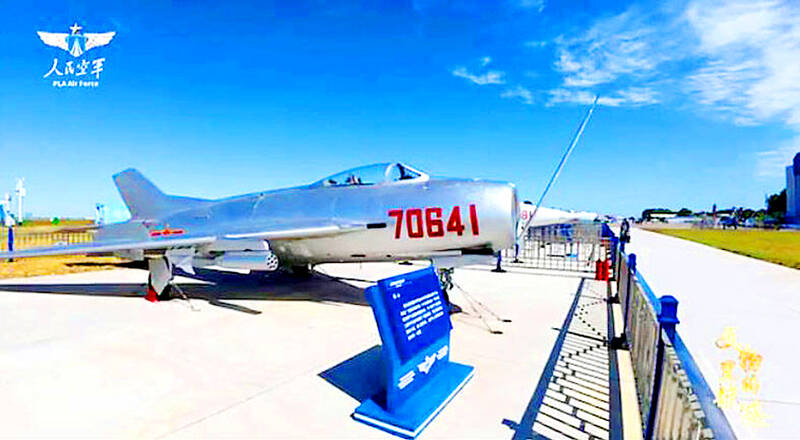
Photo: Reuters / Screen grab via PLA Air Force WeChat page
Rather than acting as remotely piloted aircraft, the drones would function like cruise missiles intended for large-scale strikes against Taiwan, the US or allied nations, the report said.
Japanese satellite imagery showed J-6W drones deployed alongside J-16 multirole fighter jets in what analysts described as preparations for high-intensity air combat, the report said.
The deployment pattern suggests the J-6Ws are intended to operate in coordination with J-16s in unconventional warfare roles, carrying out saturation strikes and decoy missions without interfering with frontline fighter aircraft, it said.
In a high-intensity conflict scenario, the strategy could significantly strain Taiwan’s air defense capabilities, stockpiles of interceptor missile and overall battlefield resilience, the report said.
In addition to frontline deployments near the Taiwan Strait, China has also stored hundreds of aging aircraft at Baofeng Airfield in Henan Province as reserve inventory that could be redeployed forward if necessary, it added.
The report described the arrangement as a flexible logistics system, combining “forward deployment and inland reserves.”
Meanwhile, a special defense spending bill proposed by the Executive Yuan originally allocated NT$335 billion (US$10.62 billion) for drones and counterdrone systems, including plans to procure 211,990 drones of various types and 1,320 suicide drone boats.
The proposal also included plans to purchase integrated “soft-kill” and “hard-kill” drone countermeasure systems, as well as 635 portable anti-drone systems.
However, the opposition-controlled Legislative Yuan on May 8 passed a reduced NT$780 billion special arms procurement bill, far below the Executive Yuan’s NT$1.25 trillion proposal, with the NT$335 billion drone and counterdrone component left out.
Opposition party legislators said funding for domestic defense production and drones could instead be handled through annual budget allocations.
However, during legislative reviews of the central government’s budget for fiscal year 2026, Chinese Nationalist Party (KMT) Legislator Ma Wen-chun (馬文君), convener of the legislature’s Foreign Affairs and National Defense Committee, proposed eliminating several drone development budgets, including NT$507.65 million for the Armaments Bureau’s “Integrated Development Program for Advanced Unmanned Vehicle Technologies.”
Ma questioned whether the bureau had adequately explained what constituted “advanced technologies,” how the systems would be used and whether the military intended to domestically produce all categories of uncrewed vehicles.
She proposed cutting the entire budget.
Ma also proposed freezing a NT$456 million budget to procure counterdrone systems for the army, citing failed equipment testing conducted by the winning contractor in October 2025 and March this year.
Democratic Progressive Party Legislator Wang Ting-yu (王定宇), who also serves on the Foreign Affairs and National Defense Committee, yesterday criticized the KMT proposals, saying they ignored Taiwan’s defense needs, China’s military threat, international trends and the development needs of Taiwan’s domestic defense industry.
“Although parties might compete politically, national defense and industrial development should transcend partisan divisions,” Wang said, adding that weakening Taiwan’s defense capabilities would ultimately harm the country’s interests.
Additional reporting by Lin Che-yuan
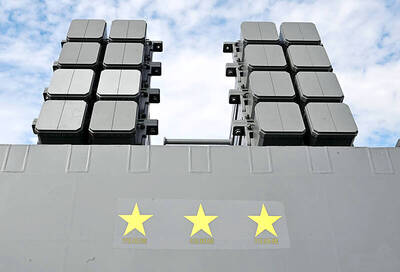
UPGRADE: The Kang Ding-class frigate is replacing its Chaparall missiles with Tien Chien II and Hua Yang VLS, which would provide it with long-range, 360° air defense Taiwan plans to produce 1,200 to 1,376 Hai Chien II missiles (海劍二, Sea Sword II) — also known as TC-2N — to serve as the standard air defense system of the navy’s surface combatant fleet, a source said yesterday. Last week, the Hai Chien II, the naval version of the Tien Kung II missile (天劍二, Sky Sword II), completed a live-fire test in waters off the National Chungshan Institute of Science and Technology’s Jiupeng facility (九鵬) in Pingtung County’s Manjhou Township (滿州). The MIM72 Chaparral and other dated air defense missiles that currently arm Taiwanese ships have inadequate range to combat Chinese

REASONS FOR TRAVEL: An assistant professor said that proposed amendments to penalize drivers if they used drugs overseas would not deter people from traveling People who operate a motor vehicle under the influence of marijuana would have their driver’s license revoked, even if they used the substance while overseas, the Ministry of Transportation and Communications said yesterday, citing proposed amendments to the Road Traffic Management and Penalty Act (道路交通管理處罰條例). The amendments would also authorize the government to revoke the licenses of people determined to have used Category 1 or Category 2 narcotics, even if they were not operating a vehicle while under the influence of drugs, as well as ban them from taking the license test for three years, the ministry said. People aged 18 or

HEAVY WEATHER: Typhoon Jangmi is due to crash straight into the Ryukyus as airlines look to shift flights to larger aircraft or cancel flights to Okinawa entirely Taiwan’s international air carriers announced flight adjustments over the weekend as Typhoon Jangmi is forecast to hit the Ryukyu Islands today and tomorrow. The Central Weather Administration (CWA) upgraded Jangmi from a tropical storm to a typhoon at 8am yesterday, with the eye located 580km south of Naha city. It was moving north at 19kph. Today, China Airlines’ CI-120, CI-121, CI-122 and CI-123 flights between Taoyuan and Naha, Okinawa, have been canceled as well as CI-132 and CI-133 between Kaohsiung and Naha. EVA Air’s BR-112, BR-113, BR-186 and BR-185 flights between Taoyuan and Naha are also canceled. Low-cost carrier Tigerair Taiwan canceled IT-230,
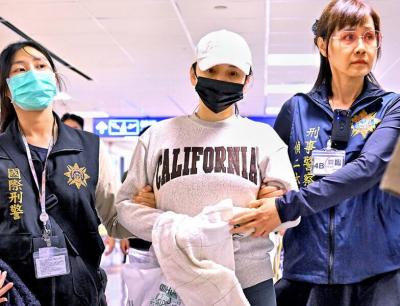
Johanne Liou (劉喬安), a Taiwanese woman who shot to unwanted fame during the Sunflower movement protests in 2014, returned to Taiwan last night after being deported from the US. She is to stand trial in Taiwan for charges involving embezzlement, fraud and drug crimes. The Criminal Investigation Bureau (CIB) said it took her into custody at Taiwan Taoyuan International Airport and would first question her before transferring her to the New Taipei District Prosecutors’ Office. She was arrested upon disembarking a flight from San Francisco that landed shortly before 7pm. Liou absconded to the US in 2019 after jumping bail


 RSS
RSS