


Local authorities in China have been inviting Taiwanese to participate in cross-strait Mid-Autumn Festival celebrations centered around ideals of “family and nation,” a move Taiwanese academics said politicizes the holiday to promote the idea of “one family” across the Taiwan Strait.
Sources said that China’s Fujian Provincial Government is organizing about 20 cross-strait-themed events in cities including Quanzhou, Nanping, Sanming and Zhangzhou.
In Zhangzhou, a festival scheduled for Wednesday is to showcase Minnan-language songs and budaixi (布袋戲) glove puppetry to highlight cultural similarities between Taiwan and the region.
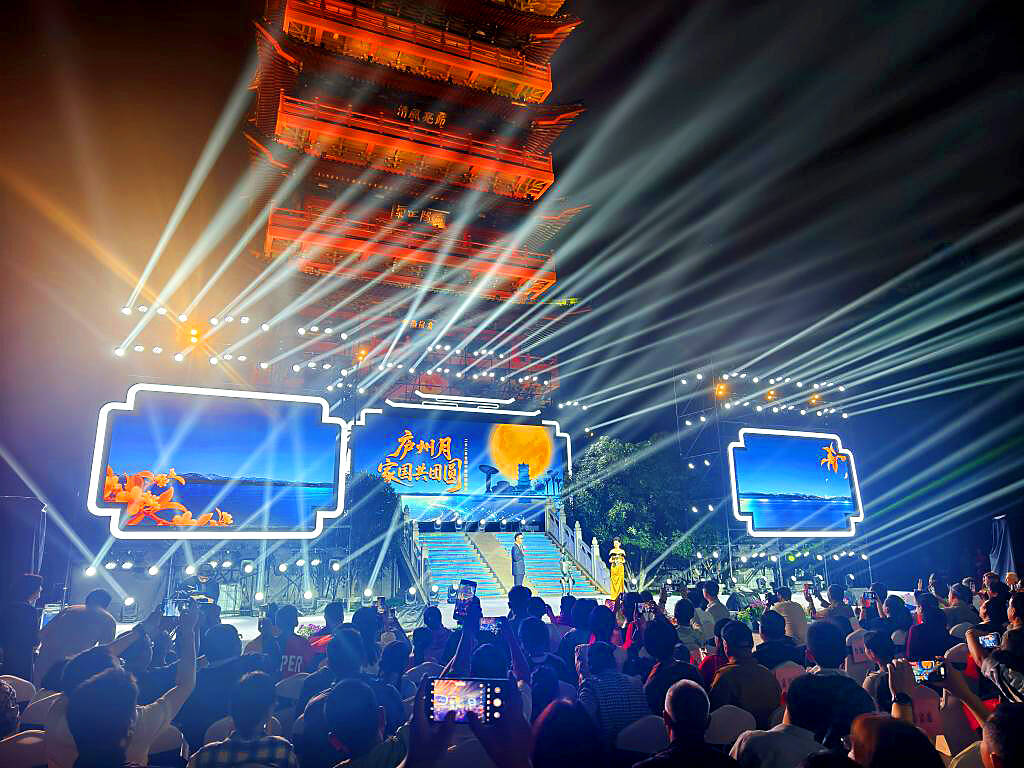
Photo: Screen grab from Weibo
Elsewhere, Jiangsu Province is hosting more than 10 similar celebrations in Taizhou, Changzhou, Suzhou, Nantong and Yancheng, with local Taiwan affairs offices extending invitations to Taiwanese community groups.
In Anhui Province, Hefei City held a cross-strait event on Monday last week, where Hsieh Jian-bao (謝建寶), president of the Hefei Association of Taiwanese Investment Enterprises, was quoted by Chinese media as saying that cultures on both sides of the Taiwan Strait share the same roots and origins.
Shandong and Henan provinces also hosted similar cross-strait Mid-Autumn Festival celebrations on Sept. 27 and 28 respectively, with programs targeting Taiwanese participation.
In Hubei, local authorities organized a series of cultural and sporting exchanges, inviting young Taiwanese to take part, aiming to foster a sense of shared Chinese cultural identity.
Meanwhile, in the city of Fuzhou in China’s Fujian Province, officials held a celebration on Saturday, attended by Chinese Nationalist Party (KMT) Vice Chairman Sean Lien (連勝文).
China’s Taiwan Affairs Office Director Song Tao (宋濤) said that people on both sides of the Taiwan Strait are “part of one family,” and called for firm opposition to Taiwanese independence and external interference to “jointly safeguard the wholeness of our home.”
Lien said the Mid-Autumn Festival is “an important traditional holiday of the Zhonghua minzu [中華民族, Chinese nation], symbolizing reunion, completeness and harmony,” adding that the KMT would continue to promote the peaceful development of cross-strait relations based on the so-called “1992 consensus” and opposition to Taiwanese independence.
The so-called “1992 consensus,” a term former Mainland Affairs Council chairman Su Chi (蘇起) in 2006 admitted making up in 2000, refers to a tacit understanding between the KMT and the Chinese government that both sides of the Strait acknowledge there is “one China,” with each side having its own interpretation of what “China” means.
KMT Legislator Chen Hsueh-sheng (陳雪生) also attended the event along with about 200 Taiwanese.
Chinese state media reported that participants cheered when 500 drones wrote in the sky “one family across the Strait.”
Asked about the events, Hung Pu-chao (洪浦釗), deputy director of the Center for Mainland China and Regional Development Research at Tunghai University, said that China has long used traditional festivals to conduct “united front” work, particularly holidays such as the Dragon Boat, Mid-Autumn and Spring festivals, which symbolize themes of reunion and national sentiment.
Song’s rhetoric politicizes the Mid-Autumn Festival by linking family reunions with political unification and framing opposition to Taiwanese independence as “protecting the homeland,” a hallmark of typical “united front” messaging, Hung said.
KMT leaders’ attendance at such events risks being interpreted as supporting China’s political agenda, he said, adding that genuine cross-strait exchanges should take place through equal and professional civil platforms rather than serving as propaganda designed to signal Taiwanese acceptance of “one China.”
While the Mid-Autumn Festival symbolizes reunion, such reunion should not be built on political submission or manipulation of rhetoric, Hung said.
Cross-strait exchanges should be based on dignity and equality, otherwise they are merely part of a “united front” script, he said.
National Cheng Kung University political science professor Hung Chin-fu (洪敬富) said Chinese authorities, fearing that Taiwan is becoming more “culturally independent,” have organized lavish cross-strait celebrations of major family-oriented holidays as part of their broader “cultural united front” efforts.
These events, typically organized by local Taiwan affairs offices and the Chinese Communist Party’s United Front Work Department, aim to win over Taiwanese communities, he said.
Through slogans invoking familial and national reunions and ties, Beijing seeks to undermine Taiwan’s cultural independence by promoting the belief that the two sides of the Taiwan Strait have the same roots, he added.
This propaganda promotes the idea that Taiwanese are “returning to the homeland” as “one family” celebrating national festivals together, he said.
By politicizing the Mid-Autumn Festival, China is not showing respect for the holiday itself, but deliberately exploiting it to advance its “united front” agenda, he added.

SILENCING CRITICS: In addition to blocking Taiwan, China aimed to prevent rights activists from speaking out against authoritarian states, a Cabinet department said The Ministry of Foreign Affairs (MOFA) yesterday condemned transnational repression by Beijing after RightsCon, a major digital human rights conference scheduled to be held in Zambia this week, was abruptly canceled due to Chinese pressure over Taiwanese participation. This year’s RightsCon, the world’s largest conference discussing issues “at the intersection of human rights and technology,” was scheduled to take place from tomorrow to Friday in Lusaka, and expected to draw 2,600 in-person attendees from 150 countries, along with 1,100 online participants. However, organizers were forced to cancel the event due to behind-the-scenes pressure from China, the ministry said, expressing its “strongest condemnation”
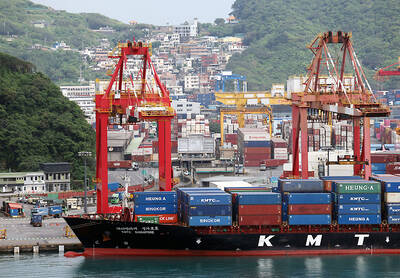
Taiwan’s economy grew far faster than expected in the first quarter, as booming demand for artificial intelligence (AI) applications drove a surge in exports, spilling over into investment and consumption, the Directorate-General of Budget, Accounting and Statistics (DGBAS) said yesterday. GDP growth was 13.69 percent year-on-year during the January-to-March period, beating the DGBAS’ February forecast by 2.23 percentage points and marking the most robust growth in nearly four decades, DGBAS senior official Chiang Hsin-yi (江心怡) told a news conference in Taipei. The result was powered by exports, which remain the backbone of Taiwan’s economy, Chiang said. Outbound shipments jumped 51.12 percent year-on-year to
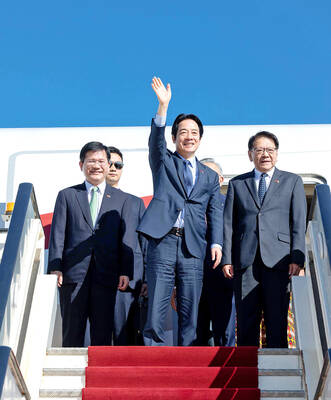
DELAYED BUT DETERMINED: The president’s visit highlights Taiwan’s right to international engagement amid regional pressure from China President Willaim Lai (賴清德) yesterday arrived in Eswatini, more than a week after his planned visit to Taiwan’s sole African ally was suspended because of revoked overflight permits. “The visit, originally scheduled for April 22, was postponed due to unforeseen external factors,” Lai wrote on social media. “After several days of careful arrangements by our diplomatic and national security teams, we successfully arrived today.” Lai said he looked forward to further deepening Taiwan-Eswatini relations through closer cooperation in the economy, agriculture, culture and education, as well as advancing the nation’s international partnerships. The president was initially scheduled to arrive in time to celebrate
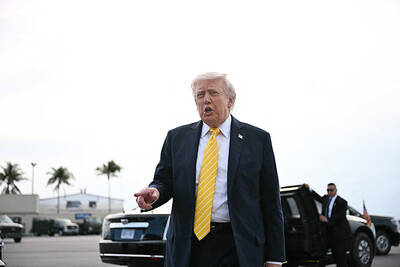
Iran’s Islamic Revolutionary Guard Corp (IRGC) yesterday said the US faced a choice between an “impossible” military operation or a “bad deal” with Tehran, after US President Donald Trump disparaged Iran’s latest peace proposal. Negotiations between the two countries have been deadlocked since a ceasefire came into effect on April 8, with only one round of direct peace talks held so far. Iran’s Tasnim and Fars news agencies reported that Tehran had submitted a 14-point proposal to mediator Pakistan, but Trump was quick to cast doubt on it. “I will soon be reviewing the plan that Iran has just sent to us, but


 RSS
RSS