


A sharply divided Brazilian Supreme Federal Tribunal yesterday voted to reject an attempt by former Brazilian president Luiz Inacio Lula da Silva to stay out of jail while he appeals a corruption conviction, delivering a hard blow to the front-running candidate in this year’s presidential election in Latin America’s largest nation.
After nearly 13 hours of often heated debate, the Supreme Federal Tribunal voted 6-5 to deny Lula’s request to stave off a 12-year prison sentence while he fights a conviction that he has always argued was nothing more than a ploy to keep him off of the October ballot.
Despite the conviction and several other corruption charges against him, Lula leads all preference polls for the election.
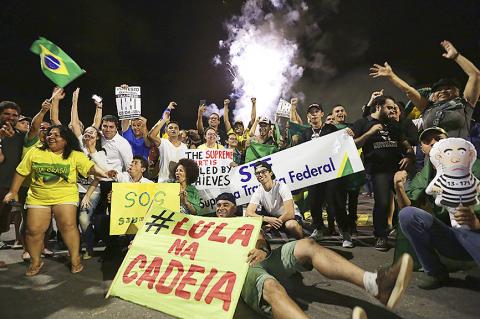
Photo: AP
The decision means that Lula would likely soon be jailed, though probably not until at least next week.
Chief Justice Carmen Lucia, who was sharply criticized during the session by various colleagues, cast the deciding vote after the court was tied at 5-5.
“The constitution secures individual rights, which are fundamental to democracy, but it also assures the exercise of criminal law,” she said.
Justice Gilmar Mendes, traditionally a critic of Lula, voted in favor of the former president’s petition to stay out of jail, challenging his colleagues to buck pressure from society.
“If a court bows [to pressure], it might as well not exist,” Mendes said.
Justice Luis Roberto Barroso argued that the integrity of the justice system was at stake.
“A penal system that doesn’t work with minimal effectiveness leads to an instinct for taking justice into one’s own hands,” Barroso said in voting against Lula.
Justice Rosa Weber, who legal analysts said was key because there was much doubt about her position on the matter, voted against Lula.
In one of several brisk exchanges, after Weber’s vote, Justice Marco Aurelio Mello accused Lucia of plotting against Lula’s case.
Limiting the vote just to the habeas corpus petition and not the larger question of when a convicted person should be forced to begin serving a sentence helped sway Weber’s vote, Mello said.
“I want this to be registered in the court’s records,” Mello told Lucia, who responded by saying “yes” to the request.
When the decision was delivered, fireworks and yells could be heard and seen in Rio de Janeiro and Sao Paulo, two of the nation’s most important cities.
On the eve of the session that began on Wednesday afternoon, the nation’s army commander raised eyebrows with tweets subtly supporting Lula’s incarceration.
General Eduardo Villas Boas on Tuesday posted two tweets that many interpreted as a form of pressure on the 11 justices on the Supreme Federal Tribunal and a veiled threat of intervention.
“In Brazil’s current situation, it’s worth asking our institutions and the people who is really thinking about what is best for the country and future generations, and who is only worried about their personal interests?” Villas Boas wrote in one tweet.
In a second tweet, Boas wrote that he shared people’s anxiousness and “repudiated impunity.”
O Globo criticized the comments, saying in an editorial that a military chief should “not be opining over judicial and political questions.”

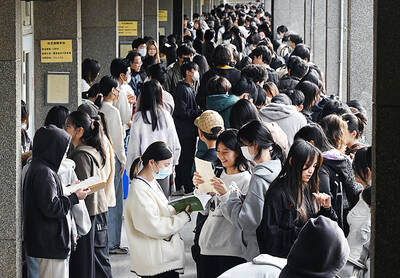
A global survey showed that 60 percent of Taiwanese had attained higher education, second only to Canada, the Ministry of the Interior said. Taiwan easily surpassed the global average of 43 percent and ranked ahead of major economies, including Japan, South Korea and the US, data from the Organisation for Economic Co-operation and Development (OECD) for 2024 showed. Taiwan has a high literacy rate, data released by the ministry showed. As of the end of last year, Taiwan had 20.617 million people aged 15 or older, accounting for 88.5 percent of the total population, with a literacy rate of 99.4 percent, the data

CCP ‘PAWN’? Beijing could use the KMT chairwoman’s visit to signal to the world that many people in Taiwan support the ‘one China’ principle, an academic said Chinese Nationalist Party (KMT) Chairwoman Cheng Li-wun (鄭麗文) yesterday arrived in China for a “peace” mission and potential meeting with Chinese President Xi Jinping (習近平), while a Taiwanese minister detailed the number of Chinese warships currently deployed around the nation. Cheng is visiting at a time of increased Chinese military pressure on Taiwan, as the opposition-dominated Legislative Yuan stalls a government plan for US$40 billion in extra defense spending. Speaking to reporters before going to the airport, Cheng said she was going on a “historic journey for peace,” but added that some people felt uneasy about her trip. “If you truly love Taiwan,

NEW LOW: The council in 2024 based predictions on a pessimistic estimate for the nation’s total fertility rate of 0.84, but last year that rate was 0.69, 17 percent lower An expected National Development Council (NDC) report expects the nation’s population to drop below 12 million by 2065, with the old-age dependency ratio to top 100 percent sooner than 2070, sources said yesterday. The council is slated to release its latest population projections in August, using an ultra-low fertility model, the sources said. The previous report projected that Taiwan’s population would fall to 14.37 million by 2070, but based on a new estimate of the total fertility rate (TFR) — the average number of children born to a woman over her lifetime — the population is expected to reach 12 million by
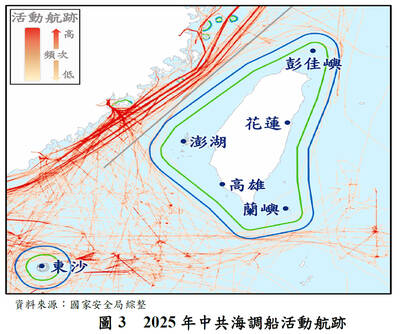
INTENSIFYING THREATS: Beijing’s tactics include massive attacks on the government service network, aircraft and naval vessel incursions and damaging undersea cables China is prepared to interfere in November’s nine-in-one local elections by launching massive attacks on the Taiwanese government’s service network (GSN), a report published by the National Security Bureau showed. The report was submitted to the Legislative Yuan ahead of the bureau’s scheduled briefing at the Foreign Affairs and National Defense Committee tomorrow. The national security team has identified about 13,000 suspicious Internet accounts and 860,000 disputed messages, the bureau said of China’s cognitive warfare against Taiwan. The disputed messages focus on major foreign affairs, national defense and economic issues, which were produced using generative artificial intelligence (AI) and distributed through Chinese


 RSS
RSS