


Several leaked cables from the American Institute in Taiwan (AIT) show that the US made “considerable effort” in negotiations leading to a secret memorandum of understanding (MOU) signed between China and the WHO in 2005, in which Taiwan was referred to as “Taiwan, China,” and repeatedly urged Taiwan not to make the text public.
Among thousands of cables from the AIT published by WikiLeaks on Aug. 30, at least four cables show a US role in crafting the 2005 agreement.
It supported the use of the term “Taiwan, China” and it wished this to be kept confidential.
The information in the cables shows contradictions with the US policy of taking no position on Taiwan’s sovereignty and contradicts the view held by the Democratic Progressive Party (DPP) that the MOU came after closed-door talks between the Chinese Nationalist (KMT) and Chinese officials.
A cable dated May 13, 2005, shows the MOU was an integral part “of the four-part package that had been worked out after considerable effort by US negotiators” to enable Taiwan to participate in the global International Health Regulations (IHR) framework for infectious disease control.
On May 23, 2005, the WHO revised and expanded the IHR, implemented since 1969, to cover any significant public health risks and events, which constitutes public health emergencies of international concern as well as plague, which remains one of the diseases of concern at its annual World Health Assembly (WHA).
According to the cables, the then-DPP administration was aware of what was being discussed in the negotiations and raised objections to their possible content, but did not obtain a copy of the text.
The cable showed that Taiwan “cannot accept the use of the term ‘Taiwan, China’ in the MOU that the PRC [People’s Republic of China] plans to sign with the WHO Secretariat. It also insists that it is unreasonable for the WHO to notify the PRC representative office in Geneva before engaging in cooperation with Taiwan under the IHR,” as stated in a press release sent out on May 12 following a Chinese diplomatic note “that has been circulated and apparently made public in Geneva.”
In response to Victor Chin (秦日新), then the director-general of the Department of North American Affairs at the Ministry of Foreign Affairs, then-AIT deputy director David Keegan, who is not named in the cable, said that US negotiators worked on the negotiations “in full consultation with [their] Taiwan counterparts.”
A cable dated March 2, 2005, recording a meeting between then-AIT director Douglas Paal and John Chen (陳忠), then director-general of the ministry’s Department of International Organizations, quoted Paal as saying that the “US was grateful” that Taiwan and its diplomatic allies had not again raised the proposal to amend Article 65 of the IHR.
“The PRC had indicated that it would withdraw its concessions if there were further mention of Article 65,” Paal is quoted by the cable as saying.
A cable dated Oct 24, 2004, shows that Taiwan tried, with the help of Nicaragua, to add language to Article 65 of the draft IHR to extend coverage of the IHR to any “territory exercising competence over its external health relations” and requested US assistance in getting it accepted.
The talking points presented to the AIT by then-director of the Centers for Disease Control (CDC) Steve Kuo (郭旭崧) read that Taiwan “proposed that an amendment be made to Article 65 to include, in addition to non-member states, any entity with a separate health administration as well,” the cable showed.
Paal said China concurred “there would be direct discussions between WTO and ‘Taipei CDC’ on a proposed exchange of letters ... on the condition that there was no publicity” and that “WHO teams could go to Taiwan in the event of another public health emergency of international concern ... subject only to WHO notification of the Chinese mission in Geneva,” according to a cable from March 2, 2005.
“Chen, however, requested further US help to modify the term of the PRC-WHO agreement, in response to which the Director [Paal] was not encouraging,” the cable shows.
Chen said Taiwan hoped the WHO-PRC agreement would not contain language detrimental to Taiwan.
Meanwhile, a cable dated May 16, 2005, shows that the US wanted Taiwan to accept the nomenclature and urged it not to make the text of the MOU public.
Keegan, who is again not named in the cable, talked to then-National Security Council secretary-general Chiou I-ren (邱義仁) and Chin over the matter on May 14, urging that “Taiwan not allow its sensitivity over nomenclature to prevent this step forward in its WHO access and this improvement in its international stature.”
In response to the US’ concerns, then-vice minister of foreign affairs Michael Kau (高英茂) called the AIT deputy director and told him that “Taiwan’s Geneva delegation had not/not obtained a copy of the WHO-PRC MOU and that it intended to respect the confidentiality of the MOU and its language,” the cable reads.
“He [Kau] stressed however that ‘we hate’ the use of ‘Taiwan, China,’” the cable says.
Keegan told Chin on May 12, 2005, that “the MOU language would not be a public document, and that it would be hardly surprising if a UN organization and a UN member used UN terminology to refer to Taiwan, however much Taiwan might disagree with that terminology,” as recorded in the cable dated May 13, 2005.

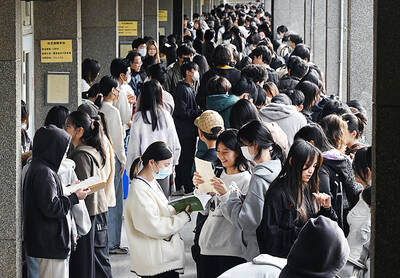
A global survey showed that 60 percent of Taiwanese had attained higher education, second only to Canada, the Ministry of the Interior said. Taiwan easily surpassed the global average of 43 percent and ranked ahead of major economies, including Japan, South Korea and the US, data from the Organisation for Economic Co-operation and Development (OECD) for 2024 showed. Taiwan has a high literacy rate, data released by the ministry showed. As of the end of last year, Taiwan had 20.617 million people aged 15 or older, accounting for 88.5 percent of the total population, with a literacy rate of 99.4 percent, the data
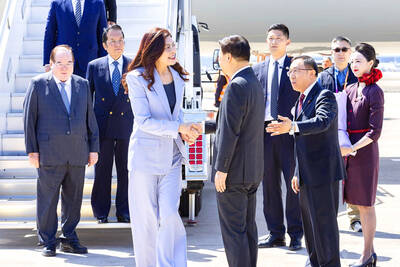
CCP ‘PAWN’? Beijing could use the KMT chairwoman’s visit to signal to the world that many people in Taiwan support the ‘one China’ principle, an academic said Chinese Nationalist Party (KMT) Chairwoman Cheng Li-wun (鄭麗文) yesterday arrived in China for a “peace” mission and potential meeting with Chinese President Xi Jinping (習近平), while a Taiwanese minister detailed the number of Chinese warships currently deployed around the nation. Cheng is visiting at a time of increased Chinese military pressure on Taiwan, as the opposition-dominated Legislative Yuan stalls a government plan for US$40 billion in extra defense spending. Speaking to reporters before going to the airport, Cheng said she was going on a “historic journey for peace,” but added that some people felt uneasy about her trip. “If you truly love Taiwan,

NEW LOW: The council in 2024 based predictions on a pessimistic estimate for the nation’s total fertility rate of 0.84, but last year that rate was 0.69, 17 percent lower An expected National Development Council (NDC) report expects the nation’s population to drop below 12 million by 2065, with the old-age dependency ratio to top 100 percent sooner than 2070, sources said yesterday. The council is slated to release its latest population projections in August, using an ultra-low fertility model, the sources said. The previous report projected that Taiwan’s population would fall to 14.37 million by 2070, but based on a new estimate of the total fertility rate (TFR) — the average number of children born to a woman over her lifetime — the population is expected to reach 12 million by
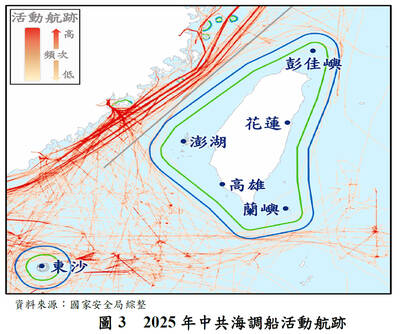
INTENSIFYING THREATS: Beijing’s tactics include massive attacks on the government service network, aircraft and naval vessel incursions and damaging undersea cables China is prepared to interfere in November’s nine-in-one local elections by launching massive attacks on the Taiwanese government’s service network (GSN), a report published by the National Security Bureau showed. The report was submitted to the Legislative Yuan ahead of the bureau’s scheduled briefing at the Foreign Affairs and National Defense Committee tomorrow. The national security team has identified about 13,000 suspicious Internet accounts and 860,000 disputed messages, the bureau said of China’s cognitive warfare against Taiwan. The disputed messages focus on major foreign affairs, national defense and economic issues, which were produced using generative artificial intelligence (AI) and distributed through Chinese


 RSS
RSS