


A majority of Taiwanese said they did not feel more proud to be a citizen of the Republic of China (ROC) after President Ma Ying-jeou (馬英九) took office in May 2008, a poll released by the Taiwan Thinktank ahead of Double Ten National Day showed yesterday.
The poll showed that 65 percent of respondents said they had not felt their sense of pride as an ROC citizen grow after Ma assumed office, while 31.3 percent said they had.
Among respondents who claimed they did not have any political affiliation, about 75 percent said they did not feel more proud to be an ROC citizen, according to the poll conducted on Wednesday and Thursday by the think tank, which is generally perceived to be more sympathetic to the pan-green camp.
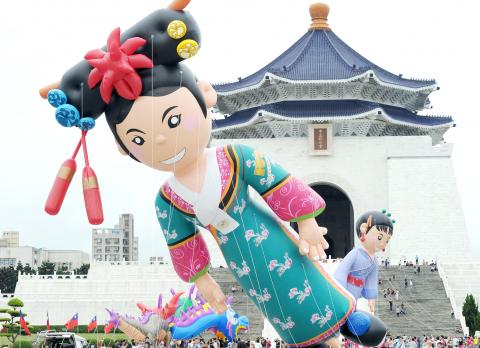
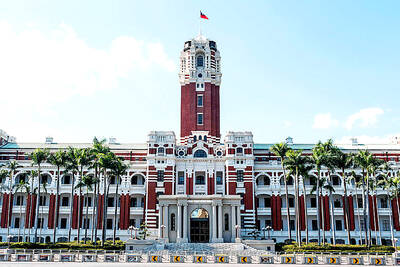
PHOTO: CNA
While the Ma administration has planned various activities this year to celebrate the 100th anniversary of the founding of the ROC next year, nearly 59 percent said they did not know about the government’s efforts against 41.5 percent who said they did.
About 96 percent said they did not feel a sense of involvement in the celebrations, against 3.8 percent who said they did. The feeling was reported among pan-blue and pan-green supporters, as well as moderate voters.
Tung Li-wen (董立文), a professor at the Graduate School of Public Security at Central Police University, said the results of the survey were not surprising because the Ma administration’s policies had made the public anxious about their future and lose their confidence in the Chinese Nationalist Party’s (KMT) governance.
“People can hardly feel proud when the government talks about the ‘1992 consensus’ and the president of this country does not mind being called ‘Mister,’” he said.
Tung attributed the declining sense of pride to the polarization of ethnic identification and an unclear national spirit.
People also feel less proud because when they wanted to express their patriotism by holding the national flag, singing the national anthem or saying the country’s name out loud, they were prevented from doing so, Tung said.
“Oh, please, it’s Double Ten Day, and we can’t even fly our national flag,” Hsu Yung-ming (徐永明), a political scientist at Soochow University, said, mimicking the tone of former Executive Yuan secretary-general Hsueh Hsiang-chuan (薛香川).
Hsueh complained that it was Father’s Day, when he was harshly criticized for dining with his father while the south was ravaged by Typhoon Morakot in August last year.
Hsu was referring to the incident at the Asian University Basketball Championship on Thursday. Spectators were asked to fold up the ROC national flag they were waving on the bleachers. The Chinese team withdrew from a game on Friday when they saw hundreds of ROC national flags from the campus’ parking lots all the way to the bleachers, an initiative undertaken by Taiwanese students in response to Thursday’s incident.
Hsu urged the government to refrain from using the ROC centennial as a pretext for drumming up support for KMT candidates in next month’s municipality elections.
Lai I-chung (賴怡忠), an executive board member at the think tank, said that pride in one’s nationality comes from two areas: government efforts to protect sovereignty and a democratic system. However, both have become problematic issues under Ma’s leadership, he said.
Former deputy National Security Council (NSC) secretary-general Chen Chung-hsin (陳忠信) added that the new term “pride of Taiwan” given to outstanding individuals reflected a certain lack of self-confidence and apprehension about identity.
The poll questioned 1,046 adults nationwide and has a margin of error of plus or minus 3 percent.
Taiwan Semiconductor Manufacturing Co (TSMC, 台積電), the world’s largest foundry service provider, yesterday said that global semiconductor revenue is projected to hit US$1.5 trillion in 2030, after the figure exceeds US$1 trillion this year, as artificial intelligence (AI) demand boosts consumption of token and compute power. “We are still at the beginning of the AI revolution, but we already see a significant impact across the whole semiconductor ecosystem,” TSMC deputy cochief operating officer Kevin Zhang (張曉強) said at the company’s annual technology symposium in Hsinchu City. “It is fair to say that in the past decade, smartphones and other mobile devices were
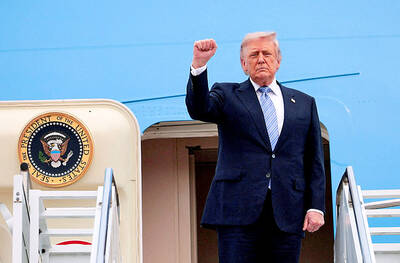
US-CHINA SUMMIT: MOFA welcomed US reassurance of no change in its Taiwan policy; Trump said he did not comment when Xi talked of opposing independence US President Donald Trump yesterday said he has not made a decision on whether to move forward with a major arms package for Taiwan after hearing concerns about it from Chinese President Xi Jinping (習近平). Trump’s comments on Taiwan came as he flew back to Washington after wrapping up critical talks in which both leaders said important progress was made in stabilizing US-China relations even as deep differences persist between the world’s two biggest powers on Iran and Taiwan. “I will make a determination,” Trump said, adding: “I’ll be making decisions. But, you know, I think the last thing we need right
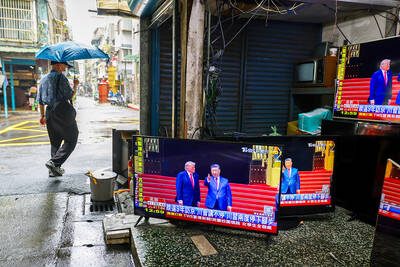
TAIWAN ISSUE: US treasury secretary Scott Bessent said on the first day of meetings that ‘it wouldn’t be a US-China summit without the Taiwan issue coming up’ There were no surprises on the first day of the summit between US President Donald Trump and Chinese President Xi Jinping (習近平), the Mainland Affairs Council (MAC) said yesterday, as the government reiterated that cross-strait stability is crucial to the Asia-Pacific region, as well as the world. As the two presidents met for a highly anticipated summit yesterday, Chinese state media reported that Xi warned Trump that missteps regarding Taiwan could push their two countries into “conflict.” Trump arrived in China with accolades for his host, calling Xi a “great leader” and “friend,” and extending an invitation to visit the White House
SECURITY: Taipei presses the US for arms supplies, saying the arms sales are not only a reflection of the US security commitment to Taiwan but also serve as a mutual deterrent against regional threats Taiwan is committed to preserving the cross-strait “status quo” and contributing to regional peace and stability, the Presidential Office said yesterday. “It is an undeniable fact that the Republic of China is a sovereign and independent democratic nation,” Presidential Office spokeswoman Karen Kuo (郭雅慧) reiterated, adding that Beijing has no right to claim sovereignty over Taiwan. The statements came after US President Donald Trump warned against Taiwanese independence. Trump wrapped up a state visit to Beijing on Friday, during which Chinese President Xi Jinping (習近平) had pressed him not to support Taiwan. Taiwan depends heavily on US security backing to deter China from carrying


 RSS
RSS