


Taiwan High Speed Rail Corp (THSRC), the operator of the nation's first bullet train, has delayed the opening of the service to October next year, citing severe delays in the construction schedule.
"The [corporation's] board of directors decided to reschedule the [opening] of the high-speed railway to Oct. 31 next year following a meeting this morning," THSRC chairwoman Nita Ing (
THSRC's major shareholders include Continental Engineering Corp, Teco Electric and Machinery Co, Fubon Financial Holding Co and the Evergreen Group.
The announcement comes after months of speculation that the THSRC would miss its deadline to launch the NT$460.7 billion (US$13.8 billion) train service after reports that the project was falling behind schedule in constructing its core mechanical and electrical systems.
The company had planned to launch the train this Oct. 31.
Ing yesterday attributed the delay to slow progress in construction, testing of various systems and evaluation of overall operations.
"It's a pity to have to make this decision," Ing said. "We are confident we can abide by the new schedule," she said.
The delay will result in increased costs of NT$19.3 billion, lifting the total cost to NT$480 billion, THSRC president George Liu (劉國治) said.
The added cost mostly consisted of extra interest payments, he said.
But the figure did not include the estimated loss of NT$50 billion in revenue based on the THSRC's projections of NT$130 million per day in the first stage of operation.
Liu said the construction of the core mechanical and electrical systems had lagged behind schedule. According to company statistics, at the end of July THSRC had completed 87.89 percent of the 345km track, 92 percent of station construction, but only 60.44 percent of the mechanical and electrical systems.
When asked whether THSRC would seek compensation for the delay from the Japanese consortium Taiwan Shinkansen Corp (TSC), contractor for the core systems' construction, Ing shunned the question.
She would only say that TSC is a partner of THSRC and that the priority now was to complete the construction of railway on time.
According to a contract signed by the two parties in December 2000, in the event of falling behind schedule, TSC would have to pay THSRC NT$200 million per day in compensation and to cover interest losses until construction was completed.
It has been reported that the core mechanical and electrical systems may be completed only by September next year.
The consortium of seven Japanese companies include Mitsui Corp, Mitsubishi Heavy Industries, Mitsubishi Corp, Marubeni Corp, Sumitomo Corp, Kawasaki Heavy Industries and Toshiba Electric.
The 345km bullet-train service will link Taipei with Kaohsiung and is expected to carry up to 1 million passengers a year.
THSRC shares, which trade on a gray market ahead of a stock-exchange listing, fell 0.67 percent to NT$7.45 yesterday.
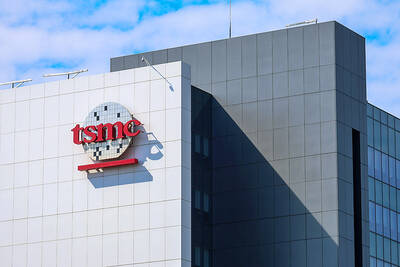
Taiwan Semiconductor Manufacturing Co (TSMC, 台積電), the world’s largest foundry service provider, yesterday said that global semiconductor revenue is projected to hit US$1.5 trillion in 2030, after the figure exceeds US$1 trillion this year, as artificial intelligence (AI) demand boosts consumption of token and compute power. “We are still at the beginning of the AI revolution, but we already see a significant impact across the whole semiconductor ecosystem,” TSMC deputy cochief operating officer Kevin Zhang (張曉強) said at the company’s annual technology symposium in Hsinchu City. “It is fair to say that in the past decade, smartphones and other mobile devices were
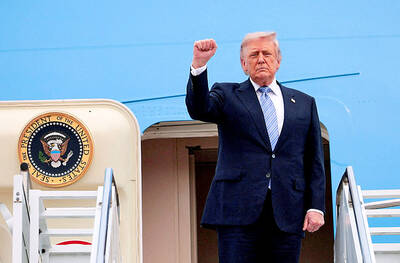
US-CHINA SUMMIT: MOFA welcomed US reassurance of no change in its Taiwan policy; Trump said he did not comment when Xi talked of opposing independence US President Donald Trump yesterday said he has not made a decision on whether to move forward with a major arms package for Taiwan after hearing concerns about it from Chinese President Xi Jinping (習近平). Trump’s comments on Taiwan came as he flew back to Washington after wrapping up critical talks in which both leaders said important progress was made in stabilizing US-China relations even as deep differences persist between the world’s two biggest powers on Iran and Taiwan. “I will make a determination,” Trump said, adding: “I’ll be making decisions. But, you know, I think the last thing we need right
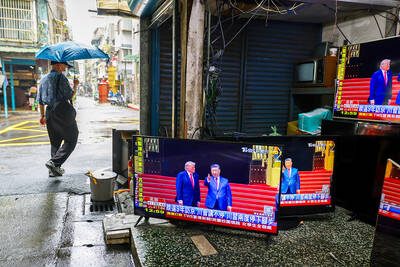
TAIWAN ISSUE: US treasury secretary Scott Bessent said on the first day of meetings that ‘it wouldn’t be a US-China summit without the Taiwan issue coming up’ There were no surprises on the first day of the summit between US President Donald Trump and Chinese President Xi Jinping (習近平), the Mainland Affairs Council (MAC) said yesterday, as the government reiterated that cross-strait stability is crucial to the Asia-Pacific region, as well as the world. As the two presidents met for a highly anticipated summit yesterday, Chinese state media reported that Xi warned Trump that missteps regarding Taiwan could push their two countries into “conflict.” Trump arrived in China with accolades for his host, calling Xi a “great leader” and “friend,” and extending an invitation to visit the White House
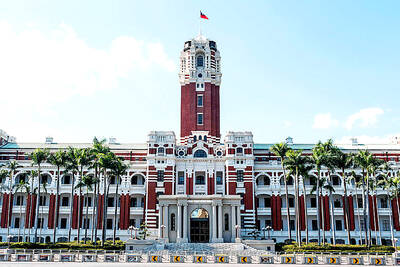
SECURITY: Taipei presses the US for arms supplies, saying the arms sales are not only a reflection of the US security commitment to Taiwan but also serve as a mutual deterrent against regional threats Taiwan is committed to preserving the cross-strait “status quo” and contributing to regional peace and stability, the Presidential Office said yesterday. “It is an undeniable fact that the Republic of China is a sovereign and independent democratic nation,” Presidential Office spokeswoman Karen Kuo (郭雅慧) reiterated, adding that Beijing has no right to claim sovereignty over Taiwan. The statements came after US President Donald Trump warned against Taiwanese independence. Trump wrapped up a state visit to Beijing on Friday, during which Chinese President Xi Jinping (習近平) had pressed him not to support Taiwan. Taiwan depends heavily on US security backing to deter China from carrying


 RSS
RSS