


Minister of the Coast Guard Administration (CGA) Shi Hwei-yow (
"The CGA prefers to fight to the death to anger to death," Shi told Suao's fishermen before boarding, earning cheers from his audience.
"The CGA will work with the navy on protecting Taiwan's fishing boats. While the coast guard plays the lead role in protecting fishermen, the navy plays a supporting role," he said.
He said that if the coast guard asked the navy to support its mission, the navy would quickly send warships.
"The CGA has outlined 13 sea patrol areas, and it will take responsibility to protect fishing boats practicing in these areas," he said.
Shi and representatives from Suao fishermen's associations took the 1,800-tonne Ho Hsing to the disputed waters near Diaoyutais yesterday morning.
Shi said the CGA had temporarily outlined 124km off the coast as the coast guard's patrol lines, but he promised to expand the patrol lines to the 370km-mark if fishermen made such a request through their associations.
Shi met with a group of Suao fishermen before yesterday's voyage. According to Chinese-language press reports, the fishermen told Shi that their protests against Japanese boats was not aimed at triggering an international dispute, but to demonstrating that they have rights to fish within Taiwan's own waters, the reports said.
The fishermen said they hoped Shi and the government would take their fishing rights seriously.
The fishermen reminded Shi that Japanese patrol boats had recently driven them away from the waters between the northeastern coast of Taiwan and Okinawa.
About 40 Taiwanese fishing boats sailed north on June 9 to challenge Japan's claim over the fishing grounds surrounding the disputed Diaoyutai group.
Suao fishermen and Chinese-language media have attacked the government for taking too soft an approach in dealing with fishing disputes with Japan.
Chinese Nationalist Party (KMT) Legislator Shuai Hua-min (
The ministry initially said that it had no intention of getting involved into the fishing dispute with Japan, after People First Party Legislator Lin Yu-fang (林郁方) demanded that the government send warships to protect the fishing boats in the disputed waters.
Minister of National Defense Lee Jye (李傑) later said the ministry would allow lawmakers from the legislature's National Defense Committee onboard navy vessels to sail to the disputed waters.
Meanwhile, the captain of a Taiwanese fishing boat was detained by the Japanese coast guard yesterday for illegally fishing off Miyako Island, Okinawa, according to Japanese police.
A police officer in Okinawa told the Central News Agency that the Chinmingtsai No. 11 was spotted by a Japanese patrol ship on Friday night in waters 65km off the east coast of Miyako Island, which is within Japan's exclusive economic zone. The five-man boat refused to stop for inspection, and was finally apprehended early yesterday, the officer said.
Captain Chen Teh-liang (陳得良) admitted that he was fishing illegally, according to the police.
Ministry of Foreign Affairs spokesman Michel Lu (呂慶龍) said the boat was operating in waters 64.8km off the east coast of Miyako Island, which is beyond Taiwan's exclusive economic zone.
Lu said that Taiwanese officials stationed on Okinawa had contacted Japanese authorities in the hope that Chen could be released on bail as early as possible.

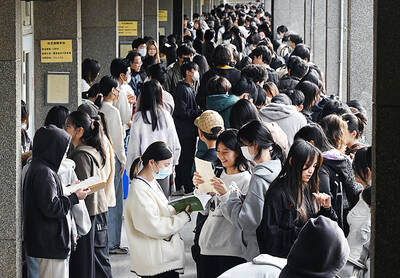
A global survey showed that 60 percent of Taiwanese had attained higher education, second only to Canada, the Ministry of the Interior said. Taiwan easily surpassed the global average of 43 percent and ranked ahead of major economies, including Japan, South Korea and the US, data from the Organisation for Economic Co-operation and Development (OECD) for 2024 showed. Taiwan has a high literacy rate, data released by the ministry showed. As of the end of last year, Taiwan had 20.617 million people aged 15 or older, accounting for 88.5 percent of the total population, with a literacy rate of 99.4 percent, the data

NEW LOW: The council in 2024 based predictions on a pessimistic estimate for the nation’s total fertility rate of 0.84, but last year that rate was 0.69, 17 percent lower An expected National Development Council (NDC) report expects the nation’s population to drop below 12 million by 2065, with the old-age dependency ratio to top 100 percent sooner than 2070, sources said yesterday. The council is slated to release its latest population projections in August, using an ultra-low fertility model, the sources said. The previous report projected that Taiwan’s population would fall to 14.37 million by 2070, but based on a new estimate of the total fertility rate (TFR) — the average number of children born to a woman over her lifetime — the population is expected to reach 12 million by

CCP ‘PAWN’? Beijing could use the KMT chairwoman’s visit to signal to the world that many people in Taiwan support the ‘one China’ principle, an academic said Chinese Nationalist Party (KMT) Chairwoman Cheng Li-wun (鄭麗文) yesterday arrived in China for a “peace” mission and potential meeting with Chinese President Xi Jinping (習近平), while a Taiwanese minister detailed the number of Chinese warships currently deployed around the nation. Cheng is visiting at a time of increased Chinese military pressure on Taiwan, as the opposition-dominated Legislative Yuan stalls a government plan for US$40 billion in extra defense spending. Speaking to reporters before going to the airport, Cheng said she was going on a “historic journey for peace,” but added that some people felt uneasy about her trip. “If you truly love Taiwan,
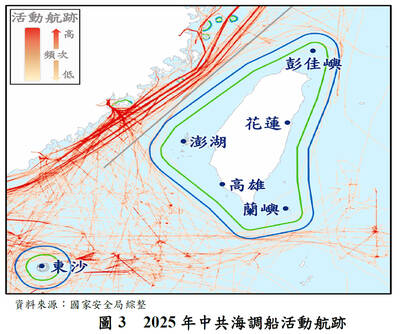
INTENSIFYING THREATS: Beijing’s tactics include massive attacks on the government service network, aircraft and naval vessel incursions and damaging undersea cables China is prepared to interfere in November’s nine-in-one local elections by launching massive attacks on the Taiwanese government’s service network (GSN), a report published by the National Security Bureau showed. The report was submitted to the Legislative Yuan ahead of the bureau’s scheduled briefing at the Foreign Affairs and National Defense Committee tomorrow. The national security team has identified about 13,000 suspicious Internet accounts and 860,000 disputed messages, the bureau said of China’s cognitive warfare against Taiwan. The disputed messages focus on major foreign affairs, national defense and economic issues, which were produced using generative artificial intelligence (AI) and distributed through Chinese


 RSS
RSS