


While the Presidential Office indicated that President Chen Shui-bian (
At a Chinese New Year dinner hosted by Chen for the heads of the five branches of the central government, Wang agreed to meet Chang this morning to begin negotiations.
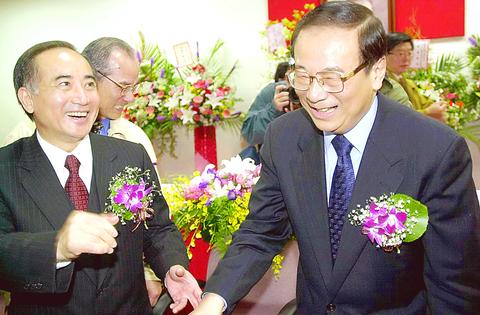
PHOTO: LU CHUN-WEI, TAIPEI TIMES
If the negotiations between the leaders of the executive and legislative branches fail to result in agreement, the Presidential Office said, Chen will, in accordance with the Constitution, hold further negotiations in which he will act as mediator.
Opposition party caucus leaders agreed in the afternoon during a closed-door session with Wang that he should participate in the negotiations.
"Out of courtesy and respect, all caucus leaders agree that I may go to listen to the views of the premier, but I should act in accordance with the Constitution," Wang said.
People First Party spokesperson Hwang Yih-jiau (黃義交) said, however, that Article 44 of the Constitution authorized the president to organize meetings to resolve disputes between government branches, but "only in respect of controversies that are not specifically covered by the Constitution."
"But the power plant controversy should not be i.ncluded in this regulation because it is a matter of law. The Constitution clearly states a set of procedures for the legislative and executive branches to handle any dispute over a legal matter," Hwang said.
"Wang could only go [to the meeting] if the president organized the meeting out of his personal intention to end the tension between the two branches, but not by virtue of the Constitution.
"Even if he goes, he alone cannot make any promises. All final decisions must be made as a result of discussions with lawmakers,"Hwang said.
Sources within the Preidential Office, who declined to be named, said that the president is trying to create a "compromise option," which can satisfy both the DPP and the opposition alliance.
"Since the DPP government and the opposition parties have agreed to build a nuclear-free country, we believe that both sides will make concessions and ultimately reach agreement, which should be enshrined in legislation," the sources said. "Even the DPP has to persuade its members to accept the final agreement."
According to some DPP lawmakers, the conditions currently under consideration by the president might include: early decommissioning of the first, second, and third nuclear power plants; decommissioning of the fourth plant if other energy projects can supply sufficient electricity in the future; the enshrining into law of a scheduled date for decommissioning of the Fourth Nuclear Power Plant; a clear declaration that no further nuclear power plants will be built.
The sources said that any conditions will still have to be discussed during the upcoming negotiations.
"The final agreement must be written into law," according to the sources, "in order to ensure that both the government and opposition parties abide by it in the future."
Meanwhile, to extend his goodwill, the premier yesterday unexpectedly appeared at the handover ceremony of the KMT's legislative caucus leaders, urging the opposition alliance to "never close the door to negotiations."
"A nuclear-free country is our mutual and ultimate goal. We will definitely reach an agreement," Chang said, adding that the balance of power between the executive branch and the legislature prevented the Cabinet from becoming a mere "branch" of the legislature by adhering to any resolutions unilaterally passed by the body.
In response to Chang's remarks, Wang said that the legislature did not insist on immediately restarting the Fourth Nuclear Power Plant's construction before negotiations had taken place. Wang's remarks were widely seen as a reciprocal gesture of goodwill.
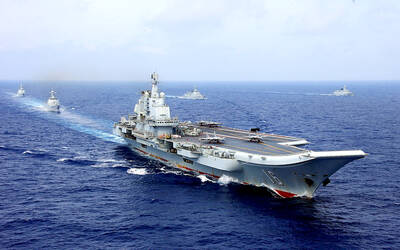
Japan on Wednesday rejected Beijing’s accusations that the Japanese military harassed a Chinese aircraft carrier strike group during 40 days of exercises in “distant waters” of the Pacific. The Chinese navy earlier this week said that Japanese ships and aircraft “repeatedly engaged in close-range tracking, surveillance, harassment and provocation.” China said a formation led by its Liaoning aircraft carrier had operated in areas including the South China Sea and the western Pacific for “multiple rounds of day-and-night offensive and defensive exercise.” The Liaoning group “maintained a high state of alert throughout, launching carrier-based aircraft for combat sorties ... and steadily responding to the

COUNTER: The government should put forward a more proactive exchange policy for the youth and encourage them to engage with the wider world, the source said Beijing is trying to entice young Taiwanese to attend the Cross-Strait Sun Yat-sen Forum in Guangdong Province, China, by offering to cover all their expenses except round-trip airfare, an official said yesterday. “The cheapest things are the most expensive,” an official familiar with China’s “united front” work said, adding that such tours typically include visits to “red propaganda bases.” “These kinds of united front trips only end up bringing back a lot of falsehoods,” said the official, who wished to remain anonymous. The forum, which began on Saturday last week, ends today. China is offering an all-expense paid trip to Taiwanese participants aged
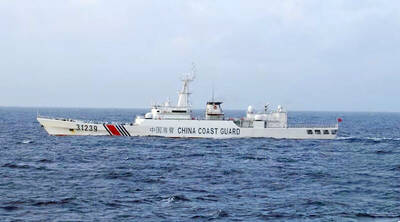
GLOBAL CONCERN: The UK, German and French offices reiterated their opposition to unilateral changes to the Taiwan Strait ‘status quo,’ particularly by threat or force The UK, Germany and France’s de facto embassies in Taiwan, as well as the US’ office, yesterday expressed concern over China’s “special maritime law enforcement operations” in waters east of Taiwan, saying that such behavior threatens regional stability. In a joint statement issued by the British Office Taipei, the German Institute Taipei and the French Office in Taipei, the three offices, which represent their respective countries’ interests in Taiwan in the absence of official diplomatic ties, said that they had “noted with concern novel Chinese activity in the waters east of Taiwan.” “These actions threaten regional stability, and the freedom of navigation
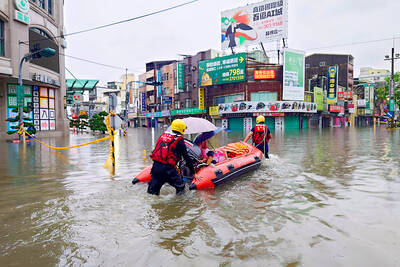
Torrential rain battered Taiwan for a second day yesterday and caused widespread flooding nationwide that led to at least two deaths as rising waters stranded residents and prompted emergency rescues. Premier Cho Jung-tai (卓榮泰) yesterday morning directed the Ministry of Economic Affairs to aid local governments with pumps to clear inundated areas. The heavy rain was brought by Tropical Storm Mekkhala as it moved northward east of Taiwan, strengthening southwesterly winds and an approaching weather front from southern China, the Central Weather Administration said. As of press time last night, the severe flooding had killed two people. Kaohsiung police said a 73-year-old woman surnamed


 RSS
RSS