


Four roads cut through the Coastal Mountain Range in Taiwan’s east. From north to south, they are: Highway 11A (台11甲線); Hualien County Road 64 (花64線), sometimes called Ruigang Industry Road (瑞港產業道路); the newish Highway 30 (台30線), also known as the Yuchang Highway (玉長公路); and Highway 23 (台23線).
A determined walker could tramp the length of any of the first three roads in a single day. For cyclists and hikers, however, the southernmost route is a significantly greater challenge.
The distance from the inland end of Highway 23 in Hualien County’s Fuli Township (富里鄉) to its western terminus, on the coast in Taitung County’s Donghe Township (東河鄉), is 45.5km. What’s more, a good bit of it is uphill. Fuli Railway Station (富里火車站) is at an elevation of 227m, while the highest point on the road — which also happens to be the border between the counties of Hualien and Taitung — is 637m above sea level.
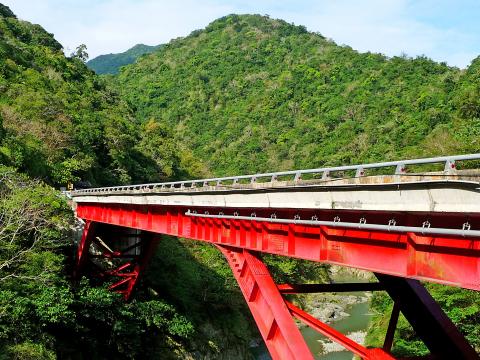
Photo: Steven Crook
This perhaps explains why, when we drove from Fuli to Donghe a few weeks back, we didn’t see a single cyclist, despite the weather being just about perfect for a long bike ride.
If going all the way to the coast doesn’t fit in with your plans, but you find yourself in the vicinity of Fuli, do make an effort to drive or ride part of Highway 23. Excellent scenery can be found less than 4km up the road.
Turning a corner as we approached the two-church village of Fengnan (豐南), we were treated to an entrancing combination of rice paddies and steep green hills. Surprisingly, nobody seems to have thought of marketing this area as “Little Guilin” (小桂林). For those who don’t know it, Guilin is one of the most famous scenic attractions in China.
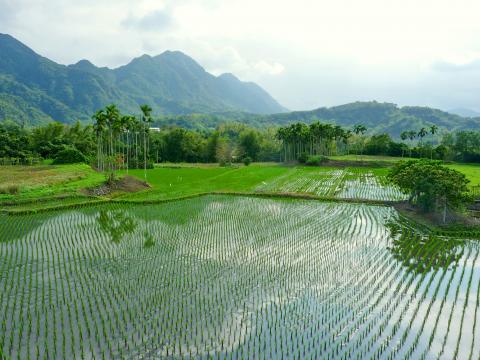
Photo: Steven Crook
It’d be hyperbole — but no more unreasonable than other claims made by the tourism industry. Also, it would cancel out the unappealing names given to two remote locations near Fengnan: One is called Choushuigou (臭水溝, “Stinky Water Ditch”), the other Wenzidong (蚊子洞, “Mosquito Hole”).
Those traveling all the way to Donghe should bear in mind that beyond Fengnan, there’s very little chance of being able to order a bowl of noodles, or buy soft drinks, until you reach Taiyuan (泰源), a good 30km away. We had our lunch at the village’s only eatery, next door to a shop that oozed retro appeal. Alongside the usual dried and canned goods and bottled drinks, the latter sells seasonal homemade products like pickled chillis.
The noodle restaurant and shop are easy to find. They’re right beside Highway 23, directly across the road from the Roman Catholic church that was built in 1962.
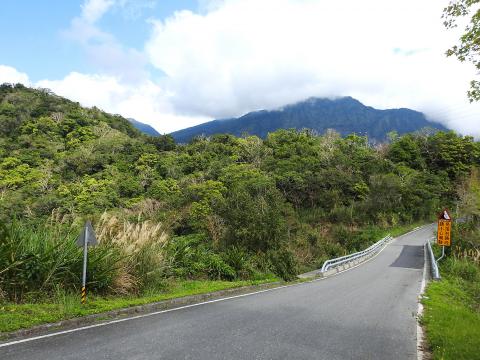
Photo: Steven Crook
Just up the road, around the 7km-marker, there’s a spot dubbed Little Tiansiang (小天祥). It doesn’t have the scale or majesty of the canyon near Tiansiang in Taroko Gorge (太魯閣) — which is why relatively few people have heard of it — but it does deserve several minutes of your time. As in Taroko Gorge, the road is narrow, so take care not to block the road if stopping.
Every turn on Highway 23 is a visual pleasure, but the section just before and after the Hualien-Taitung boundary near km16.5 justifies a certain overused adjective: breathtaking. Even after the road crests, it’s a long time before you get to see the Pacific Ocean. There are too many mountains in the way, and some towering cliffs.
After the 25km-marker, approaching Donghe Farm (東河農場), we saw more signs of human habitation. Down in the valley to our right, there were farmsteads and another Catholic house of worship.
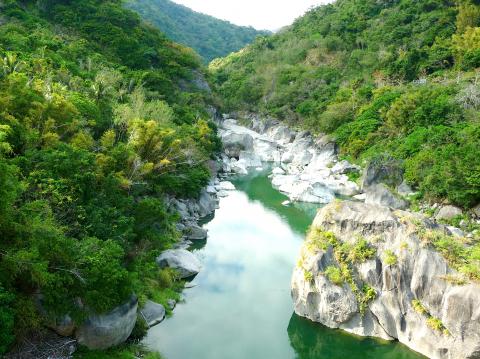
Photo: Steven Crook
The population density was a little higher around Beiyuan (北源), beyond the 35km-marker. The largest buildings hereabouts belong to Taiyuan Skills Training Institute (泰源技能訓練所), which (despite the benevolent sound of its name) is a correctional facility. During the Martial Law era (1949 to 1987), this complex held political prisoners, some of whom launched an unsuccessful uprising in 1970.
Taiyuan, 3km down the road from the prison, isn’t much of a town, but it does have a few restaurants and at least one guesthouse. Instead of stopping there, we halted three minutes to the south at Dengsian Bridge (登仙橋).
Bilingual signs at both ends of the bridge ask tourists not to feed the Formosan macaques which gather there. When we stopped, however, the eight or nine monkeys hanging around were all tucking into oranges which looked very similar to those a man was hawking from the back of his truck.
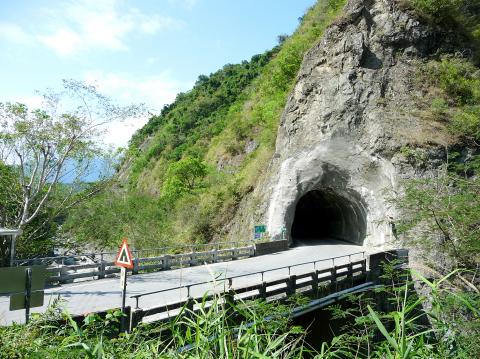
Photo: Steven Crook
Where Highway 23 hits Highway 11, the coast road connecting Hualien City and Taitung City, two bridges cross Mawuku Creek (馬武窟溪). From the Old Donghe Bridge (舊東河橋), now closed to vehicles, the view upriver is captivating. In fact, if any point along Highway 23 deserves to be compared to Taroko Gorge, it’s this one.
The valley combines green forest, white rock, and serpentine water. Hoping to see it from a different angle, I took the well-maintained pathway at the southern end of the old bridge down to the water’s edge. Instead of going upriver, it lead me under the old bridge, then the new bridge, and eventually to the seashore. But I wasn’t disappointed. In this part of Taiwan, it’s not merely all good.
It’s fantastic.
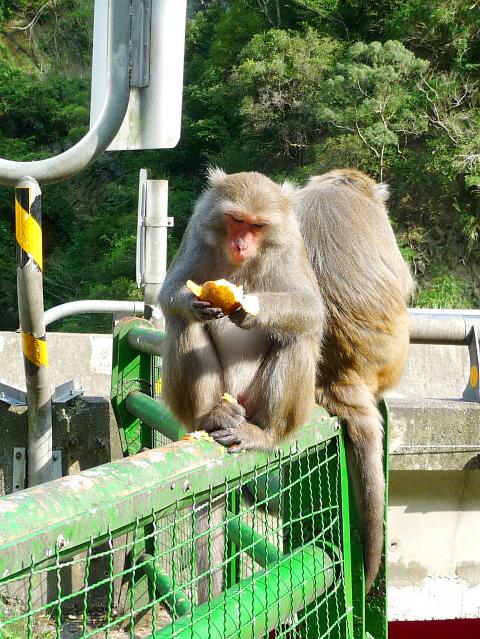
Photo: Steven Crook
Steven Crook has been writing about travel, culture, and business in Taiwan since 1996. He is the co-author of A Culinary History of Taipei: Beyond Pork and Ponlai, and author of Taiwan: The Bradt Travel Guide, the third edition of which has just been published.

Photo: Steven Crook
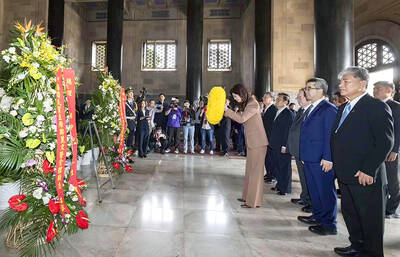
The problem with Marx’s famous remark that history repeats itself, first as tragedy, the second time as farce, is that the first time is usually farce as well. This week Chinese Nationalist Party (KMT) Chair Cheng Li-wun (鄭麗文) made a pilgrimage to the People’s Republic of China (PRC) “to confer, converse and otherwise hob-nob” with Chinese Communist Party (CCP) officials. The visit was an instant international media hit, with major media reporting almost entirely shorn of context. “Taiwan’s main opposition leader landed in China Tuesday for a rare visit aimed at cross-strait ‘peace’”, crowed Agence-France Presse (AFP) from Shanghai. Rare!

What is the importance within the Chinese Nationalist Party (KMT) of the meeting between Xi Jinping (習近平), the leader Chinese Communist Party (CCP), and Cheng Li-wun (鄭麗文), the leader of the KMT? Local media is an excellent guide to determine how important — or unimportant — a news event is to the public. Taiwan has a vast online media ecosystem, and if a news item is gaining traction among readers, editors shift resources in near real time to boost coverage to meet the demand and drive up traffic. Cheng’s China trip is among the top headlines, but by no means

Sunflower movement superstar Lin Fei-fan (林飛帆) once quipped that the Democratic Progressive Party (DPP) could nominate a watermelon to run for Tainan mayor and win. Conversely, the DPP could run a living saint for mayor in Taipei and still lose. In 2022, the DPP ran with the closest thing to a living saint they could find: former Minister of Health and Welfare Chen Shih-chung (陳時中). During the pandemic, his polling was astronomically high, with the approval of his performance reaching as high as 91 percent in one TVBS poll. He was such a phenomenon that people printed out pop-up cartoon
A recent report from the Environmental Management Administration of the Ministry of Environment highlights a perennial problem: illegal dumping of construction waste. In Taoyuan’s Yangmei District (楊梅) and Hsinchu’s Longtan District (龍潭) criminals leased 10,000 square meters of farmland, saying they were going to engage in horticulture. They then accepted between 40,000 and 50,000 cubic meters of construction waste from sites in northern Taiwan, charging less than the going rate for disposal, and dumped the waste concrete, tile, metal and glass onto the leased land. Taoyuan District prosecutors charged 33 individuals from seven companies with numerous violations of the law. This


 RSS
RSS