


The musical and emotional contrasts of the two productions at the National Kaohsiung Center for the Arts — Weiwuying this weekend could not be more dramatic: A powerful passifistic choral elegy for the dead of two world wars and jazzy riff on one of William Shakespeare’s romantic comedies.
One is a Taiwan debut, the other is a touring revival of a popular 2018 production.
Tickets for either show would normally be hot sellers, but these are not normal times, given the concern about the potential spread of COVID-19 in Taiwan and the reluctance of many people to enter public venues, so there are still plenty of tickets at all price levels.
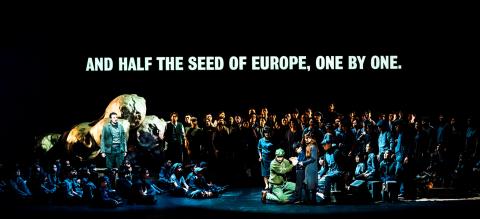
Photo courtesy of National Kaohsiung Center for the Arts
That means if you are worried about sitting too close to other people, there will be room to spread out.
In addition, the National Performing Arts Center, the umbrella organization for the National Theater Concert Hall in Taipei, Weiwuying and the National Taichung Theater, earlier this month imposed disease-prevention protocols at all of its venues.
Disinfection measures have been increased, employees are required to have their temperatures taken daily and frontline staff must wear masks while on duty, while audience members must have their temperatures checked before entering a venue, and while they are not required to wear masks, it is encouraged.

A Weiwuying-English National Opera (ENO) coproduction of Benjamin Britten’s famed War Requiem, which premiered in London in November 2018, will have its Taiwan premier tomorrow night, an apt choice to honor 228 and the 228 Peace Memorial Day.
Weiwuying artistic director Chien Wen-pin (簡文彬), who will conduct National Taiwan Symphony Orchestra (國立臺灣交響樂團) for the two performances, on Tuesday told a news conference that staging the show on 228 and on the site of a former military encampment, gives the production an added layer of meaning.
War Requiem gives voice to the sense of helplessness and confusion people feel in times of war, he said.
War Requiem premiered on May 30, 1962, to mark the consecration of the rebuilt 14th-century St Michael’s Cathedral in Coventy, England, which had been almost completely destroyed by German bombing on Nov. 14, 1940.
Britten, a noted pacifist and conscientious objector, used the traditional Latin text for a Catholic requiem and battlefield poems by English poet Wilfred Owen, who was killed in France during World War I.
Taiwanese soprano Chen Mei-lin (陳美玲), Welsh tenor Joshua Owen Mills and Singaporean baritone Martin Ng (吳翰衛) are the featured soloists who will perform alongside the Taipei Philharmonic Chorus (台北愛樂合唱團) and the Century Voice Choir (世紀合唱團), a children’s group.
Former ENO artistic director Daniel Kramer has been in Kaohsiung to direct the production, which he created along with Turner Prize-winning photographer Wolfgang Tillmans, who did the stage design.
The production has a running time of 90 minutes and will be performed in Latin and English, with Mandarin and English subtitles.
Next door in the Playhouse, the Tainaner Ensemble’s (台南人劇團) revival of its 2018 jazz musical version of William Shakespeare’s Twelfth Night (第十二夜) opens tomorrow night as well, for the first of two shows.
Directed by Lu Po-Shen (呂柏伸), with music by Blaire Ko (柯智豪) and lyrics by Chao Chi-Yun (趙啟運), this all-singing, all-dancing take on Shakespeare’s comedy about gender and identity, deception and romance, premiered in the fall of 2018 at the Cloud Gate Theater.
Kaohsiung is the second stop of a three-city tour for the revival, and the show moves to Taipei’s Metropolitan Hall next weekend.
The 11-member cast is led by Kyle Lo (凱爾), Liu Ting-fang (劉廷芳) and Tsuei Tai-hao (崔台鎬), with music by the Hot Tubes (哈管幫).
The show runs 150 minutes, with a 15 minute intermission.
Performance Notes
WHAT: Benjamin Britten: War Requiem
WHEN: Tomorrow at 7:30pm and Sunday at 2:30pm
WHERE: The Opera House at the National Kaohsiung Center for the Arts - Weiwuying (衛武營國家藝術文化中心) 1, Sanduo 1st Rd, Kaohsiung City (高雄市三多一路1號)
ADMISSION: NT$300 to NT$4,800, available at Weiwuying box offices, online at www.artsticket.com.tw and at convenience store ticket kiosks
WHAT: Twelfth Night ─ A Shakespearean Musical
WHEN: Tomorrow at 7:30pm and Saturday at 2:30pm
WHERE: The Playhouse at the National Kaohsiung Center for the Arts - Weiwuying (衛武營國家藝術文化中心) 1, Sanduo 1st Rd, Kaohsiung City (高雄市三多一路1號)
ADMISSION: NT$700 to NT$2,000, available at Weiwuying box offices, online at www.artsticket.com.tw and at convenience store ticket kiosks
ADDITIONAL PERFORMANCES: Friday next week at 7:30pm and Saturday at 2:30pm at the Metropolitan Hall (城市舞台), 25 Bade Rd, Sec 3, Taipei (台北市八德路三段25號)
Tickets are NT$600 to NT$1,600, available at National Theater Concert Hall box offices, online at www.artsticket.com.tw and at convenience store ticket kiosks

If a leisurely afternoon of high-end dining and watching the scenery roll by from the comfort of a plush armchair sounds like a good time to you, consider a trip on the Sea Breeze (海風號). This culinary, cultural and scenic experience is the perfect setting for a date, a celebratory outing with a small group of friends or a relaxing solo ride. The price tag is steep, especially if you consider the short distance the train actually covers over the 3.5-hour journey. But what you’re paying for on the Sea Breeze isn’t transportation; it’s the comfort, the service, the exclusivity, the

June 15 to June 21 According to legend, a giant from Orchid Island (Lanyu, 蘭嶼) named Si Mangangavang once built a large tatala canoe capable of carrying 16 people. He set sail southward to the Batanes in the Philippines, where he traded with the local Ivatan people. One of the goods they coveted was cowhide, which the Tao people of Orchid Island used to make armor. Through continued trade, the Tao and Ivatan forged close ties, and Si Mangangavang became good friends with a Batanes giant named Si Vakag. This story, collected in a 1998 book by ethnologist Yu Guang-hong (余光弘)

Taiwan’s renewable shortfall is a problem of execution, not resources. Japan’s long-cycle, joined-up energy planning is the model worth studying — but what Taiwan can borrow is the institutional machinery, not the politics. When Nvidia CEO Jensen Huang (黃仁勳) used his visit to Taipei last month to warn that the country needs far more electricity, he was naming a constraint its own planners already know well: Taiwan Power Co (Taipower, 台電) expects demand from the semiconductor and artificial intelligence (AI) sector alone to exceed 5 gigawatts (GW) by 2030. The harder question is not whether to build more capacity but which

One of the wildest things about the reception of Chinese Nationalist Party (KMT) Chair Cheng Li-wun (鄭麗文) in the international media is the way her words are presented without being contextualized, let alone challenged. The Financial Times, for example, interviewing her during her visit to New York, said that she blamed the halt to exchanges between Taiwan and the People’s Republic of China (PRC) for raising tensions. “There has been no dialogue, so you can see that the situation is almost on the brink of war,” the Financial Times quoted her as saying, without any hint that the PRC, not


 RSS
RSS