


Feb. 3 to Feb. 9
Liu Hsia (劉俠) clearly remembered the day her left arm began to ache. At first, her family thought it was sore from carrying her newborn sister around. But when her left foot started hurting and swelled up, it was evident that something was seriously wrong.
After two misdiagnoses, Liu was close to death. By the time she got to a proper hospital, the doctor screamed at her father for letting her illness drag on for so long. They proclaimed that it was rheumatoid arthritis, a degenerative autoimmune disorder that results in painful, swollen and stiff joints. The condition left her wheelchair bound for most of her life.
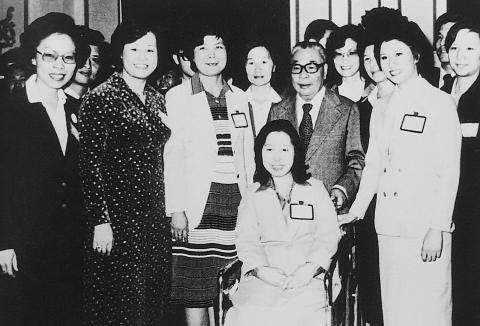
Photo courtesy of National Central Library
That day was July 7, 1954.
“That day was the beginning of my endless war with my illness,” Liu, better known by her pen name Xing Lin Tzu (杏林子), writes in her best-known book, Xing Lin Xiao Ji (杏林小記). She was just 12 years old.
Liu went on to be a prolific and popular writer, an activist for the disabled, which led to her being listed among the nation’s 10 Outstanding Young Women (十大傑出女青年) in 1980. She later founded the influential non-profit Eden Social Welfare Foundation (伊甸社會福利基金會). Having only completed elementary school, she was awarded an honorary doctorate from Providence University (靜宜大學) and appointed a national policy advisor in 2001.
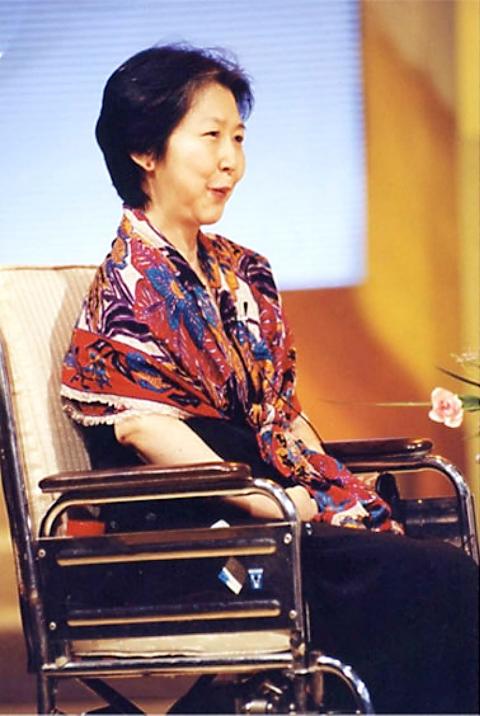
Photo courtesy of Wikimedia Commons
“I don’t know how many times I thought of ending my life,” she writes. “But in the back of my mind, I always refused to resign to my fate. I’ve already suffered so much. If I give up now, wouldn’t I have suffered for nothing?”
HOSPITAL BLUES
Liu’s pen name was drawn from her hometown of Xinglin (杏林) in China, a honorific in Chinese that refers to accomplished physicians. Xing Lin Xiao Ji is a light-hearted and contemplative collection of essays about her illness and her observations from the hospital, which was her second home.
“The hospital is a microcosm of society,” she writes in the introduction. “Life and death happen at the same time, laughter and tears coexist. You can feel the fragility and helplessness of life, but also the resolve and perseverance of life. Oftentimes, you can see the cruelest and most heartless side of humanity, but also the most heartwarming and touching side … The hospital is a place that always makes people think deeply, get inspired and renew their strength.”
Liu was playful about her illness. In one passage, she writes: “In most cases, the same joints on both sides of the body flare up simultaneously. Mine was different; sometimes it would be my left shoulder, right elbow and left hand … I liked to say that my symptoms were ‘fancy.’ From a young age I was very individualistic. Even my illness was special!”
But she also detailed her suffering. “In the past 20 years, I haven’t had one good night of sleep, and I have been constantly in pain. I’ve sorted my pain into five levels: small pain, medium pain, big pain, immense pain and insane pain. My family often jokingly asked me, ‘What level is it today?’”
Liu believes that the culprit for her illness was the immense pressure to enter a good junior high school. Back then, compulsory education was only six years, and sixth graders had to take an exam to further their studies. Liu endured 13-hour days and barely had the energy or time to eat properly, and her body, which was already frail to begin with, broke down.
The years passed by, and Liu’s condition only worsened. At the age of 15, she decided that if things didn’t become more bearable within three years, she would take her own life. But she changed her mind after becoming a devout Christian a year later, her faith greatly helping her to cope with her misfortune.
FINANCIAL FREEDOM
Liu was determined to find a way not to be a burden on others. Of all her interests, she chose writing because it was something she could do in bed, and required the least materials. She started taking writing classes, and although at first she could barely scribble with her “twisted, deformed hands,” through sheer will she managed to perfect her handwriting. Since she couldn’t raise her arms, she wrote with a wooden plank in her lap.
After many rejections, an essay by the 19-year-old Liu made it to the literary supplement section of the Central Daily News (中央日報), proving that she could make money on her own. She also wrote scripts for radio and television programs, which paid much more.
“As a disabled person, money meant much more to me than just [being able to buy things]. My family sacrificed for me all these years … and now I could at least give back a little bit. Being able to make money also proved to myself that I wasn’t a waste of space; I was useful, and my feelings of inferiority dissipated.”
She writes that this is why her future Eden Social Welfare Foundation prioritized vocational training. “If a disabled person couldn’t support themselves, how could they have dignity?”
Liu regained the ability to walk after undergoing surgery when she was 22. In the next three years, she worked, studied, took care of disabled children and also found the time to travel extensively and have fun with friends. But three years later, her sickness flared up again.
SOCIAL WARRIOR
Although Liu came to terms with her illness, she lamented that society stigmatized the disabled. After being asked to leave a government exhibition because “someone important was coming,” she decided to start the foundation to address the issue.
By that time, Liu’s condition had worsened to the point where she needed to take eight painkillers just to make it through the day. But she writes that her illness miraculously improved just enough to take action. She started the Eden foundation in 1982.
The goal of Eden was twofold: fuli (福利, welfare) and fuyin (福音, gospel). At the age of 40, she moved out of her parents’ house for the first time to better manage the organization. After the lifting of martial law in 1987, her foundation took part in the explosion of activism across the nation.
Liu was especially concerned about one issue: many universities still barred disabled students from enrolling in certain departments. After negotiations with the government failed Liu’s foundation went on a public relations blitz, gaining the support of the public and media through public events. It worked. The Ministry of Education announced that all restrictions on disabled students would be lifted except for the six normal universities. Two years later, the normal universities also followed suit.
In December 1987, the government abruptly terminated the Patriotic Lottery. Liu took up this issue because many of the vendors were disabled and had few other means to make money. After finding that government measures to help these former vendors were largely ineffective, Liu led more than 500 people to the streets on Jan. 19, 1988 to fight for their rights and also to urge the government to amend the law governing the rights of the physically disabled, which they joked was itself “disabled.”
Liu formed and chaired the League for Persons with Disabilities in 1989, which focused on fixing the law. During their first protest in front of the Legislative Yuan, one of the protesters stabbed himself with a knife — vaulting the issue into the national spotlight. The amendment was drafted within a month, but the disabled groups were unhappy with it. The two sides went back and forth for five months, finally passing the final version in January 1990.
Another episode of Liu’s activism took place in 1989, when she ran for legislator despite knowing that candidates needed to have at least a high-school education. That rule disqualified about 80 percent of disabled citizens at the time due to the lack of special education, Liu writes, and she ran just to highlight their disadvantages. She even sued the government, leading to an intense series of events, dubbed the “Liu Hsia Incident” by the media, which reported everyday on its developments for the next three months. Liu did not get to run in the end, but the case went before the Council of Grand Justices, which for her was a moral victory.
Liu had moved to the countryside when she was called on to organize three large-scale demonstrations in May 1997 against government incompetence after a series of national disasters and violent crimes.
She officially retired from Eden in 2000.
“I asked God, what else do you want me to do?” she writes. A year later, she was named a National Policy Advisor for then-president Chen Shui-bian (陳水扁).
By the time Liu authored her autobiography, the arthritis had started attacking her organs, and she could no longer perform even basic tasks. She died on Feb. 8, 2003.

Ajay Verma, a consultant gastroenterologist at Kettering general hospital in Northamptonshire, says our gut is a “complex machine.” “It is constantly providing us with the nutrition we need, initially to grow and develop, and then for us to survive, thrive and repair from injury and illness.” How can we keep it functioning well? Put simply: “Make sure what you put into it is balanced, and that you clear out its waste products adequately,” Verma says. “In a general gastroenterology clinic, the most common conditions we see are irritable bowel syndrome (IBS), gastroesophageal reflux disease, inflammatory bowel disease and constipation,” says Nisha
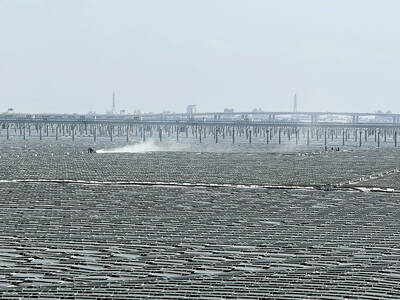
The arithmetic is straightforward and uncomfortable. By the end of 2025, Taiwan had committed itself to a 50-30-20 electricity mix — half natural gas, 30 per cent coal, 20 per cent renewables. The Ministry of Economic Affairs’s (MOEA) own monthly energy reports tell a different story. Natural gas reached 47.8 per cent of generation last year. Coal stood at 35.4 per cent, comfortably above its target ceiling. Renewables came in at 13.1 per cent, well short of the 20 per cent Taipei had pledged a decade earlier. Installed renewable capacity reached roughly half of the 12 gigawatts (GW) the government

Last week US President Donald Trump was asked by a reporter whether he would speak on the phone to the President of Taiwan. “l’ll speak to him. I speak to everybody. We have that situation very well in hand,” Trump said. This marked the second time in a couple of weeks he had said he would talk to the President of Taiwan. In 2016 he famously took a call from then-president Tsai Ing-wen (蔡英文), when he was president-elect. Despite warnings that the apocalypse was nigh because of a phone call, the world quickly forgot about the conversation between two democratically-elected presidents.

May 25 to May 31 Few believed that apples could be cultivated on a commercial scale in Taiwan’s high mountains. When horticulturalist Cheng Chao-hsiung (程兆熊) first proposed the idea in 1955, both American and Taiwanese colleagues dismissed it as implausible, arguing that temperate fruit could not be reliably grown on a subtropical island, especially on rugged terrain. However, it was this terrain in the Central Mountain Range where many Chinese Civil War veterans were resettled in the late 1950s. With limited job prospects and no family in Taiwan, they were placed on cooperative farms aimed toward self-sufficiency. Some say the conditions


 RSS
RSS