


The Crucible remains one of US playwright Arthur Miller’s best-known works, and a film of a highly acclaimed 2014 London production is now showing at Vieshow Cinemas around Taiwan.
The 1953 play is a retelling of the Salem witch trials of 1692 to 1693 in what was then the Massachusetts Bay Colony, but Miller wrote it amid the hysteria of the US government’s hunt for communists following the end of the Chinese Civil War, Chiang Kai-shek (蔣介石) and his Chinese Nationalist Party (KMT) government fleeing to Taiwan and the establishment of the People’s Republic of China.
Then-US senator Joseph McCarthy, who was chairman of the Senate’s Government Operations Committee, and other members of the US Congress became obsessed with the idea that the US “had lost China” because the US Department of State — and many other organizations such as universities, labor unions and the entertainment industry — harbored pro-Soviet traitors and could soon lose Western Europe.
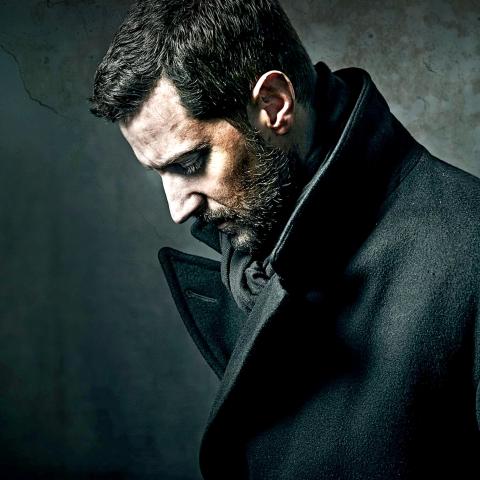
Photo courtesy of the Old Vic
The paranoia led to the State Department firing many of its “China experts” and hundreds of people being accused of being communist sympathizers finding themselves under investigation, losing their jobs and, in many case, jailed.
As Miller intended, people saw The Crucible as an allegory for the US House of Representatives’ Committee on Un-American Activities’ hunt for communist sympathizers.
Three years after The Crucible opened, Miller himself was questioned by committee. While willing to talk about his own political activities, he would not give the names of others who might have been at the same meetings and so he was convicted of contempt of Congress.
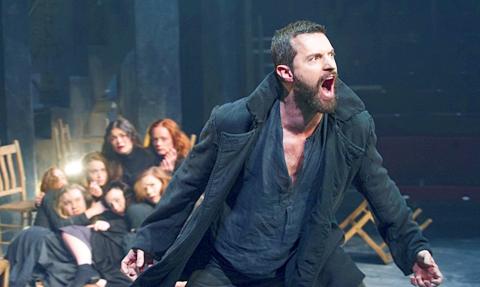
Photo courtesy of the Old Vic
In a piece published in the The New Yorker magazine on Oct. 13, 1966, about the writing of the play and his memories of that time, Miller wrote: “Few of us can easily surrender our belief that society must somehow make sense. The thought that the state has lost its mind and is punishing so many innocent people is intolerable. And so the evidence has to be internally denied.”
South African director Yael Farber’s production of The Crucible ran for 12 weeks from June to September 2014 at The Old Vic theater in London, starring Richard Armitage, who had gained worldwide recognition for his portrayal of the doomed dwarf leader Thorin Oakenshield in Peter Jackson’s The Hobbit trilogy.
The Guardian’s Michael Billington called it “an extraordinary production that preserves the integrity of Miller’s language while investing the action with a raw, visceral power.”
This film production was captured by Digital Theatre live at the Old Vic over three nights.
The play ran three-and-a-half hours with an intermission. The film clocks in at 3 hours and 19 minutes.
■ The Farber/Armitage film can be seen in Taipei at the Xinyi complex at 7:20pm on Monday and Friday next week, in Hsinchu, Taichung, Tainan and Kaohsiung at 7:20pm on Tuesday next week, and in Taoyuan at 2pm on Dec. 1.
■ More information and ticket links can be found on the company’s Web site Crucible page (www.vscinemas.com.tw/vsweb/film/detail.aspx?id=4182).

The Lee (李) family migrated to Taiwan in trickles many decades ago. Born in Myanmar, they are ethnically Chinese and their first language is Yunnanese, from China’s Yunnan Province. Today, they run a cozy little restaurant in Taipei’s student stomping ground, near National Taiwan University (NTU), serving up a daily pre-selected menu that pays homage to their blended Yunnan-Burmese heritage, where lemongrass and curry leaves sit beside century egg and pickled woodear mushrooms. Wu Yun (巫雲) is more akin to a family home that has set up tables and chairs and welcomed strangers to cozy up and share a meal
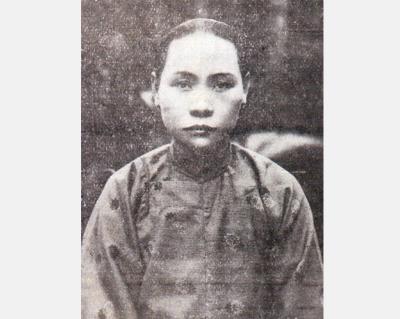
Dec. 8 to Dec. 14 Chang-Lee Te-ho (張李德和) had her father’s words etched into stone as her personal motto: “Even as a woman, you should master at least one art.” She went on to excel in seven — classical poetry, lyrical poetry, calligraphy, painting, music, chess and embroidery — and was also a respected educator, charity organizer and provincial assemblywoman. Among her many monikers was “Poetry Mother” (詩媽). While her father Lee Chao-yuan’s (李昭元) phrasing reflected the social norms of the 1890s, it was relatively progressive for the time. He personally taught Chang-Lee the Chinese classics until she entered public

Last week writer Wei Lingling (魏玲靈) unloaded a remarkably conventional pro-China column in the Wall Street Journal (“From Bush’s Rebuke to Trump’s Whisper: Navigating a Geopolitical Flashpoint,” Dec 2, 2025). Wei alleged that in a phone call, US President Donald Trump advised Japanese Prime Minister Sanae Takaichi not to provoke the People’s Republic of China (PRC) over Taiwan. Wei’s claim was categorically denied by Japanese government sources. Trump’s call to Takaichi, Wei said, was just like the moment in 2003 when former US president George Bush stood next to former Chinese premier Wen Jia-bao (溫家寶) and criticized former president Chen

President William Lai (賴清德) has proposed a NT$1.25 trillion (US$40 billion) special eight-year budget that intends to bolster Taiwan’s national defense, with a “T-Dome” plan to create “an unassailable Taiwan, safeguarded by innovation and technology” as its centerpiece. This is an interesting test for the Chinese Nationalist Party (KMT), and how they handle it will likely provide some answers as to where the party currently stands. Naturally, the Lai administration and his Democratic Progressive Party (DPP) are for it, as are the Americans. The Chinese Communist Party (CCP) is not. The interests and agendas of those three are clear, but


 RSS
RSS