


Champions of the fight against sexual violence, Congolese doctor Denis Mukwege and Yazidi activist Nadia Murad, a former captive of Islamic militants, will on Monday receive the Nobel Peace Prize, which this year highlights rape as a weapon of war.
Murad, 25, and Mukwege, 63, will be jointly presented with the prize in Oslo, after they were announced as winners by the Norwegian Nobel Committee in October this year for “their efforts to end the use of sexual violence as a weapon of war and armed conflict.”
Mukwege, called “Doctor Miracle” for his surgical skills, has spent 20 years treating the horrendous wounds and intense emotional trauma inflicted on women in the Democratic Republic of the Congo’s (DR Congo) war-torn east.
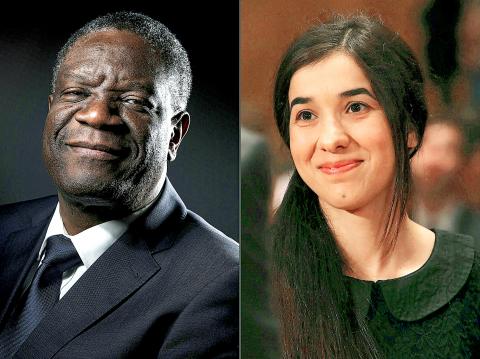
Photo: AFP
He has been scathing about the world’s lackluster response to sexual violence in conflict.
“We have been able to draw a red line against chemical weapons, biological weapons and nuclear arms,” he said in 2016. “Today we must also draw a red line against rape as a weapon of war.”
Fellow laureate Murad has become a tireless campaigner for the rights of Yazidis since surviving the horrors of captivity under the Islamic State (IS) group, who stormed across swathes of Iraq and Syria targeting her Kurdish-speaking community.
Captured in 2014, she suffered forced marriage, beatings and gang rape before she was able to escape.
The pair have dedicated their prize to the hundreds of thousands of women around the world who have endured sexual violence.
“Denis Mukwege is the helper who has devoted his life to defending these victims. Nadia Murad is the witness who tells of the abuses perpetrated against herself and others,” Nobel Committee chairwoman Berit Reiss-Andersen said when the award was announced on Oct. 5.
“Each of them in their own way has helped to give greater visibility to wartime sexual violence, so that the perpetrators can be held accountable for their actions,” she added.
QUEST FOR JUSTICE
The co-laureates have come to represent the struggle against a global scourge that goes well beyond any single conflict, as the #MeToo movement has shown.
Mukwege has treated tens of thousands of victims — women, children and even babies just a few months old — at Panzi Hospital, which he founded in 1999 in the DR Congo’s South Kivu.
Murad was among thousands of Yazidi women and girls who were abducted, raped and brutalized by Islamic militants during their assault in 2014.
Older women and men faced summary execution during the IS assault, which the UN has described as a possible genocide. Her mother and six of her brothers were killed.
Murad is now a UN ambassador for victims of human trafficking at the forefront of efforts to protect the Yazidi community and find justice for the victims of the militants — a mission she has embarked on with international human rights lawyer Amal Clooney.
In early December, a UN team authorized to investigate the massacre of the Yazidi minority said it would finally start fieldwork next year.
More than 6,800 Yazidis were kidnapped, of which 4,300 either escaped or were bought as slaves, while 2,500 remain missing, according to a recent report from the International Federation for Human Rights (FIDH).
“For me, justice doesn’t mean killing all of the Daesh members who committed these crimes against us,” Murad said in October in Washington, using an Arabic acronym for IS.
“Justice for me is taking Daesh members to a court of law and seeing them in court admitting to the crimes they committed against Yazidis and being punished for those crimes specifically.”
NOBEL SCANDAL
The choice to highlight campaigns against sexual violence comes as a rape scandal has shredded the reputation of the Swedish Academy and led to the postponement of this year’s Nobel Literature Prize.
A Stockholm court on Dec. 3 found the 72-year-old husband of a Swedish Academy member guilty on appeal of two counts of rape, jailing him for two-and-a-half years.
The Nobel Peace Prize — a gold medal, diploma and 9 million Swedish krona (US$1 million) — will be officially presented in a ceremony in Oslo City Hall on Monday.
Other Nobel prizes are set to be handed out on the same day in Stockholm, except the literature prize, which is postponed until next year.

Just after 6am, I walked up to the ticket gate at Taipei Main Station and entered the Taiwan Railway platform without scanning any ticket; instead, I flashed the Sanrio Fun Rail pass on my phone to the gate worker and was admitted. I found my train and prepared to board. My destination? This very same station. I was embarking on a 13-hour journey on one of two round-the-island trains operated by ezTravel. They run each day, one counterclockwise around the island and one clockwise. They differ in a number of ways from an ordinary Taiwan Railway train and can make for
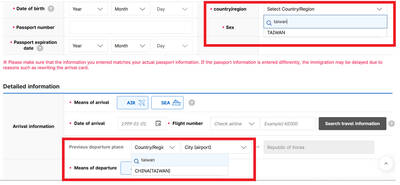
Jason Han says that the e-arrival card spat between South Korea and Taiwan shows that Seoul is signaling adherence to its “one-China” policy, while Taiwan’s response reflects a reciprocal approach. “Attempts to alter the diplomatic status quo often lead to tit-for-tat responses,” the analyst on international affairs tells the Taipei Times, adding that Taiwan may become more cautious in its dealings with South Korea going forward. Taipei has called on Seoul to correct its electronic entry system, which currently lists Taiwan as “China (Taiwan),” warning that reciprocal measures may follow if the wording is not changed before March 31. As of yesterday,

The Portuguese never established a presence on Taiwan, but they must have traded with the indigenous people because later traders reported that the locals referred to parts of deer using Portuguese words. What goods might the Portuguese have offered their indigenous trade partners? Among them must have been slaves, for the Portuguese dealt slaves across Asia. Though we often speak of “Portuguese” ships, imagining them as picturesque vessels manned by pointy-bearded Iberians, in Asia Portuguese shipping between local destinations was crewed by Asian seamen, with a handful of white or Eurasian officers. “Even the great carracks of 1,000-2,000 tons which plied

On Thursday, former Taipei mayor and founder of the Taiwan People’s Party (TPP) Ko Wen-je (柯文哲) was sentenced to 17 years in prison and had his civil rights suspended for six years over corruption, embezzlement and other charges. Seven others related to the case were also handed prison sentences, while two were found not guilty. It has been a bad week for the TPP. On Tuesday, prosecutors charged Chinese immigrant Xu Chunying (徐春鶯) with suspicion of taking part in Beijing-directed election interference. Xu has strong links to the TPP, which once offered her a party list legislator nomination. Tuesday also


 RSS
RSS