


Growing up in the digital age and digesting most of my news and entertainment online, radio seems like a relic of the past. I owned a bright red radio in elementary school that mostly spewed out static and my family sometimes turned on the car radio to listen to Backstreet Boys and Celine Dion when we went on trips in the ‘90s. That was pretty much all I knew about it.
Earlier this month, I received a Twitter message from Keith Menconi, a producer at the International Community Radio Taipei (ICRT) asking if I was interested in being interviewed by him and Terry Engel on the Morning Show about my experience covering Taiwan’s craft beer scene as a reporter. The idea was for us to hit up a couple of bars and talk to the brewers. The clips would be interspersed throughout our live segment. Of course, we would have to sample some of the beers while chatting with the brewers.
Drinking on the job? Obviously, I said yes.
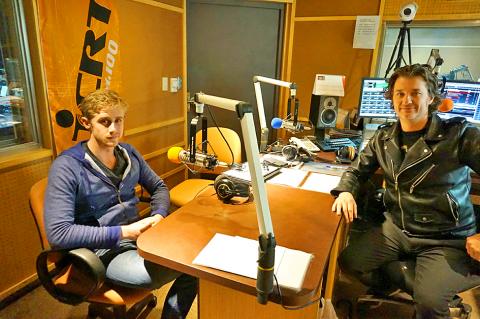
Photo: Dana Ter, Taipei Times
Graduating from the University of California, Berkeley in 2011, Menconi previously worked at San Francisco’s KQED News before moving to Taiwan. Part of his job at ICRT is to find interesting angles to frame his shows.
The goal of the Morning Show, he tells me, “is always to give our guests a chance to goof off on air.”
Sometimes, they’ll also incorporate games and skits, though Menconi says that most of the time, it’s just him and Engel making fun of each other.
“When you want to make things fun, your greatest friend in radio is banter,” he says. “If you get a good back-and-forth going between interesting people, you can make almost any topic interesting.”
INSPIRATION FROM PODCASTS
In order to help me prepare for my radio debut, Menconi asks if I ever listen to podcasts. Radio and podcasts are essentially the same, he says, whether it’s audio being broadcasted over airwaves or downloaded through the Internet.
While the popularity of radio may have plummeted, the number of people listening to podcasts has steadily increased. A study published by Pew Research Center last year (www.journalism.org/2015/04/29/podcasting-fact-sheet) showed that one-third of Americans aged 12 and over had listened to a podcast, as opposed to one-tenth in 2006.
While Menconi admits that he rarely listens to the radio, he says he’s “a big podcast guy” and draws inspiration for his radio shows from what podcast producers are doing. A lot of popular radio shows in the US such as This American Life and Planet Money are also available online as podcasts, and Menconi believes that ICRT should be following suit in order to remain relevant.
Engel, a Canadian native and 16-year Taiwan resident, agrees. He believes that Taiwan has yet to catch up with the US when it comes to exploring new mediums and being on multiple platforms. While radio stations including ICRT are maintaining an online presence through their Web sites and social media, it’s simply not enough.
“In Taiwan, the industry at large has to change to capture the younger demographic through doing podcasts and videos,” Engel says.
Currently, Engel stars in Wow Taiwan, a video series where he travels to a different part of Taiwan every month and talks about the things you can do there.
While ICRT does not technically do podcasts, their interviews are posted online and Menconi makes sure to put out content that is tailored to online listeners.
“When I produce content, I always have half my mind on ‘how could we make this segment work online,’” Menconi says.
His approach so far has been trying to tap into a niche audience of listeners looking for English-language audio entertainment about Taiwan. There are people out there who want to learn more about Taiwan, but might not be able to access ICRT because they are overseas, or simply because they don’t want to tune in to the radio — “maybe they don’t like our music,” Menconi jokes.
GOING NICHE, THINKING GLOBAL
Being the only English-language radio station in Taiwan, ICRT is in a unique position. They can play songs from multiple genres and the types of personalities they’ve interviewed in the past are extremely varied, ranging from pop stars like Kelly Clarkson to athletes like Andre Agassi.
Though Engel emphasizes that they also try to stay in touch with the English-speaking community in Taipei by inviting politicians, authors, bloggers and other pundits who have contributed to the community in some way.
“In order to remain relevant to your listeners, you have to talk about the community from where they come from,” Engel says.
Menconi finds topics and people from a lot of the English-language dailies such as the Taipei Times and Centered on Taipei magazine, as well as on Facebook.
“Facebook is pretty big,” he says.
Among the people who Menconi has interviewed include the woman behind the popular food blog, “A Hungry Girl’s Guide to Taipei,” human rights activist Linda Gail Arrigo, lawyer and environmentalist Robin Winkler, as well as a couple of authors who published with Camphor Press, a publishing house focused on books written about Taiwan and East Asia.
For Engel, the advantage that a radio station has is the personal connection with its listeners. He thinks that it’s something they should be working on more. For instance, they’ve started hosting events such as “bike days” where they’ll bring a group of people on biking trips.
“Online is still impersonal — at some point, people will have to get away from their laptops and smartphones,” Engel says.
Of course, there’s no escaping the fact that there needs to be an online presence as well, though it’s not to say that the content can’t be personal. Ultimately, it’s this type of content — Taiwan-centered topics told from a personal angle — that will interest more listeners from overseas. In fact, Menconi believes that this is their selling point.
Looking at it from a perspective of producing podcasts, the more niche the better, especially when thinking globally. It’s precisely why Menconi says their content needs to be “laser-focused on Taiwan.”
In other words, there’s a lot of English-language podcasts out there, but not a ton of information about Taiwan.
“If we don’t make sure to focus on the Taiwan angle, there’s not much of a reason to listen to us rather than someone else,” Menconi adds.


The problem with Marx’s famous remark that history repeats itself, first as tragedy, the second time as farce, is that the first time is usually farce as well. This week Chinese Nationalist Party (KMT) Chair Cheng Li-wun (鄭麗文) made a pilgrimage to the People’s Republic of China (PRC) “to confer, converse and otherwise hob-nob” with Chinese Communist Party (CCP) officials. The visit was an instant international media hit, with major media reporting almost entirely shorn of context. “Taiwan’s main opposition leader landed in China Tuesday for a rare visit aimed at cross-strait ‘peace’”, crowed Agence-France Presse (AFP) from Shanghai. Rare!

What is the importance within the Chinese Nationalist Party (KMT) of the meeting between Xi Jinping (習近平), the leader Chinese Communist Party (CCP), and Cheng Li-wun (鄭麗文), the leader of the KMT? Local media is an excellent guide to determine how important — or unimportant — a news event is to the public. Taiwan has a vast online media ecosystem, and if a news item is gaining traction among readers, editors shift resources in near real time to boost coverage to meet the demand and drive up traffic. Cheng’s China trip is among the top headlines, but by no means

A recent report from the Environmental Management Administration of the Ministry of Environment highlights a perennial problem: illegal dumping of construction waste. In Taoyuan’s Yangmei District (楊梅) and Hsinchu’s Longtan District (龍潭) criminals leased 10,000 square meters of farmland, saying they were going to engage in horticulture. They then accepted between 40,000 and 50,000 cubic meters of construction waste from sites in northern Taiwan, charging less than the going rate for disposal, and dumped the waste concrete, tile, metal and glass onto the leased land. Taoyuan District prosecutors charged 33 individuals from seven companies with numerous violations of the law. This

Sunflower movement superstar Lin Fei-fan (林飛帆) once quipped that the Democratic Progressive Party (DPP) could nominate a watermelon to run for Tainan mayor and win. Conversely, the DPP could run a living saint for mayor in Taipei and still lose. In 2022, the DPP ran with the closest thing to a living saint they could find: former Minister of Health and Welfare Chen Shih-chung (陳時中). During the pandemic, his polling was astronomically high, with the approval of his performance reaching as high as 91 percent in one TVBS poll. He was such a phenomenon that people printed out pop-up cartoon


 RSS
RSS