


I’m not sure what I was expecting when I walked into a restaurant featuring a “Heart Attack Burger” — but my stomach still let out a small cry of pain when a stream of meat grease literally poured out of the sandwich upon first bite.
Burger Ray (個性漢堡) has generated much hype since it opened in the heart of Taipei’s east district in July. As expected, there was a crowd of people waiting for seats in front of the restaurant, though there is a standing table for the less patient. It’s a bit claustrophobic in the front with a cluster of tables, but opens to a more comfortable seating area in the back.
This place is a no-frills burger joint. You order at the counter next to the door off a basic menu that only contains burgers, shakes and drinks. No appetizers, no desserts. There’s a 50-minute eating limit, but with the basic menu and reasonably fast service, I doubt you will need longer than that. And come on, it’s Taiwan. They won’t kick you out.
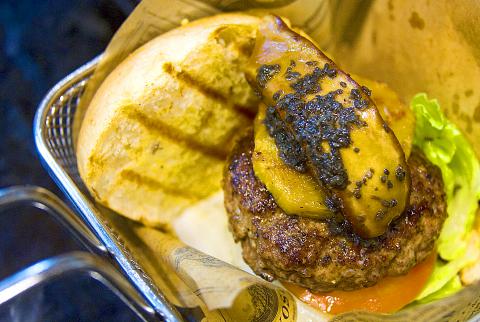
Photo: Han Cheung, Taipei Times
The special burgers are already garnished, but those ordering the basic build-it-yourself creation can enjoy an all-you-can-eat toppings bar with the usual lettuce, tomatoes, onions, pickles, salsa and jalapenos. There’s also unlimited beef chili and cheese you can add to your fries — probably the best feature of this place.
Customers can add NT$50 for fries and a drink. If you feel guilty about eating so much greasy and fried stuff, luckily, you can “make up” for it by going for sugar-free green tea instead of Mountain Dew.
So let’s get to the burgers, made with USDA Choice beef patties. Of course I had to order the Heart Attack (NT$400), which is curiously only named so in Chinese (心臟病堡). The English name literally describes the toppings: a generous slice of foie gras, truffles and your choice of caramelized onions or candied pineapple. I chose the latter, which was probably a mistake.
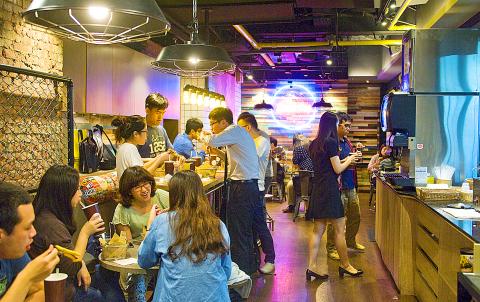
Photo: Han Cheung, Taipei Times
I had a choice between brioche, ciabatta and multi-grain buns. To save whatever of my health would be left after the meal, I went with the multi-grain, which was excellently prepared — toasted and buttery with the smell of whole wheat.
My friend took the safe route and went with the basic signature burger (NT$145), which is really cheap compared to other Taipei joints. For extra cash you can add toppings such as bacon, mushrooms, fried egg, sauerkraut and, well, foie gras.
My burger was a disaster. The components on their own probably would have been decent, as the beef was tender and moist, although it could have been leaner. There were simply too many things at work in one bite, and the bun immediately became soggy from all the juicy forces at work, which doesn’t go well texture-wise with the fatty foie gras. The pineapple had the right amount of firmness, but its sweet tang completely overpowered the truffle. As a result, all the textures and flavors were muffled or mushed into each other, and simply creating my own Hawaiian burger would have been a better choice.
My friend’s burger was much better — a bacon, Swiss and mushroom concoction that was much less messy. Although there was still a bit too much grease from the meat, it wasn’t as bad as mine.
The fries (NT$60 a la carte) were the meal’s saving grace, probably some of the best I’ve tried in Taipei. Perfectly crisp on the outside and full of satisfying moist potato goodness, I finished the whole basket, something I usually don’t do.
The fries are not spiced, which is a perfect invitation to pour the all-beef chili sauce and cheddar cheese directly on top. The chili is subtle with hints of tomato and peppers, and at no point takes over, meshing well with the cheese. The textures also go well together — the fries retain their crispness, the beef tender and chewy and the cheese adds just the perfect amount of viscosity.
It’s my fault for ordering something called a Heart Attack Burger, but I felt a bit nauseous after the meal and had to go for some tea.
If I come back again, though, I’m interested in checking out the non-beef options: the Southeast Asian pork burger (NT$145) or the seafood burger (NT$185). I’m not sure why a vegetarian would even consider wandering into this place, but if you do, there’s a quinoa mushroom veggie burger (NT$145).

Paul Thomas Anderson’s “One Battle After Another” was crowned best picture at the 98th Academy Awards, handing Hollywood’s top honor to a comic, multi-generational American saga of political resistance. The ceremony Sunday, which also saw Michael B. Jordan win best actor and “Sinners” cinematographer Autumn Durald Arkapaw make Oscar history as the first female director of photography to win the award, was a long-in-coming coronation for Anderson, a San Fernando Valley native who made his first short at age 18 and has been one of America’s most lionized filmmakers for decades. Before Sunday, Anderson had never won an Oscar. But “One Battle
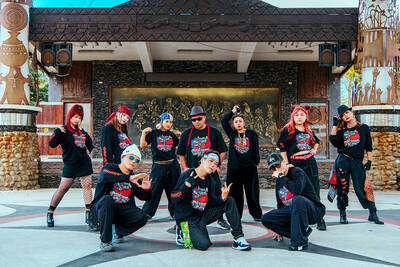
In Kaohsiung’s Indigenous People’s Park (原住民主題公園), the dance group Push Hands is training. All its members are from Taiwan’s indigenous community, but their vibe is closer to that of a modern, urban hip-hop posse. MIXING CULTURES “The name Push Hands comes from the idea of pushing away tradition to expand our culture,” says Ljakuon (洪濬嚴), the 44-year-old founder and main teacher of the dance group. This is what makes Push Hands unique: while retaining their Aboriginal roots, and even reconnecting with them, they are adamant about doing something modern. Ljakuon started the group 20 years ago, initially with the sole intention of doing hip-hop dancing.
What was the population of Taiwan when the first Negritos arrived? In 500BC? The 1st century? The 18th? These questions are important, because they can contextualize the number of babies born last month, 6,523, to all the people on Taiwan, indigenous and colonial alike. That figure represents a year on year drop of 3,884 babies, prefiguring total births under 90,000 for the year. It also represents the 26th straight month of deaths exceeding births. Why isn’t this a bigger crisis? Because we don’t experience it. Instead, what we experience is a growing and more diverse population. POPULATION What is Taiwan’s actual population?

You would never believe Yancheng District (鹽埕) used to be a salt field. Today, it is a bustling, artsy, Kowloon-ish “old town” of Kaohsiung — full of neon lights, small shops, scooters and street food. Two hundred years ago, before Japanese occupiers developed a shipping powerhouse around it, Yancheng was a flat triangle where seawater was captured and dried to collect salt. This is what local art galleries are revealing during the first edition of the Yancheng Arts Festival. Shen Yu-rung (沈裕融), the main curator, says: “We chose the connection with salt as a theme. The ocean is still very near, just a


 RSS
RSS