


Ten years after returning to Taiwan from Canada, Jiho Chang (張之豪) has already earned impressive activist credentials. He helped initiate the Wild Strawberry movement in 2008, helped organize a national campaign against media monopolization in 2012 and was deeply involved in the 24-day occupation of the Legislative Yuan, which came to be known as the Sunflower movement.
His resume could help him land positions within opposition parties like the Democratic Progressive Party (DPP) or the Taiwan Solidarity Union. But this intellectual and dedicated Taiwan independence advocate has his mind set on something else.
Believing that the pro-Beijing, pro-business Chinese Nationalist Party (KMT) is fatal to the nation, Chang wants to weaken the KMT’s grip on power, starting at the grassroots level.
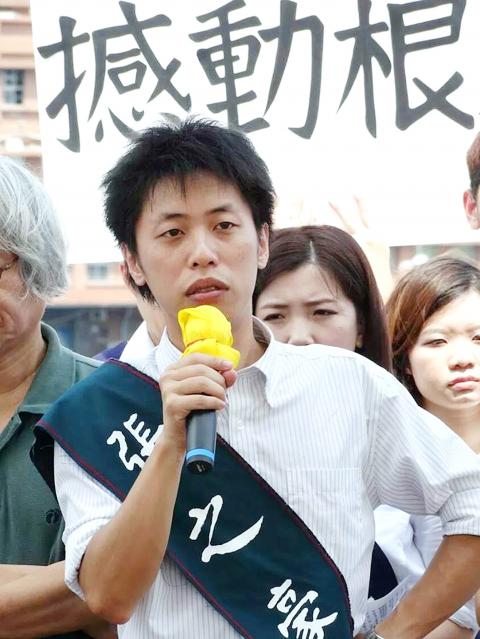
Photo: Lin Hsin-han, Taipei Times
As an independent candidate, he is joining the Nov. 29 nine-in-one elections and running for borough warden in Keelung City’s Yingan borough (鶯安里), his home for the last seven years.
His goal: “to take down one KMT member at a time.”
ENCOUNTERING SU BENG
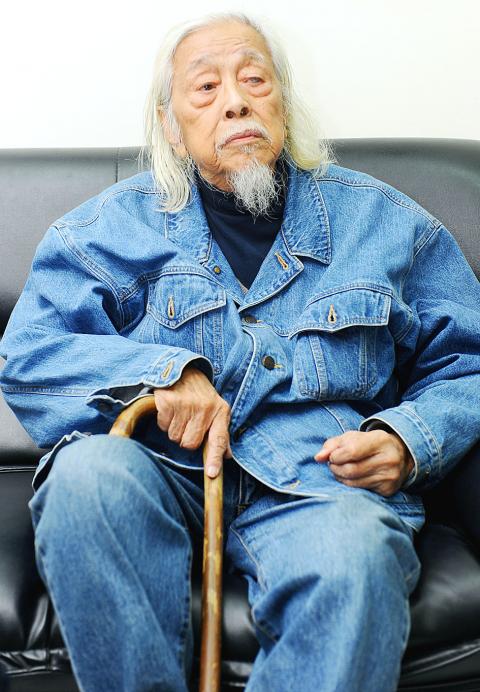
Photo: Chang Chia-ming, Taipei Times
Chang moved to Canada with his family at the age of 13 and experienced a political awakening as a young adult.
In college, he met an anarchist teacher who took him and other students to Seattle in 1999 to take part in the massive anti-World Trade Organization protests.
Later, Chang studied Taiwan’s 400 Year History (台灣人四百年史) by Su Beng (史明), a lifelong campaigner for Taiwan independence known for his devotion to socialism and vigorous effort to overthrow the KMT regime. Su had completed the tome in the early 1960s, after going into exile in Japan when his plot against the Chiang Kai-shek (蔣介石) regime was compromised in 1952.
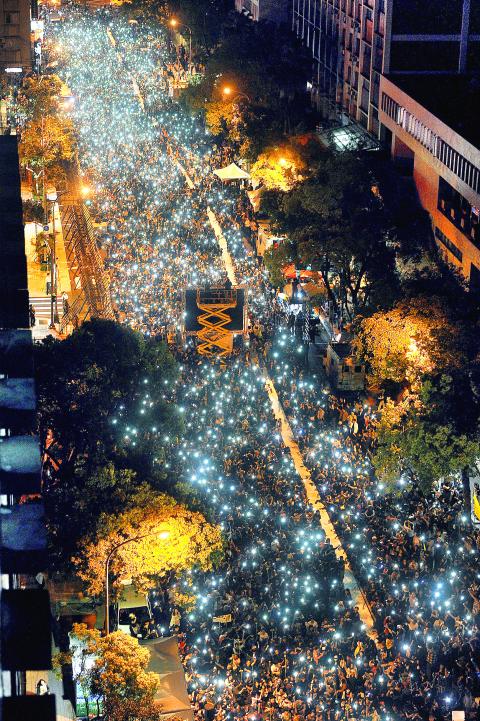
Photo: Fang Bin-chao, Taipei Times
In 2004, Chang returned to Taiwan to study political science at National Taiwan University (NTU).
Several months later, he encountered his idol, Su, who by then had returned to Taiwan. Su, then 87 years old, was holding a nine-day sit-in in front of NTU to protest the Chinese Communist Party’s (CCP) new “Anti-Secession” Law, which states that the People’s Liberation Army can use “non-peaceful means” against Taiwan.
Chang and several other NTU students joined the sit-in and were deeply affected by Su’s unflinching activism. Inspired, the young activists then revived the previously defunct NTU Dalawasao club (台大濁水溪社), the only political student club on campus that focused on topics like Taiwan’s national identity and the colonial KMT regime.
The rest of the student clubs and groups were social issue-oriented, Chang says.
“It was five years into Chen Shui-bian’s (陳水扁) tenure. The DPP government had experienced serious setbacks as its Taiwanese localization policies sparked strong opposition from the KMT and pro-unification forces. But no one talked about it on campus,” he adds.
Chang says that Taiwan’s ambiguous political status is the chief source of conflict within society. Any social or political movement that doesn’t address the relationship between Taiwan and China is avoiding the most fundamental problem facing the country.
MEETING THE NIHILISTS
Chang says that sociopolitical activism is becoming something of a fashion among college students and other youngsters, who have turned protesting against the government into a popular and trendy thing to do.
He has little positive to say about the new breed of hipster activists, who he believes are attracted to a lifestyle rather than to a clear cause.
“We are up against a well-trained, highly disciplined and very rich plutocratic coalition. They have sticks, guns and bullets,” he says.
“You sit there with your friends, playing drums and smoking weed, saying you are against this and that. It is nihilism. I hold nothing against nihilism, but don’t tell me you have ideals to accomplish.”
Chang says it takes unyielding determination and hard work to bring the increasingly China-tilted political establishment back on the right track.
To Chang and to like-minded activists, what they fight against is as concrete and tangible as the CCP, which regards Taiwan, a democratic country, as a renegade province awaiting unification.
CHANG AND CHINA
Over the years, Chang’s activism has made him increasingly aware of Chinese sway in Taiwan.
In 2008, Ma Ying-jeou (馬英九) of the KMT was elected president of Taiwan. That November, the then-chairman of China’s Association for Relations Across the Taiwan Strait, Chen Yunlin (陳雲林), visited the country, sparking a wave of strong protests against the meeting between the Ma administration and the Chinese envoy.
Many felt the meeting was pushing Taiwan significantly closer to China, Chang says.
Sadly, the government adopted overly drastic measures to muffle protesters. Demonstrators were manhandled by the police without cause. National flags were confiscated. The display of political banners and other lawful acts were banned. At one point, a store was forced to turn off the patriotic Taiwanese music it played and to pull down its metal shutters.
Gravely concerned about what they saw as an authoritarian revival, Chang, together with NTU sociology professor Lee Ming-tsung (李明璁), helped to initiate a sit-in in front of the Executive Yuan and later at National Taiwan Democracy Memorial Hall, which later became known as the Wild Strawberry movement.
“We didn’t have time to talk about Taiwan’s national identity [during Wild Strawberry]. What we fought for was the freedom to talk about anything,” Chang reflects.
The CCP’s infiltration in Taiwan’s democracy became an issue again four years later, when a student-led campaign was ignited by the Want Want China Times Group’s (旺旺中時集團) acquisition of cable TV services owned by China Network Systems (中嘉網路).
Students also protested the planned takeover of Next Media Group’s four Taiwanese outlets by a consortium including Want Want chairman Tsai Eng-meng (蔡衍明) and Formosa Plastics Group (台塑集團) chairman William Wong (王文淵). In light of Tsai’s and Wong’s substantial investments and business ties across the Taiwan Strait, the protestors raised concerns about China’s influence over Taiwan’s media.
THE LIMITATION OF MOVEMENTS
The Sunflower movement began on March 18, with hundreds of students and activists storming the legislature. Grand in scale, the movement has severely discredited Ma and his KMT, which have trampled core democratic values of Taiwan by unilaterally approving a highly controversial and potentially far-reaching cross-strait service trade agreement with China, Chang says.
But while succeeding in stalling the implementation of the trade agreement, the movement, in the eyes of Chang, failed to achieve any of its goals: The pact was not withdrawn, and the legislature has not established legal oversight for all future cross-strait agreement negotiations.
“Even with a large-scale movement that involved a great number of people and generated a huge amount of media coverage, nothing was accomplished… It led to a strong sense of helplessness,” the activist points out.
Many asked what more could be done to shake up the system.
“The answer is simple,” Chang says. “We should get closer to the center of political power.”
BEGINNING AT THE BOROUGH
Prompted by a sense of urgency to make changes here and now, Chang dropped out of his PhD program at National Chengchi University to enter politics. Instead of starting at the center, however, he is on the periphery of power.
Unlike many Sunflower movement participants who have chosen to run for city councilor in the upcoming local elections, he is running for the position of borough warden, whose job description entails everyday community services.
Chang points out that the number of supporters for city councilors from the pan-blue and pan-green camps in each constituency is largely fixed.
When joining the election, Sunflower activists-turned-political hopefuls are more likely to split votes with the DPP, rather than affecting the KMT.
The borough warden position, however, is an all-or-nothing situation, since only one person can get elected.Chang describes the warden’s election as close combat.
“If I win, it means that one KMT fails. It is a gentlemen’s duel. It won’t stop until one man comes down,” the candidate says.
Chang’s competitor is the incumbent warden Hsieh Wei-jen (謝偉仁) of the KMT, who is seeking his fourth term in the upcoming election. In Keelung, voter affiliation is strongly tilted toward the KMT. Across the country, the majority of borough wardens are KMT members or KMT-affiliated.
What is important now is to take back the power and show people that it is possible, Chang says.
He has been advised that, in order to gain support, he needs to pay visits to certain individuals in local factions and to join certain groups. But he has pushed aside the advice and adopted a totally different strategy: door-knocking.
Every evening, when local residents return home from work, Chang visits them one household at a time, introducing himself and chatting with them. His political platform consists of ideas gleaned from local residents and his own observations, which include building better-designed bus shelters for local commuters riding to Taipei on bus every day.
Looking back, the candidate says his anarchist roots have made him a person highly critical of the concentration of power. But how does he intend to become a politician if he is skeptical of power?
The anti-authoritarian paused before replying: “That is a problem I have to face for the rest of my life.”

Just after 6am, I walked up to the ticket gate at Taipei Main Station and entered the Taiwan Railway platform without scanning any ticket; instead, I flashed the Sanrio Fun Rail pass on my phone to the gate worker and was admitted. I found my train and prepared to board. My destination? This very same station. I was embarking on a 13-hour journey on one of two round-the-island trains operated by ezTravel. They run each day, one counterclockwise around the island and one clockwise. They differ in a number of ways from an ordinary Taiwan Railway train and can make for
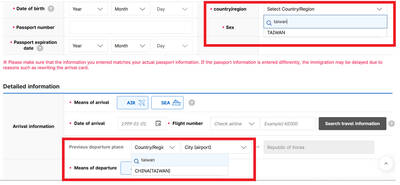
Jason Han says that the e-arrival card spat between South Korea and Taiwan shows that Seoul is signaling adherence to its “one-China” policy, while Taiwan’s response reflects a reciprocal approach. “Attempts to alter the diplomatic status quo often lead to tit-for-tat responses,” the analyst on international affairs tells the Taipei Times, adding that Taiwan may become more cautious in its dealings with South Korea going forward. Taipei has called on Seoul to correct its electronic entry system, which currently lists Taiwan as “China (Taiwan),” warning that reciprocal measures may follow if the wording is not changed before March 31. As of yesterday,
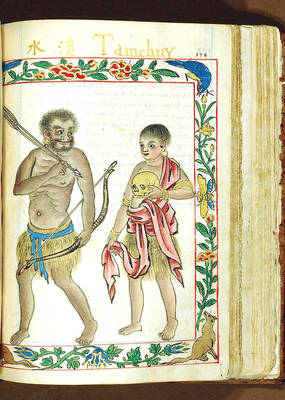
The Portuguese never established a presence on Taiwan, but they must have traded with the indigenous people because later traders reported that the locals referred to parts of deer using Portuguese words. What goods might the Portuguese have offered their indigenous trade partners? Among them must have been slaves, for the Portuguese dealt slaves across Asia. Though we often speak of “Portuguese” ships, imagining them as picturesque vessels manned by pointy-bearded Iberians, in Asia Portuguese shipping between local destinations was crewed by Asian seamen, with a handful of white or Eurasian officers. “Even the great carracks of 1,000-2,000 tons which plied
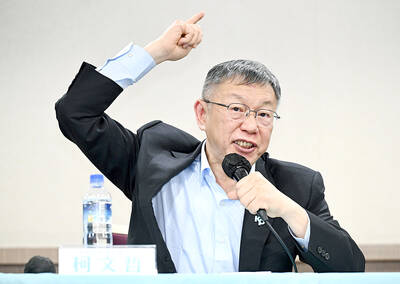
On Thursday, former Taipei mayor and founder of the Taiwan People’s Party (TPP) Ko Wen-je (柯文哲) was sentenced to 17 years in prison and had his civil rights suspended for six years over corruption, embezzlement and other charges. Seven others related to the case were also handed prison sentences, while two were found not guilty. It has been a bad week for the TPP. On Tuesday, prosecutors charged Chinese immigrant Xu Chunying (徐春鶯) with suspicion of taking part in Beijing-directed election interference. Xu has strong links to the TPP, which once offered her a party list legislator nomination. Tuesday also


 RSS
RSS