


When his family business was closing after nearly four centuries of making sake and other spirits, Ichiro Akuto swooped to rescue the doomed distillery’s whiskey stock and went out on his own.
A little over a decade later, the 10-person operation is on a roll with its Ichiro’s Malt scooping up praise from a rapidly growing fan base in Japan and overseas.
“Some of that whiskey had been maturing for 20 years ... and it felt like leaving my children behind,” said the 49-year-old Akuto.
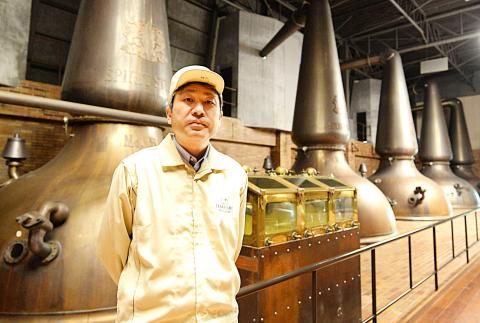
Photo: AFP/kazuhiro
“So I decided to take all that whiskey with me and start a new business.”
Soaring demand for whiskeys made in a country long associated with sake has catapulted Japan into the ranks of the world’s whiskey heavyweights — Scotland, Ireland, the US and Canada — despite having fewer than 10 distilleries, about a tenth of the number in Scotland.
Commercial production has been around in Japan since the 1920’s after a student who learned the art of whiskey making in Scotland helped start the Yamazaki distillery near Kyoto.
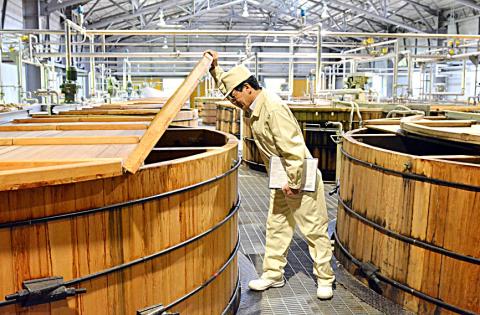
Photo: AFP/kazuhiro
But made-in-Japan whiskey was practically unknown overseas even a decade ago until it started picking up a slew of top awards at international spirits competitions, followed by a boom in exports.
When the hammer fell at a rare whiskey auction in Hong Kong last month, the Japanese brands sold out, including a bottle of 50-year-old Yamazaki which went for about US$33,000, well above pre-sale estimates.
“Demand for rare single malt whiskeys and in particular Japanese ones remains at an all-time high,” auctioneer Bonhams said after the sale.
‘Fresh Taste’
About one-third of Ichiro’s Malt is now sold overseas.
But it was a rough beginning as the distillery northwest of Tokyo was faced with declining whiskey consumption at home while making a niche product that was aimed at the palates of bartenders and whiskey lovers, rather than the mass market.
“Our success might have had something to do with that,” Akuto said.
“But at first it didn’t sell at all. The brand wasn’t famous. It took two years to sell the first 600 bottles. Now I sell 600 bottles in a day.”
Yamazaki maker Suntory, a beverage giant which earlier this year bought the US maker of Jim Beam bourbon for nearly US$16 billion, operates the sprawling Hakushu distillery nestled in a mountain-ringed forest with Mount Fuji in the distance.
Suntory — introduced to a global audience by Bill Murray’s character in Lost In Translation — picked up “Distiller of the Year” at the 2014 International Spirits Challenge for the fourth time.
The distinctive green bottle of its award-winning Hakushu gives a nod to the natural surroundings of the distillery.
“To understand Hakushu’s specificities, you need to know why we chose this place for the distillery,” said general manager Takeshi Ono.
“Suntory wanted a place surrounded by rich nature, with plenty of water and green forests. We think this all gives Hakushu its fresh taste.”
The popular brand is among the 300-odd bottles on offer at Zoetrope, a whiskey bar in Tokyo’s bustling Shinjuku entertainment district.
Owner Atsushi Horigami is happy to help out customers keen on sampling his mostly-Japanese collection. But don’t ask him if he has a favored tipple.
“I can’t say what my favorite one is. What I love about Japanese whiskey is that there is so many variations,” Horigami said.
“Generally, they’re smooth and soft, with a sweet touch. But more importantly, they’re really varied. Every distillery produces many types of their own whiskey.”
‘We’re just Maniacs’
Lebanese tourist Abdallah Atie sought out Zoetrope so he could try Ichiro’s Malt and see what all the fuss was about. “Four or five years ago, we could not find any Japanese whiskey in Lebanon,” he said.
“But now, every good bar has two or three kinds. Before that it was only Scotch and American bourbon.”
Zoetrope’s owner reckons that his compatriots’ obsessive attention to detail was the main reason for Japan’s whiskey success.
“There is a culture in Japan of not giving up. When we start something, we don’t stop,” he said.
“People would think you don’t need to put that much effort in it, but well, since we’ve started we might as well do it right — I guess we’re just maniacs.”
Warning:
Excessive consumption of alcohol can damage your health

Michael slides a sequin glove over the pop star’s tarnished legacy, shrouding Michael Jackson’s complications with a conventional biopic that, if you cover your ears, sounds great. Antoine Fuqua’s movie is sanctioned by Jackson’s estate and its producers include the estate’s executors. So it is, by its nature, a narrow, authorized perspective on Jackson. The film ends before the flood of allegations of sexual abuse of children, or Jackson’s own acknowledgment of sleeping alongside kids. Jackson and his estate have long maintained his innocence. In his only criminal trial, in 2005, Jackson was acquitted. Michael doesn’t even subtly nod to these facts.
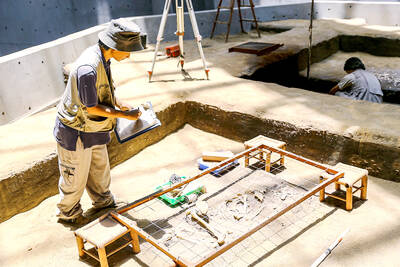
Writing of the finds at the ancient iron-working site of Shihsanhang (十 三行) in New Taipei City’s Bali District (八里), archaeologist Tsang Cheng-hwa (臧振華) of the Academia Sinica’s Institute of History and Philology observes: “One bronze bowl gilded with gold, together with copper coins and fragments of Tang and Song ceramics, were also found. These provide evidence for early contact between Taiwan aborigines and Chinese.” The Shihsanhang Web site from the Ministry of Culture says of the finds: “They were evidence that the residents of the area had a close trading relation with Chinese civilians, as the coins can be
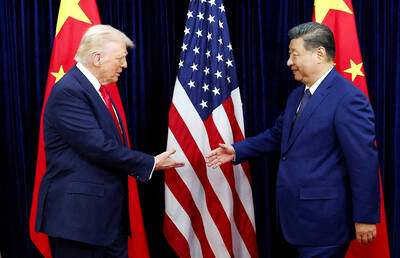
The March/April volume of Foreign Affairs, long a purveyor of pro-China pablum, offered up another irksome Beijing-speak on the issues and solutions for the problems vexing the People’s Republic of China (PRC) and the US: “America and China at the Edge of Ruin: A Last Chance to Step Back From the Brink” rang the provocative title, by David M. Lampton and Wang Jisi (王緝思). If one ever wants to describe what went wrong with US-PRC relations, the career of Wang Jisi is a good place to start. Wang has extensive experience in the US and the West. He was a visiting
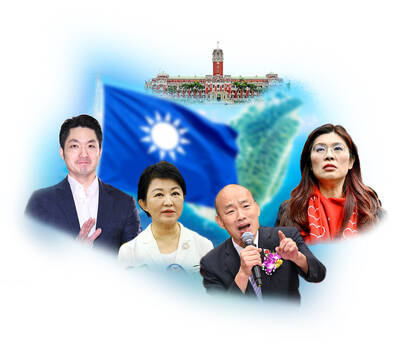
The January 2028 presidential election is already stirring to life. In seven or eight months, the primary season will kick into high gear following this November’s local elections. By this point next year, we will likely know the Democratic Progressive Party (DPP) candidate and whether the Taiwan People’s Party (TPP) will be fielding a candidate. Also around this time, the Chinese Nationalist Party (KMT) will either have already completed their primary, or it will be heading into the final stretch. By next summer, the presidential race will be in high gear. The big question is who will be the KMT’s


 RSS
RSS