


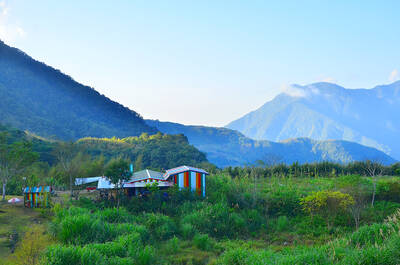
Despite her initial dream of becoming a model, Tapas or Chang Ling-hsin (張凌馨) is a 14-year-old girl who is not obsessed with taking duck-face selfies. Armed with her Nikon D60, she focuses her 18-55mm lens and snaps a few shots of schoolchildren playing basketball outside of her old school, Taoshan Elementary School (桃山國小). The court overlooks the fogged-covered mountains of her hometown, an Atayal village called Chingchuan (清泉) which is near Hsinchu.
Her camera was a gift from Australian photographer Jonathan Burke, a long-time Taipei resident who regularly volunteers at the school. He gave it to Tapas in January after noticing her experimentation with angles and perspectives on her cellphone camera. Since then, Tapas has been photographing scenes from Chingchuan to submit to the Makapah Arts Award for images depicting Aboriginal culture.
CHALLENGING STEREOTYPES
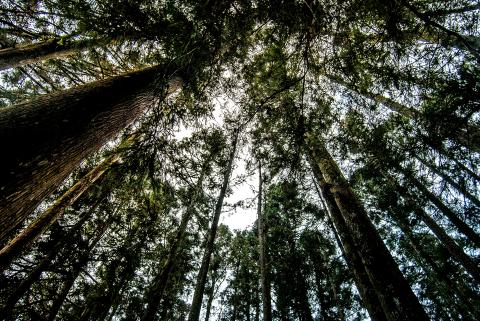
Photo courtesy of Tapas
Despite her youth, Tapas understands the stereotypes people have of Aboriginal people and hopes to challenge those negative perceptions through her photography.
“I don’t feel oppressed or marginalized at all, which is how people might expect us to feel,” she said.
Aboriginal culture is often filtered to cater to the needs of tourists, especially in the form of costumes, dance and music. Tapas’ pride in her Atayal culture is evident in her pictures but in a different and subtle way. Her portraitures capture everyday life in Chingchuan from special occasions like birthday gatherings to friends having a chat. The message she wishes to convey is that Atayal people do the same things other people do.

Photo courtesy Jonathan Burke
“Each shot that I take captures the emotion I am feeling at that moment, whether it is happy, sad or frustrated, so while the pictures tell my own story, anyone can relate to them because life is about experiencing all these various emotions,” Tapas said.
Although her message is universal, Tapas’ love for Chingchuan is obvious. Gazing into the same mountainous backdrop, she talks about a picture she took of the fog resting on the trees after an argument she had with a classmate.
She says that “taking the picture really helped me to let go of the negative energy, and the feeling that other people glean from viewing it is also very peaceful.”
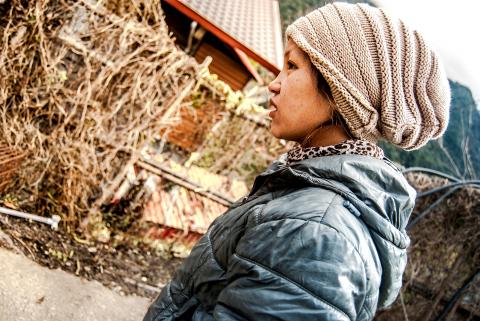
Photo courtesy of Tapas
FAMILY SUPPORT
Tapas’ family did not initially understand the meanings behind her photographs. She describes how they used to just look at them and say “great,” handing the camera back to her.
After seeing how dedicated Tapas has been towards pursuing this “hobby” though, her family, especially her mother, has been supportive of her decision to enter competitions and even pursue photography as a profession.
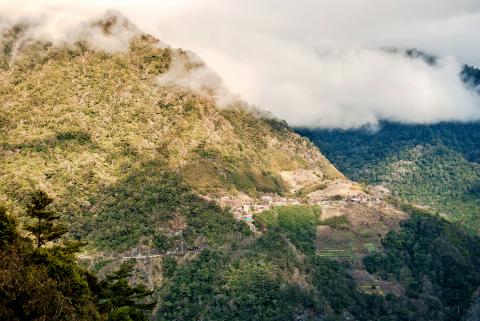
Photo courtesy of Tapas
This encouragement is important to Tapas since she is very close to her extended family. She calls her cousins “brothers and sisters,” and they are often the main subjects of her work.
Referring to a picture she took of her older sister playing the piano, Tapas says that if she had to write a caption for her photobook portfolio, it would read: “Everyone’s life is like a song and each song tells a different story.”
Tapas’ photography has caught the eye of Taipei-based foreign filmmakers who are working on a crowdfunding campaign on Fuudai.com to upgrade her lens to a Nikkor 18-200mm for a greater zoom function so that she can better tell her stories.
Tapas says she is still too young to decide her future. Although she adds that her mother believes photography is “at least a more practical option to pursue than modeling.”

Michael slides a sequin glove over the pop star’s tarnished legacy, shrouding Michael Jackson’s complications with a conventional biopic that, if you cover your ears, sounds great. Antoine Fuqua’s movie is sanctioned by Jackson’s estate and its producers include the estate’s executors. So it is, by its nature, a narrow, authorized perspective on Jackson. The film ends before the flood of allegations of sexual abuse of children, or Jackson’s own acknowledgment of sleeping alongside kids. Jackson and his estate have long maintained his innocence. In his only criminal trial, in 2005, Jackson was acquitted. Michael doesn’t even subtly nod to these facts.

The March/April volume of Foreign Affairs, long a purveyor of pro-China pablum, offered up another irksome Beijing-speak on the issues and solutions for the problems vexing the People’s Republic of China (PRC) and the US: “America and China at the Edge of Ruin: A Last Chance to Step Back From the Brink” rang the provocative title, by David M. Lampton and Wang Jisi (王緝思). If one ever wants to describe what went wrong with US-PRC relations, the career of Wang Jisi is a good place to start. Wang has extensive experience in the US and the West. He was a visiting
If one asks Taiwanese why house prices are so high or why the nation is so built up or why certain policies cannot be carried out, one common answer is that “Taiwan is too small.” This is actually true, though not in the way people think. The National Property Administration (NPA), responsible for tracking and managing the government’s real estate assets, maintains statistics on how much land the government owns. As of the end of last year, land for official use constituted 293,655 hectares, for public use 1,732,513 hectares, for non-public use 216,972 hectares and for state enterprises 34 hectares, yielding

The January 2028 presidential election is already stirring to life. In seven or eight months, the primary season will kick into high gear following this November’s local elections. By this point next year, we will likely know the Democratic Progressive Party (DPP) candidate and whether the Taiwan People’s Party (TPP) will be fielding a candidate. Also around this time, the Chinese Nationalist Party (KMT) will either have already completed their primary, or it will be heading into the final stretch. By next summer, the presidential race will be in high gear. The big question is who will be the KMT’s


 RSS
RSS