


Diplomacy
Taiwan cuts ties with Ivory Coast
March 3, 1983: Taiwan severs diplomatic ties with Ivory Coast. The 20-year relationship ended as the West African country switched recognition to China. The Honorary Consulate of the Republic of Cote D’Ivoire assumes non-diplomatic functions, such as promoting trade and investment.
Joint communique signed with Belize
March 2, 1994: Taiwan and Belize sign a joint communique, strengthening formal relations and economic cooperation. The Central American country has been a diplomatic ally since 1989. Over the years, Taiwan has sent agricultural and technical missions to Belize, as well as offered scholarships to Belizeans.
Taiwan included in UK’s visa-waiver program
March 3, 2009: The British Trade and Cultural Office in Taipei announces that Republic of China (ROC) passport holders will enjoy visa-free privileges for stays of less than six months. The UK is the 31st county to include Taiwanese in its visa-waiver program, followed by the EU in 2011 and the US in 2012.
Health
First AIDS patient dies; HIV research finds breakthrough
March 2, 1986: Taiwan’s first confirmed AIDS patient dies. Free medical treatment for HIV/AIDS patients begins in 1988. The government promulgated the AIDS Prevention and Control Act (後天免疫缺乏症候群防治條例) in 1990 as the legal basis for HIV/AIDS control policy. In 2007, an amendment made to the act stipulated that HIV-infected citizens cannot be denied access to education, medical services and housing.
March 3, 2008: Biochemists from Academia Sinica’s Genomics Research Center and California-based Scripps Research Institute announce their finding of a new compound, glycodendrons. The compound has been proven effective in stopping HIV-infection in animals at an early stage.
Obituary
Academia Sinica president passes away
March 4, 2000: Wu Ta-you (吳大猷), atomic and nuclear physicist and former president of Academia Sinica, dies in Taipei at the age of 95. Wu was credited for his contributions in physics and education, which earned him a sobriquet — Father of Chinese Physics (中國物理學之父). Wu authored more than 20 books, including a seven-part series on theoretical physics. He trained Lee Tsung-dao (李政道) and Yang Chen-ning (楊振寧), Chinese-born, US-educated physicists who together won the 1957 Nobel Prize in Physics. In 1963, Wu helped to re-establish the Institute of Physics at Academia Sinica, where he was president from 1983 to 1994. He continued lecturing into his 90s.
Disaster
Scores killed in disasters
March 2, 2003: A four-carriage train derails on a bridge in Alishan. The accident kills 17 passengers while injuring more than 150 people. Investigations later ruled that human error was the probable cause of the crash.
March 4, 2010: A 6.4 magnitude earthquake hits southern Taiwan in the early morning, damaging houses, cutting power supplies and disrupting the nation’s transportation systems. The quake is centered 17km southeast of Jiasian Township in Kaohsiung County (now Greater Kaohsiung) at a depth of 5km. It causes no deaths but injures nearly a 100 people. The earthquake was followed by several aftershocks; the largest had a magnitude of 6.7 on the Richter scale.
March 6, 2011: A nightclub in Greater Taichung catches fire, causing nine deaths and 12 injuries. A dancer accidentally set fire to the ceiling with a torch during a performance, triggering the blaze at about 1:30am. Audiences initially thought that the fire was part of the show.
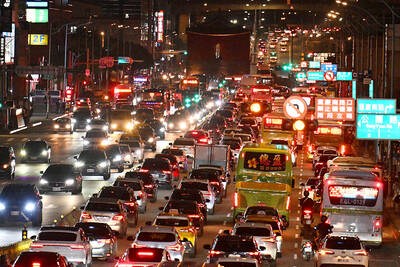
By global standards, the traffic congestion that afflicts Taiwan’s urban areas isn’t horrific. But nor is it something the country can be proud of. According to TomTom, a Dutch developer of location and navigation technologies, last year Taiwan was the sixth most congested country in Asia. Of the 492 towns and cities included in its rankings last year, Taipei was the 74th most congested. Taoyuan ranked 105th, while Hsinchu County (121st), Taichung (142nd), Tainan (173rd), New Taipei City (227th), Kaohsiung (241st) and Keelung (302nd) also featured on the list. Four Japanese cities have slower traffic than Taipei. (Seoul, which has some

In our discussions of tourism in Taiwan we often criticize the government’s addiction to promoting food and shopping, while ignoring Taiwan’s underdeveloped trekking and adventure travel opportunities. This discussion, however, is decidedly land-focused. When was the last time a port entered into it? Last week I encountered journalist and travel writer Cameron Dueck, who had sailed to Taiwan in 2023-24, and was full of tales. Like everyone who visits, he and his partner Fiona Ching loved our island nation and had nothing but wonderful experiences on land. But he had little positive to say about the way Taiwan has organized its
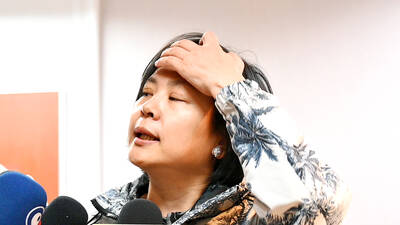
The entire Li Zhenxiu (李貞秀) saga has been an ugly, complicated mess. Born in China’s Hunan Province, she moved to work in Shenzhen, where she met her future Taiwanese husband. Most accounts have her arriving in Taiwan and marrying somewhere between 1993 and 1999. She built a successful career in Taiwan in the tech industry before founding her own company. She also served in high-ranking positions on various environmentally-focused tech associations. She says she was inspired by the founding of the Taiwan People’s Party (TPP) in 2019 by Ko Wen-je (柯文哲), and began volunteering for the party soon after. Ko
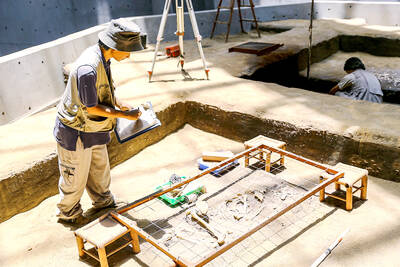
Writing of the finds at the ancient iron-working site of Shihsanhang (十 三行) in New Taipei City’s Bali District (八里), archaeologist Tsang Cheng-hwa (臧振華) of the Academia Sinica’s Institute of History and Philology observes: “One bronze bowl gilded with gold, together with copper coins and fragments of Tang and Song ceramics, were also found. These provide evidence for early contact between Taiwan aborigines and Chinese.” The Shihsanhang Web site from the Ministry of Culture says of the finds: “They were evidence that the residents of the area had a close trading relation with Chinese civilians, as the coins can be


 RSS
RSS