


When it’s time for a cold one, James Case, a bartender at Bierkraft in Park Slope, Brooklyn, is not without choices. Behind him at the bar are more than a dozen kegs filled with American craft beers that customers order in growlers to take home. In front of him are refrigerators packed with more than 800 bottles and cans from breweries the world over.
Still, for Case and kitchen manager Ryan Huntley, the beer they invariably reach for is the one in the funky blue can that, despite its straightforward name, just happened to be sold-out one late August afternoon — Taiwan Beer.
“We were just criticizing our beer manager for not buying it,” Case said jokingly. “Part of the culture of working here is that you drink the stuff. When my friends come in to town, I grab a six-pack of Taiwan Beer.”
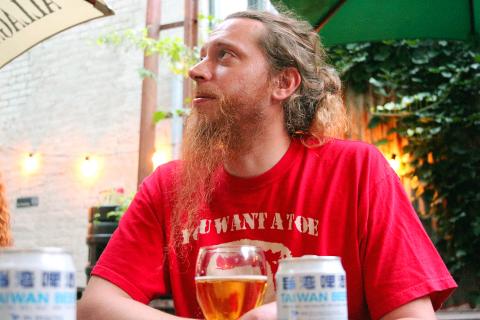
Photo: Chris Fuchs
While Asian imports like China’s Tsingtao and Thailand’s Singha have long been fixtures of New York’s drinking scene, Taiwan Beer in the last few years has muscled its way into the refrigerators of nearly two dozen restaurants, bars and craft-beer stores in Brooklyn, Manhattan and Queens, spawning a small cult following among young discerning beer enthusiasts who say they enjoy the brew’s high drinkability and the can’s trippy, undulating design — even though they admit to knowing little about Taiwan itself.
Chan Hui-ming (詹慧敏), Taiwan Beer’s sales representative for Paleewong Trading Company, the exclusive East Coast distributor, said they began selling the island’s national brew in New York in 2010, mostly to Taiwanese restaurants and Chinese supermarkets. Soon after, they introduced the blue-and-silver cans to craft-beer shops like Bierkraft and Brouwerji Lane in hip Brooklyn neighborhoods that were looking to diversify their Asian beer stock, she said.
“Young people here are really attracted to the can,” Chan, a native of Sanchong (三重), said. “It’s kind of a ’60s or ’70s style, so they simply love the package.”
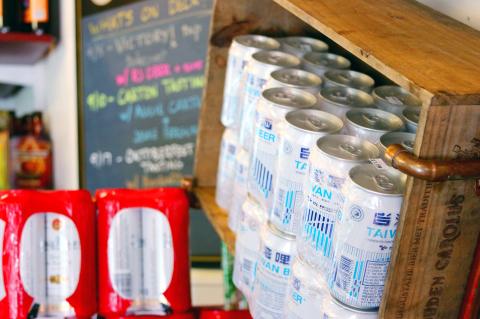
Photo: Chris Fuchs
Despite making inroads in bohemian Brooklyn, Taiwan Beer still accounts for only 5 percent of total annual sales of Asian beers on the East Coast, said Nu Kumprakool, manager of Paleewong’s craft-beer division. Chan said that because many Chinese restaurants often prefer to showcase only one Chinese beer, which since 1972 traditionally has been Tsingtao, it is difficult to convince owners to also carry Taiwan Beer.
“A lot are from the mainland, and they have this funny thing about things from Taiwan, if you know what I mean,” Chan said. “Sometimes it can be a little political, sometimes economical, but it’s not easy for them to bring in another beer.”
One Chinese restaurant that has broken the mold, Chan said, is Vanessa’s Dumpling House in Williamsburg, which offers Taiwan Beer in a can for US$3, as well as South Korea’s Hite and several American draughts. When asked for an interview, however, the manager declined to comment and headed downstairs, saying through a worker that the owners, his relatives, were away in China and would not be back for three weeks.
For many non-Taiwanese, though, a big part of Taiwan Beer’s charm and mystique is the name itself, Chan said. While many have heard of Taiwan, she said, few know anything about its history or culture, or even where it is on a map, a knowledge gap Chan tries to fill when she visits customers.
“In many people’s minds, Taiwan is a fascinating place,” Chan said. “But it’s kind of a mystery.”
Case, Bierkraft’s bartender, agreed.
“I’ve never really thought about it, the politics and all between China and Taiwan,” he said. “Now you’ve got me thinking.”
What resonates loudly for Bierkraft’s employees, though, is that Taiwan Beer, coming from a small island nation that has produced what some consider a “craft” product for more than 90 years, is a dependable lager that is refreshing and will not break the bank.
“I think it’s a fine beer for what it is,” said Joe Tracy, Bierkraft’s beer manager, adding that his store goes through five cases at least every two weeks. “On a hot summer day after getting done from work, sometimes a Taiwan Beer is exactly what I want to drink.”
Some beer drinkers interviewed suggested that Taiwan Beer might become the next Pabst Blue Ribbon — the darling American adjunct lager among hipsters — but Elizabeth Zalarick, beer supervisor at the Lower East Side Whole Foods, was not ready to make that call.
“I don’t know about that,” Zalarick said, laughing. “When we first started carrying Taiwan Beer, it was pretty popular. People would buy two or three six-packs at a time. Now, it’s slowed down.”
Even though Taiwan Beer will likely never chase China’s Tsingtao out of the American market, Chan said that after selling it in New York for the last three years, she has developed a newfound respect for her country’s national beverage.
“It suddenly has a new life because of its surroundings,” she said. “When Americans drink it, they know they are drinking something that tastes of Taiwan.”
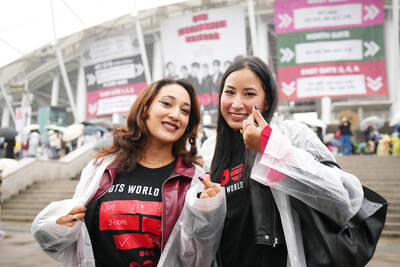
As mega K-pop group BTS returns to the stage after a hiatus of more than three years, one major market is conspicuously missing from its 12-month world tour: China. The omission of one of the group’s biggest fan bases comes as no surprise. In fact, just the opposite would have been huge news. China has blocked most South Korean entertainment since 2016 under an unofficial ban that also restricts movies and the country’s popular TV dramas. For some Chinese, that means flying to Seoul to see their favorite groups perform — as many were expected to do for three shows opening
A recent report from the Environmental Management Administration of the Ministry of Environment highlights a perennial problem: illegal dumping of construction waste. In Taoyuan’s Yangmei District (楊梅) and Hsinchu’s Longtan District (龍潭) criminals leased 10,000 square meters of farmland, saying they were going to engage in horticulture. They then accepted between 40,000 and 50,000 cubic meters of construction waste from sites in northern Taiwan, charging less than the going rate for disposal, and dumped the waste concrete, tile, metal and glass onto the leased land. Taoyuan District prosecutors charged 33 individuals from seven companies with numerous violations of the law. This
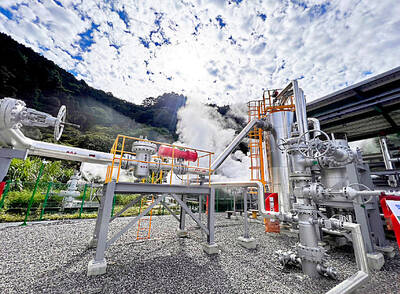
Taiwan’s semiconductor industry consumes electricity at rates that would strain most national grids. Taiwan Semiconductor Manufacturing Co (TSMC) alone accounted for more than 9 percent, or 2,590 megawatts (MW), of the nation’s power demand last year. The factories that produce chips for the world’s phones and servers run around the clock. They cannot tolerate blackouts. Yet Taiwan imports 97 percent of its energy, with liquefied natural gas reserves measured in days. Underground, Taiwan has options. Studies from National Taiwan University estimate recoverable geothermal resources at more than 33,000 MW. Current installed capacity stands below 10 MW. OBSTACLES Despite Taiwan’s significant geothermal potential, the
Chinese Nationalist Party (KMT) Chair Cheng Li-wun (鄭麗文) returned from her trip to meet People’s Republic of China (PRC) dictator Xi Jinping (習近平) bearing “a gift” for the people of Taiwan: 10 measures the PRC proposed to “facilitate the peaceful development of cross-strait relations.” “China on Sunday unveiled 10 new incentive measures for Taiwan,” wrote Reuters, wrongly. The PRC’s longstanding habit with Taiwan relations is to repackage already extant or once-existing policies and declare that they are “new.” The list forwarded by Cheng reflects that practice. NEW MEASURES? Note the first item: establishing regular communication mechanisms between the Chinese Communist Party


 RSS
RSS