


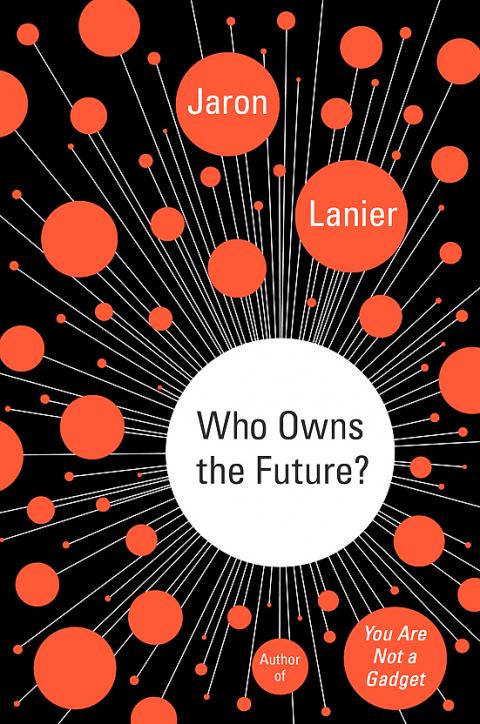
As its title indicates, Jaron Lanier’s new tech manifesto asks, “Who owns the future?” But for many of those who will be captivated by Lanier’s daringly original insights, another question comes first: Who is Jaron Lanier? He is a mega-wizard in futurist circles. He is the father of virtual reality in the gaudy, reputation-burnishing way that Michael Jackson was the king of pop. Lanier would undoubtedly be more of a household name if he were not a large, dreadlocked, anything but telegenic figure with facial hair called “mossy” in a 2011 profile in The New Yorker.
While working on “intriguing unannounced projects” for Microsoft Research — “a gigantic lighter-than-air railgun to launch spacecraft” and a speculative strategy for “repositioning earthquakes” — Lanier found time to follow up on his first book, You Are Not a Gadget (2010). That was a feisty, brilliant, predictive work, and the new volume is just as exciting. Lanier bucks a wave of more conventional diatribes on Big Data to deliver Olympian, contrarian fighting words about the Internet’s exploitative powers. A self-proclaimed “humanist softie,” he is a witheringly caustic critic of big Web entities and their business models.
He’s talking to you, Facebook. (“What’s Facebook going to do when it grows up?”) And to you, Google. (“The Google guys would have gotten rich from the search code without having to create the private spying agency.”) And to all the other tempting Siren Servers (as he calls them) that depend on accumulating and evaluating consumer data without acknowledging a monetary debt to the people mined for all this “free” information. One need not be a political ideologue, he says, to believe that people have quantifiable value and deserve to be recompensed for it.
It’s true that Lanier was once driving in Silicon Valley, listening to what he thought was some Internet startup “trumpeting the latest scheme to take over the world,” when he realized he was hearing Karl Marx’s Das Kapital. (“If you select the right passages, Marx can read as being incredibly current.”)
He is no “lefty” (to use his word); he sees high-tech thievery as an apolitical problem. And he is too much of a maverick to align with anyone’s thinking, even his own. Whether it is a boast or a mea culpa, Lanier acknowledges: “I was an early participant in the process and helped to formulate many of the ideas I am criticizing in this book.” And “to my friends in the ‘open’ Internet movement, I have to ask: What did you think would happen?”
Who Owns the Future? reiterates some ideas in Lanier’s first book: that Web businesses exploit a peasant class, that users of social media may not realize how entrapped they are, that a thriving middle class is essential to keeping the Internet sustainable. When “ordinary people ‘share,’ while elite network presences generate unprecedented fortunes,” even that elite will eventually be undermined. Lanier compares his suggestions for reconfiguring this process to Jonathan Swift’s Modest Proposal, but the last thing he worries about is writerly grandiosity. “Understand that in the context of the community in which I function,” he says of Silicon Valley, “my presentation is practically self-deprecating.”
Lanier’s sharp, accessible style and opinions make Who Owns the Future? terrifically inviting. What is he calling for? Just “The Ad Hoc Construction of Mass Dignity.” He much prefers sweeping formulations to qualified ones, although, as he points out, “being an absolutist is a certain way to become a failed technologist.” This book may not provide many answers (“It is too early for me to solve every problem brought up by the approach I’m advocating here”), but is does articulate a desperate need for them.
Who Owns the Future? overlaps with The New Digital Age, Eric Schmidt and Jared Cohen’s much more polished work of Web analysis. Their book focuses more on global issues, but disagrees with specific points.
The New Digital Age looks forward to self-driving trucks that can ease the strain on Teamsters; Lanier rambunctiously writes of “Napstering the Teamsters” out of work, and of how such technology could go terribly wrong. The books also disagree on whether surgeons’ work will be enhanced or diminished by robotics.
And where Schmidt and Cohen see promise in technology’s effect on the Arab Spring, Lanier is sick of the back-patting about social networking. Revolutions can happen without it, too, he says. Lanier may not have any personal animus against Schmidt. But he describes listening to him and Amazon’s Jeff Bezos discuss the future of books just as he, Lanier, was struggling to write his first one. This prompts an attack on how Siren Servers could undermine and impoverish the world of reading, just as they did music. (Lanier is also a musician. He specializes in the arcane and innovative, as might be expected.) More generally, and very quotably, he warns against being seduced by “dazzlingly designed forms of cognitive waste.”
Finally, Who Owns the Future? takes some of it biggest swipes at those who do presume to own the future: fans of the Singularity (the hypothetical imminent merger of biology and technology), Silicon Valley pioneers seeking “methusalization” (i.e., immortality), techie utopians of every stripe. Yes, Lanier happens to be one of them. But he is still capable of remembering when, in his boyhood, prognosticators foresaw Moon colonies and flying cars. Now they think about genomics and data. Mindful of that way-cool past, he says, “I miss the future.”


The US war on Iran has illuminated the deep interdependence of Asia on flows of oil and related items as raw materials that become the basis of modern human civilization. Australians and New Zealanders had a wake up call. The crisis also emphasizes how the Philippines is a swatch of islands linked by jet fuel. These revelations have deep implications for an invasion of Taiwan. Much of the commentary on the Taiwan scenario has looked at the disruptions to world trade, which will be in the trillions. However, the Iran war offers additional specific lessons for a Taiwan scenario. An insightful
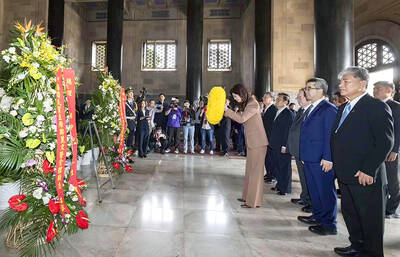
The problem with Marx’s famous remark that history repeats itself, first as tragedy, the second time as farce, is that the first time is usually farce as well. This week Chinese Nationalist Party (KMT) Chair Cheng Li-wun (鄭麗文) made a pilgrimage to the People’s Republic of China (PRC) “to confer, converse and otherwise hob-nob” with Chinese Communist Party (CCP) officials. The visit was an instant international media hit, with major media reporting almost entirely shorn of context. “Taiwan’s main opposition leader landed in China Tuesday for a rare visit aimed at cross-strait ‘peace’”, crowed Agence-France Presse (AFP) from Shanghai. Rare!
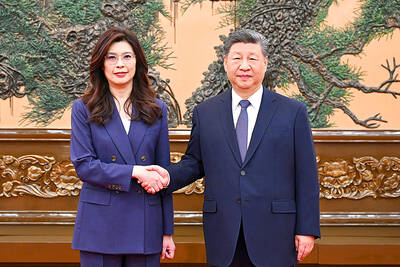
What is the importance within the Chinese Nationalist Party (KMT) of the meeting between Xi Jinping (習近平), the leader Chinese Communist Party (CCP), and Cheng Li-wun (鄭麗文), the leader of the KMT? Local media is an excellent guide to determine how important — or unimportant — a news event is to the public. Taiwan has a vast online media ecosystem, and if a news item is gaining traction among readers, editors shift resources in near real time to boost coverage to meet the demand and drive up traffic. Cheng’s China trip is among the top headlines, but by no means

Sunflower movement superstar Lin Fei-fan (林飛帆) once quipped that the Democratic Progressive Party (DPP) could nominate a watermelon to run for Tainan mayor and win. Conversely, the DPP could run a living saint for mayor in Taipei and still lose. In 2022, the DPP ran with the closest thing to a living saint they could find: former Minister of Health and Welfare Chen Shih-chung (陳時中). During the pandemic, his polling was astronomically high, with the approval of his performance reaching as high as 91 percent in one TVBS poll. He was such a phenomenon that people printed out pop-up cartoon


 RSS
RSS