


As night begins to give way to dawn, 40 high-performance cars pull up on an empty Hong Kong back street. While the city sleeps, their revving engines fill the air with a heavy smell of petrol.
The drivers huddle together to set the route, always at the last possible minute. One of them spots the red and blue glare of police lights and they scramble to their cars, regrouping a few miles away to continue the race.
By day, Eva is a nurse. For one night each week she is also an illegal street racer — one of hundreds in Hong Kong who are bound by their addiction to breakneck speed.
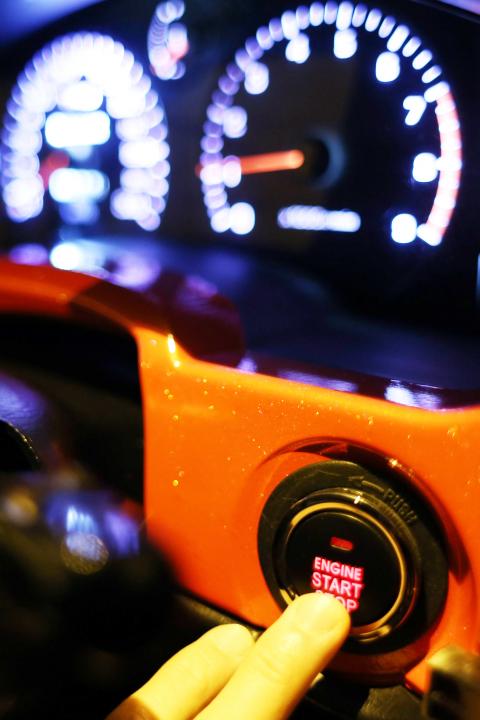
Photo: AFP
With the engine of her black Mitsubishi Lancer Evolution VII modified to generate maximum power, the 25-year-old is only the second woman to join an illicit club whose members include teachers, businessmen, lawyers and even a Taoist priest.
Most of them would not even cross a pedestrian walkway on a red light in the day — jaywalking is an offence in Hong Kong — but the rules of a normally ordered city are put to one side in this twilight world of street racing.
Tearing along public roads at speeds of up to 200 kilometers (124 miles) per hour, Eva is fiercely proud of her secret identity as an illegal racer — one that she never plans to reveal to her parents.
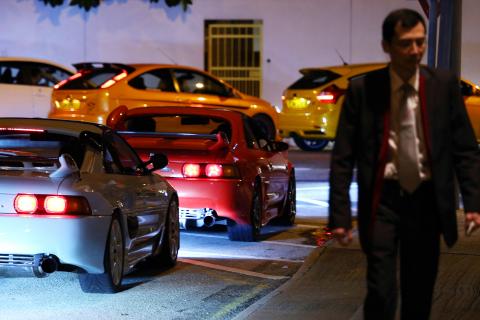
Photo: AFP
“They cannot imagine what racing is because I’m a girl and I’m a little girl in their eyes ... So I will not tell my parents. I don’t want to bother them.”
While illegal street racing is a global phenomenon, rife in cities from Los Angeles to Sydney and Kuala Lumpur, in Hong Kong it is as much about being part of a racing community as it is a battle on the road.
“Every day we do the same thing, the same time. And then suddenly we can have our time to drive together,” says Alex, 27, who has been racing for four years.
Blazing down a clear road normally clogged with traffic unleashes the tension of living in an overcrowded city, he explains.
All other cars are obstacles “when you’re driving at 250 kilometers an hour,” the jewelry trader says.
“All of them are walls. I’m the one who can win, win the road ... I’m king of the road.”
Alex didn’t overtake anyone on this particular morning, after noticing an unmarked police car following friends ahead, but drove at more than 200 kilometers hour on a road where the speed limit is 70.
A dangerous, selfish act
The potentially devastating consequences of racing are far from the minds of the drivers comparing cars after the “morning drive” — the seemingly innocuous term they use to describe breaking the rules of the road.
“When I’m driving very fast, I feel I’ve combined with the car. The car is part of my body. I am in control,” says one 36-year-old, even though like most racers she knows at least one person who has had an accident while speeding.
Hong Kong police said there are no figures on injuries caused by illegal racing and there have been no related deaths in recent years, but stress that one fatal case would be one too many.
“Road racing is a highly dangerous and selfish act that puts other members of the public in severe danger ... What we want to try and do is to make sure that the road is safe,” Inspector Ngai Chun-yip, who heads the illegal road racing unit in the northern territories of Hong Kong, told AFP.
Last year there was an eight percent rise in the number of illegal racing complaints compared to the year before. Ngai led 291 anti-racing operations, increasingly using online videos uploaded by racers to help track them down.
Richard was one of the 1,700 people prosecuted in the crackdown.
Back at the winding road where he was caught speeding, he points at the bushes in which police rigged speed cameras. After 120 hours of community service and losing his driving license for a year, the 41-year-old says he rarely races anymore.
“If I really want to drive fast, maybe I will go to China [and use] the racing track. But not on the roads in Hong Kong.”
He added that if arrested again he may face jail and would lose his job as an English tutor.
Police describe racing in the city as an ad-hoc rather than a large-scale or well-organized activity. The racers gathered for breakfast paint a different picture.
Morning or midnight races take place every week in several different parts of the territory, while there are also more spontaneous contests when drivers eye a willing competitor on the street or simply take a chance to rip down highways alone.
Beneath the racing community’s camaraderie lurks an undeniable sense of the status that cars and racing bring.
“There are too many rich people in Hong Kong. All my friends race, all own sports cars. Most of it is to show off,” says Nick, who owns a Porsche and a Ford Focus rs500.
With the cost of cars and modifications — faster wheels and engines or louder exhausts — running into hundreds of thousands of dollars, it’s an expensive as well as a risky way to make a mark.
Amateur racers have long been lobbying for an official racetrack in Hong Kong that they claim will stop people racing illegally on the streets.
Some already cross the border into mainland China to use a circuit where two races over a weekend can cost as much as US$10,000.
Others admit a track will never replace the thrill of racing on public roads. “You cannot match the excitement,” says Nick. “Some people will always race on the streets.”
(All racers’ names have been changed.)

The US war on Iran has illuminated the deep interdependence of Asia on flows of oil and related items as raw materials that become the basis of modern human civilization. Australians and New Zealanders had a wake up call. The crisis also emphasizes how the Philippines is a swatch of islands linked by jet fuel. These revelations have deep implications for an invasion of Taiwan. Much of the commentary on the Taiwan scenario has looked at the disruptions to world trade, which will be in the trillions. However, the Iran war offers additional specific lessons for a Taiwan scenario. An insightful
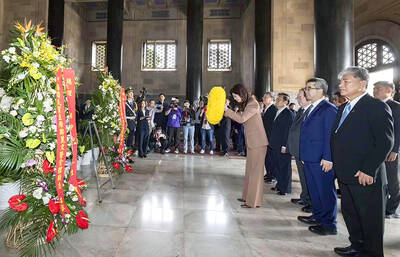
The problem with Marx’s famous remark that history repeats itself, first as tragedy, the second time as farce, is that the first time is usually farce as well. This week Chinese Nationalist Party (KMT) Chair Cheng Li-wun (鄭麗文) made a pilgrimage to the People’s Republic of China (PRC) “to confer, converse and otherwise hob-nob” with Chinese Communist Party (CCP) officials. The visit was an instant international media hit, with major media reporting almost entirely shorn of context. “Taiwan’s main opposition leader landed in China Tuesday for a rare visit aimed at cross-strait ‘peace’”, crowed Agence-France Presse (AFP) from Shanghai. Rare!

What is the importance within the Chinese Nationalist Party (KMT) of the meeting between Xi Jinping (習近平), the leader Chinese Communist Party (CCP), and Cheng Li-wun (鄭麗文), the leader of the KMT? Local media is an excellent guide to determine how important — or unimportant — a news event is to the public. Taiwan has a vast online media ecosystem, and if a news item is gaining traction among readers, editors shift resources in near real time to boost coverage to meet the demand and drive up traffic. Cheng’s China trip is among the top headlines, but by no means

Sunflower movement superstar Lin Fei-fan (林飛帆) once quipped that the Democratic Progressive Party (DPP) could nominate a watermelon to run for Tainan mayor and win. Conversely, the DPP could run a living saint for mayor in Taipei and still lose. In 2022, the DPP ran with the closest thing to a living saint they could find: former Minister of Health and Welfare Chen Shih-chung (陳時中). During the pandemic, his polling was astronomically high, with the approval of his performance reaching as high as 91 percent in one TVBS poll. He was such a phenomenon that people printed out pop-up cartoon


 RSS
RSS