


The Franco-Taiwanese collaboration Yo Gee Ti (有機體) returns to the stage of the National Theater tonight for the first of two shows, and it is a production well worth a second look — and definitely something to see if you missed it the first time around.
Yo Gee Ti was commissioned by the National Theater Concert Hall (NTCH) for last year’s Taiwan International Festival of the Arts and premiered on March 2.
The NTCH played matchmaker between two very different men, artists working in disparate fields and born worlds apart: Mourad Merzouki, the Lyon-born founder of the Kafig Company, and London-based Taiwanese fashion designer Johan Ku (古又文), who is famed for his unusual, sculptural knitware.
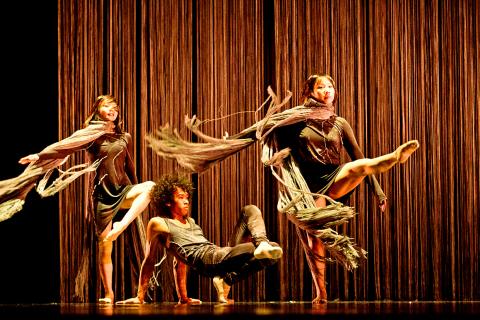
Photo courtesy of National Theater Concert Hall
The production turned out to be probably the most successful of the NTCH’s special festival cross-cultural endeavors, winning praise in Taiwan and good reviews when it hit the festival circuit in France last summer.
Given just about two months to create the piece, Merzouki and Ku — along with set designer Benjamin Lebreton, lighting designer Yoann Tivoli and a rollicking score by the composer’s brother As’n Merzouki — created a show that turns dance and textiles into a visual and artistic feast.
The cross-cultural blend extended to the performers as well, with Merzouki selecting five of his French hip-hop dancers and then five modern dancers from Taiwan, who coincidentally all turned out to be graduates of the National Taipei University of the Arts’ dance department.
Yo Gee Ti means “organism” in Mandarin. This is somewhat fitting because the production is an organic interweaving of dancers, techniques, costumes, set and music that becomes a polished whole.
Ku’s costumes and craft inspired Merzouki, whose choreographic patterns mimicked elements of knitting, weaving and sewing, with group pieces in which the dancers move and overlap with mechanical precision, their legs as pointed as knitting needles. Sometimes the costumes and set constrain the dancers — such as a segment with where the dancers emerge from knitted tubes — while other times the dancers use Lebreton’s curtains of suspended lengths of yarn to cloak themselves or playfully braid them into patterns.
The mood of the piece often shifts — for the most part seamlessly — as the choreography changes from frenetic and athletic hip hop to quiet, almost meditative movements, from group pieces to duets and back again.
While there is a strong contrast between the French hip-hop dancers and their Taiwanese colleagues, physically and stylistically, Merzouki’s choreography gives them the opportunity to shine both as individual threads and as a tightly woven team.

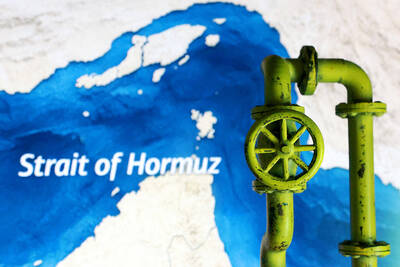
The US war on Iran has illuminated the deep interdependence of Asia on flows of oil and related items as raw materials that become the basis of modern human civilization. Australians and New Zealanders had a wake up call. The crisis also emphasizes how the Philippines is a swatch of islands linked by jet fuel. These revelations have deep implications for an invasion of Taiwan. Much of the commentary on the Taiwan scenario has looked at the disruptions to world trade, which will be in the trillions. However, the Iran war offers additional specific lessons for a Taiwan scenario. An insightful
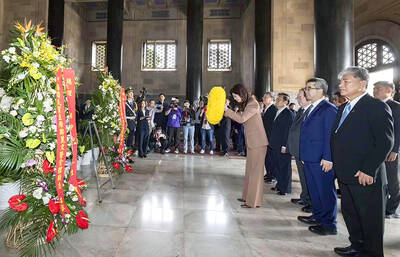
The problem with Marx’s famous remark that history repeats itself, first as tragedy, the second time as farce, is that the first time is usually farce as well. This week Chinese Nationalist Party (KMT) Chair Cheng Li-wun (鄭麗文) made a pilgrimage to the People’s Republic of China (PRC) “to confer, converse and otherwise hob-nob” with Chinese Communist Party (CCP) officials. The visit was an instant international media hit, with major media reporting almost entirely shorn of context. “Taiwan’s main opposition leader landed in China Tuesday for a rare visit aimed at cross-strait ‘peace’”, crowed Agence-France Presse (AFP) from Shanghai. Rare!
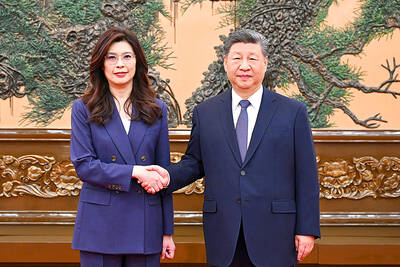
What is the importance within the Chinese Nationalist Party (KMT) of the meeting between Xi Jinping (習近平), the leader Chinese Communist Party (CCP), and Cheng Li-wun (鄭麗文), the leader of the KMT? Local media is an excellent guide to determine how important — or unimportant — a news event is to the public. Taiwan has a vast online media ecosystem, and if a news item is gaining traction among readers, editors shift resources in near real time to boost coverage to meet the demand and drive up traffic. Cheng’s China trip is among the top headlines, but by no means

Sunflower movement superstar Lin Fei-fan (林飛帆) once quipped that the Democratic Progressive Party (DPP) could nominate a watermelon to run for Tainan mayor and win. Conversely, the DPP could run a living saint for mayor in Taipei and still lose. In 2022, the DPP ran with the closest thing to a living saint they could find: former Minister of Health and Welfare Chen Shih-chung (陳時中). During the pandemic, his polling was astronomically high, with the approval of his performance reaching as high as 91 percent in one TVBS poll. He was such a phenomenon that people printed out pop-up cartoon


 RSS
RSS