


Julie Wu (吳茗秀), a 40-something Taiwanese-American living in Boston, recently published a powerful first novel in English. And The Third Son, reviewed by Bradley Winterton in yesterday’s Taipei Times, wants to do more than just entertain.
Raised in a middle-class Taiwanese family in the US and educated at Harvard University, Wu could have steered clear of the arts and the financial sacrifices that trying to become a writer often entail. Yet even after getting a medical degree and practicing as a doctor in Massachusetts, she chose to try to make an impact with literature.
Married with two children and living a comfortable life in suburban Boston, Wu spent 10 years writing the 300-page novel about Taiwan in the 20th century and Taiwanese immigrants in 1950s America.
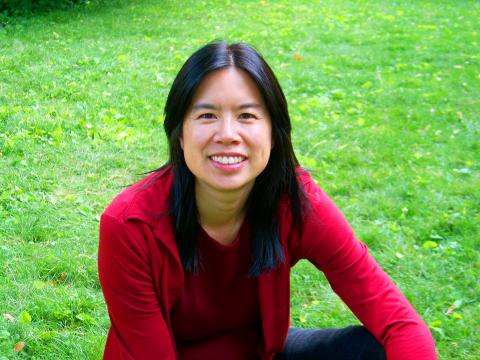
Photo Courtesy of Julie Wu
In a recent e-mail interview with the Taipei Times, Wu said that she wrote the book to tell a great story — to create an epic historical novel of the kind that she herself enjoys reading. But she also felt a calling to become part of a larger cause.
“Ever since I learned about Taiwanese history I have been driven to make it known to the outside world,” Wu said. “It is so unjust that no one is aware of what the Taiwanese people have been through, and that there is such profound ignorance in North America and Europe of Taiwan’s political situation,” she said.
“I feel that I have a unique opportunity to get the Taiwanese point of view out and onto the Western reader’s radar — just a little at least,” she said. “That’s something that’s valuable whether or not my book gets great reviews, prizes, or awards for its literary merit, and I’m happy about that.”
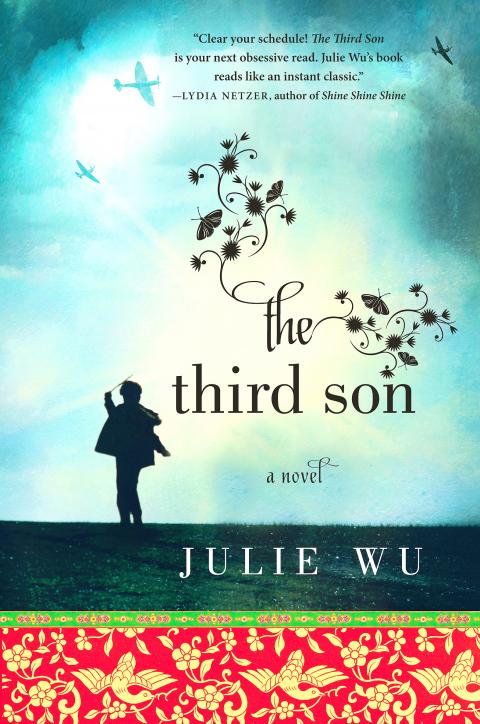
Photo Courtesy of Julie Wu
According to Wu, the reaction from Taiwanese and American readers has been “very positive” so far. “Taiwanese readers are generally happy to read a story that corresponds so closely with what they or their parents experienced,” she said.
“Non-Taiwanese readers seem to be drawn to the book partly because of the promise of a good story and partly from a desire to learn about Taiwan. Many American readers express chagrin that they didn’t even know about the Japanese occupation [of Taiwan in the first half of the 20th century], much less about the 228 Massacre or the White Terror period.” A Chinese-American reader who immigrated to the US from China told Wu that she was surprised to learn that there were people in Taiwan before Chiang Kai-Shek (蔣介石) arrived after World War II.
When asked if new forms of art and artistic expression might arise in contemporary Taiwan as a result of the raised consciousness and social awareness in the nation’s younger generations, Wu said it’s already happening.
“Artists have always been social commentators. I interviewed several former Green Island prisoners when I visited Taiwan last year, and they have been busy publishing novels and memoirs,” she said. “The Taipei 228 [Memorial] Museum, the Jingmei Human Rights [Memorial and Cultural Park], and the Green Island Human Rights Memorial Park are filled with art and art reproductions that document and help people comprehend and contextualize Taiwan’s history.”
Wu said Taiwanese-Americans overseas are also doing their part.
“In America in 2010, Taiwanese-American film director Will Tiao (刁毓能) produced and acted in a CIA thriller titled Formosa Betrayed in which the modern history of Taiwan was integral to the plot,” she said.
Wu noted that she recently attended a performance by Taiwanese-American spoken-word poet Kelly Zen-Yie Tsai, who included issues of Taiwanese history and identity in her latest piece titled Formosa. In addition, Thomas Liao’s (廖文毅) granddaughter, Kim Liao, spent a year in Taiwan researching her family roots and is working on a memoir, she added.
“It’s not that artists are lacking,” Wu insisted. “It’s that they lack acknowledgement and support, including financial support. For example, if the memorial museums in Taiwan were well-funded, they could afford to buy and properly display more examples of important artwork instead of relying only on donated art and reproductions. As it is, many socially-important works languish in the dark.”
REPRESSION IN HISTORY
The Third Son is one of the first American novels to explore “the modern historical suppression of the Taiwanese people.”
The book is not about Chiang Kai-shek or his authoritarian regime, but Wu was fully aware of that period of history when she started writing.
“There are many reasons authoritarian regimes have always suppressed artists, and it’s not just because artists are parasites who most often need financial support,” she says.
“It’s not even just because artists can produce direct social/political commentary that inflames the masses. It’s because art is a distillation of consciousness, a reflection of humanity that intersects society at infinite levels, and that is passed down from generation to generation. Smart governments understand this.”
When asked to explain this in relation to Taiwan, Wu gave as an example the life of Taiwanese painter Ouyang Wen (歐陽文).
“He has described how, when he was first taken to Green Island, he thought he could simply continue his work as an artist,” Wu said. “But the prison officials constantly harassed him, asking him what he was painting and what it meant, until he lost all desire to paint at all. But what could the prison officials have been afraid of? He was already in prison, isolated from the rest of the world. He was not painting anything overtly political or rebellious. They could only have been afraid of hidden meanings in his prison paintings, meanings that, when he was released, might be apparent to others and reveal truths that they would rather keep hidden.”
The Third Son has raced out of the starting gate and is winding its way through the hearts and minds of Western readers and book reviewers. The novel has a good chance to make its mark on American literature and put Taiwan on the international map in a literary way. And when the book is translated into Chinese for Taiwanese readers in the future, it could have a big impact here as well.

The US war on Iran has illuminated the deep interdependence of Asia on flows of oil and related items as raw materials that become the basis of modern human civilization. Australians and New Zealanders had a wake up call. The crisis also emphasizes how the Philippines is a swatch of islands linked by jet fuel. These revelations have deep implications for an invasion of Taiwan. Much of the commentary on the Taiwan scenario has looked at the disruptions to world trade, which will be in the trillions. However, the Iran war offers additional specific lessons for a Taiwan scenario. An insightful
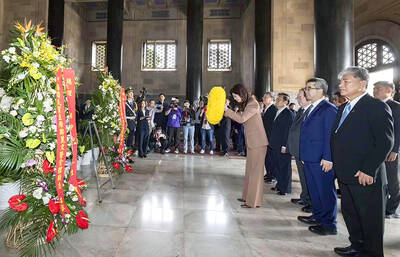
The problem with Marx’s famous remark that history repeats itself, first as tragedy, the second time as farce, is that the first time is usually farce as well. This week Chinese Nationalist Party (KMT) Chair Cheng Li-wun (鄭麗文) made a pilgrimage to the People’s Republic of China (PRC) “to confer, converse and otherwise hob-nob” with Chinese Communist Party (CCP) officials. The visit was an instant international media hit, with major media reporting almost entirely shorn of context. “Taiwan’s main opposition leader landed in China Tuesday for a rare visit aimed at cross-strait ‘peace’”, crowed Agence-France Presse (AFP) from Shanghai. Rare!
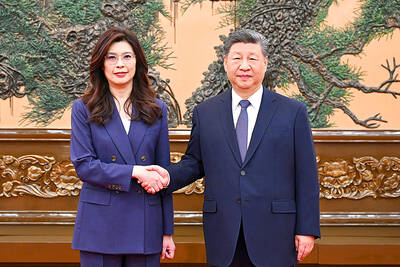
What is the importance within the Chinese Nationalist Party (KMT) of the meeting between Xi Jinping (習近平), the leader Chinese Communist Party (CCP), and Cheng Li-wun (鄭麗文), the leader of the KMT? Local media is an excellent guide to determine how important — or unimportant — a news event is to the public. Taiwan has a vast online media ecosystem, and if a news item is gaining traction among readers, editors shift resources in near real time to boost coverage to meet the demand and drive up traffic. Cheng’s China trip is among the top headlines, but by no means
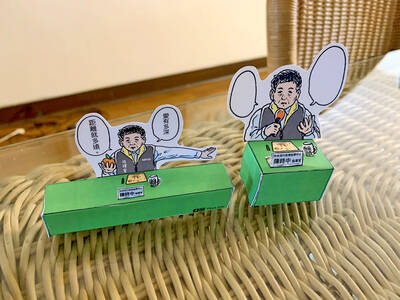
Sunflower movement superstar Lin Fei-fan (林飛帆) once quipped that the Democratic Progressive Party (DPP) could nominate a watermelon to run for Tainan mayor and win. Conversely, the DPP could run a living saint for mayor in Taipei and still lose. In 2022, the DPP ran with the closest thing to a living saint they could find: former Minister of Health and Welfare Chen Shih-chung (陳時中). During the pandemic, his polling was astronomically high, with the approval of his performance reaching as high as 91 percent in one TVBS poll. He was such a phenomenon that people printed out pop-up cartoon


 RSS
RSS