


The health benefits of vinegar have been widely touted in recent years, as the product becomes a major presence on the shelves of health food stores. Lovely packaging complements detailed instructions listing therapeutic effects ranging from improving digestion to lowering the risk of heart attacks. But the moment you start talking to people deeply involved in making and using vinegar as an alternative treatment, the theories about what works and what constitutes good vinegar are legion.
In the end it comes down to experience, and the story told by husband and wife team Cao Wu-fa (曹武發) and Liang Hsiao-ju (梁孝如) shows how vinegar can change peoples’ lives. The couple now run Love Vinegar, an artisanal vinegar producer based out of a disused warehouse on the Hualien docks. Now in their fourth year, the company has picked up numerous awards for small and medium enterprises and regularly has more orders than it can deal with.
Sitting in the cavernous space of their warehouse, Liang explained the series of seemingly unconnected events that led her and Cao overseeing a warehouse full of clay jars filled with vinegar. Cao sat beside us carefully preparing a mixture of honey, water and the lavender vinegar. Lavender vinegar is currently one of their most popular products.
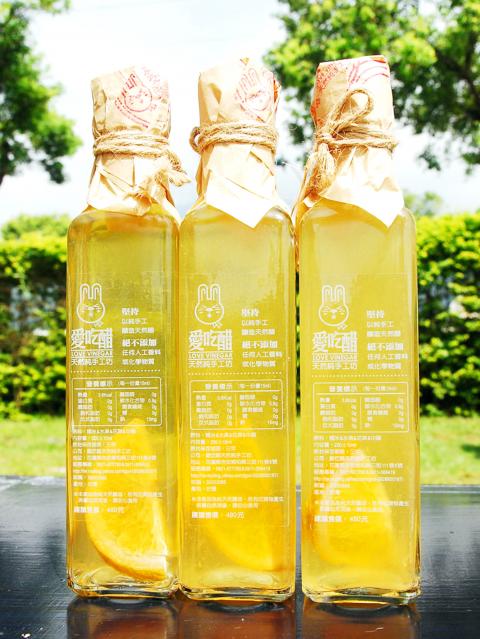
Photo Courtesy of Love Vinegar
Liang said that the lavender vinegar had proved a lifesaver for the family. As a two year old, Liang’s daughter began to suffer from chronic hives, a condition that only got worse as she got older, and by the time she was eight, she was making hospital visits once a week to treat the condition. With conventional medicine ineffective, Liang, a keen cook who made her own vinegar for culinary applications, finally agreed to try a vinegar treatment suggested by her husband.
LEAP OF FAITH
“I had no faith at all in these alternative therapies,” she said, “But we had tried everything else.” Cao, who formerly worked in television and had studied health care management at college, had a long-standing interest in alternative therapies, and he suggested using Liang’s vinegar together with lavender to treat their daughter’s condition. “Lavender is effective against skin inflammations,” Cao said, and prescribed the use of external application and ingestion of homemade lavender vinegar. According to Liang, it took no more than a month of this treatment before her daughter’s condition was brought under control.
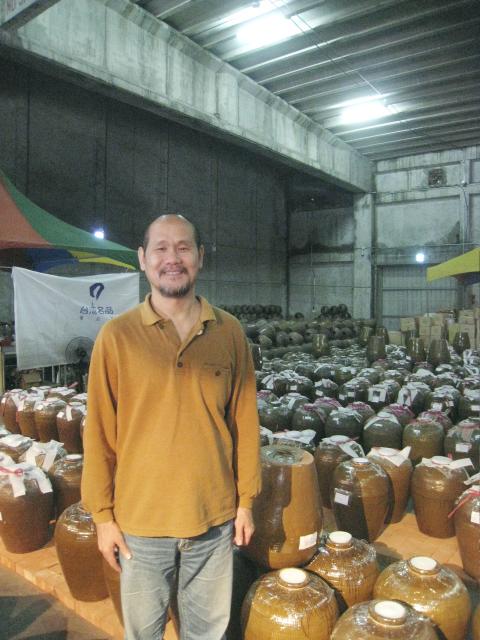
Photo: Ian Bartholomew, Taipei Times
“At first I did not accept my husband’s beliefs about the importance of using the right types of food for good health,” Liang said. “I felt that this kind of thinking belonged to the era of my grandparents. ‘In this sophisticated modern era, there is no place for this kind of thinking,’ I told myself.” She has since become an ardent convert to the effectiveness of vinegar as a means of improving overall health and dealing with a wide range of ailments.
When they decided to start Love Vinegar, Liang was confronted with Cao’s determination to manufacture vinegar on his own terms. Cao believes, and he is not alone in this, that processed cane sugar is one of the main contributors to chronic disease in modern society, and insisted that Love Vinegar produce vinegar without the use of this ingredient. Sugar greatly facilities and expedites vinegar production, and refusing to use it in the brewing process has considerable consequences for production.
SLOW PROCESS
“We do everything from scratch,” Cao said, “Starting with the fermenting of glutinous rice and an active flavoring ingredient such as lavender. This process takes about three months. Then we add the bacteria, and leave the brew to become vinegar. This takes a further six months. It is not a process that can be rushed.”
Despite the long production time and consequent costs, Liang said that more and more people are becoming aware of the damage that excessive consumption of processed sugar can cause to long-term health, and are willing to pay a premium for vinegar produced in a slower, more labor intensive fashion.
“It’s probably some of the most expensive vinegar made in Hualien,” Cao said. Despite its high cost, Liang said that they are planning to rent more warehouse space in order to meet demand. Cao has drawn on his knowledge of alternative therapies to develop 40 kinds of vinegar. Only six are regularly available: lavender; Eucommia (a tree bark widely used in Chinese medicine); chrysanthemum and wolfberry; rose and si wu (四物, a combination of medicinal herbs used particularly to treat menstrual pain); kumquat; and plain rose.
“Vinegar enhances the effectiveness of ingredients and is itself a great anti-bacterial agent. For example, kumquat is very effective for treating coughing. When added with vinegar, the vinegar kills the germs and the beneficial qualities of the kumquat can take effect in minutes. That’s how I think about,” Cao said.
Liang attributed the success of Love Vinegar to a growing awareness about the toll long-term illnesses can take, as well as a loss of faith in the effectiveness of western medicines in the treatment of these conditions. “Many people know that they are sick, but they don’t want to take medicine,” Liang said. “This is one reason why people have turned to products such as ours.”
With so many vinegars on the market, Cao said that consumers need to take care when choosing a product. “Any naturally brewed vinegar is good vinegar,” he said, “But so many products on the market simply steep various flavoring agents in vinegar or they contain petrochemical products such as synthesized alcohol. These types of vinegar have limited effectiveness for health.”


The US war on Iran has illuminated the deep interdependence of Asia on flows of oil and related items as raw materials that become the basis of modern human civilization. Australians and New Zealanders had a wake up call. The crisis also emphasizes how the Philippines is a swatch of islands linked by jet fuel. These revelations have deep implications for an invasion of Taiwan. Much of the commentary on the Taiwan scenario has looked at the disruptions to world trade, which will be in the trillions. However, the Iran war offers additional specific lessons for a Taiwan scenario. An insightful

The problem with Marx’s famous remark that history repeats itself, first as tragedy, the second time as farce, is that the first time is usually farce as well. This week Chinese Nationalist Party (KMT) Chair Cheng Li-wun (鄭麗文) made a pilgrimage to the People’s Republic of China (PRC) “to confer, converse and otherwise hob-nob” with Chinese Communist Party (CCP) officials. The visit was an instant international media hit, with major media reporting almost entirely shorn of context. “Taiwan’s main opposition leader landed in China Tuesday for a rare visit aimed at cross-strait ‘peace’”, crowed Agence-France Presse (AFP) from Shanghai. Rare!

What is the importance within the Chinese Nationalist Party (KMT) of the meeting between Xi Jinping (習近平), the leader Chinese Communist Party (CCP), and Cheng Li-wun (鄭麗文), the leader of the KMT? Local media is an excellent guide to determine how important — or unimportant — a news event is to the public. Taiwan has a vast online media ecosystem, and if a news item is gaining traction among readers, editors shift resources in near real time to boost coverage to meet the demand and drive up traffic. Cheng’s China trip is among the top headlines, but by no means

Sunflower movement superstar Lin Fei-fan (林飛帆) once quipped that the Democratic Progressive Party (DPP) could nominate a watermelon to run for Tainan mayor and win. Conversely, the DPP could run a living saint for mayor in Taipei and still lose. In 2022, the DPP ran with the closest thing to a living saint they could find: former Minister of Health and Welfare Chen Shih-chung (陳時中). During the pandemic, his polling was astronomically high, with the approval of his performance reaching as high as 91 percent in one TVBS poll. He was such a phenomenon that people printed out pop-up cartoon


 RSS
RSS