


The Terror, The Flaming Lips, Lovely Sorts/Warner Bros.
The goofy costumes, flashing lights, confetti blasts and general hilarity of the Flaming Lips’ concerts largely conceal the sense of dread that has also run through their songs in a recording career that has now lasted for an improbable 30 years. But there’s no escaping bleakness on The Terror, which willfully tosses away nearly anything that might offer easy pleasure or comic relief.
The Terror embraces repetition and abrasiveness more monolithically than previous Flaming Lips albums. Through three decades, Wayne Coyne has led his band on an uncharted trajectory amid punk, psychedelia, studio obsessiveness, science fiction, mysticism and noise; Steven Drozd, who joined the Flaming Lips as their drummer in 1991, largely shapes the music. Along the way, Flaming Lips albums have usually offset their gloomy moments with garage-rock stomps or melodic confections; even the band’s generally bummed-out 2009 album, Embryonic, had some crash and shimmer. The Terror rarely does; it’s a take-it-or-leave-it album that’s willing to be inert or annoying. But its obsessiveness brings its own rewards.
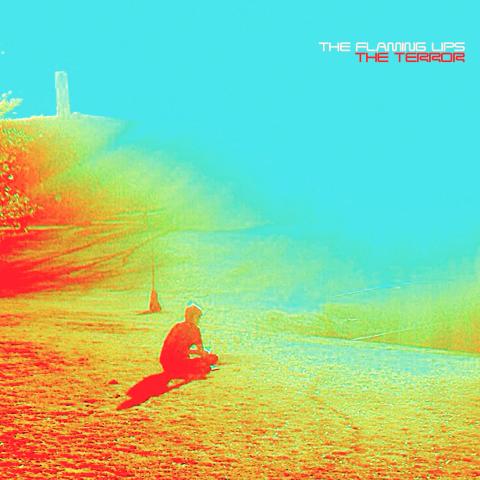
The lyrics find cosmic repercussions in a lovers’ breakup; loneliness turns to contemplation of grim human compulsions and the end of the universe. “However love can help you/We are all standing alone,” Coyne sings in the title song. The album’s prettiest melody carries Try to Explain, which concludes, “Try to explain why you’re leaving/I don’t think I understand.” It’s the kind of majestic pop chorale that has been a Flaming Lips staple, but this one is deliberately set amid emptiness: No drumbeat, just watery chords that waver slightly over a foundation of sustained distortion, keeping the song moody and unmoored.
Throughout The Terror, the band’s guitars have been all but supplanted by keyboards and synthesizers, often set to loop and drone, with eerie sounds welling up out of nowhere. The album includes just nine songs in 55 minutes, and about halfway through comes You Lust, which marches along for 13 minutes on an unvarying four-note electric piano line. But that song, and the seven-minute Butterfly, How Long It Takes to Die, grow incantatory, with inexorably surging drums in You Lust and a slow-motion spatial barrage of notes and textures in Butterfly.
At times, the music falls short of its arty ambitions; Turning Violent, with a falsetto vocal and an ominous pulse, is too close to Radiohead for its own good. And when, after brooding for nearly an hour, Coyne concludes “Always There in Our Hearts” with an affirmation of “The joy of life that overwhelms” amid cacophony and echoes, he doesn’t sound all that convinced. The album’s spell of solitary desolation can’t be set aside so easily.

— Jon Pareles, NY Times News Service
Be not so Long to speak, Bobby Avey, Minsi Ridge Records
Bobby Avey’s Be Not So Long to Speak, a solo-piano record of mystery, patience, imagination and clear design, could only have been made by a jazz pianist. It values individual touch and rhythm and phrasing, abruptness and negative space.
But it goes where it wants. It is full of will to not be easily reduced and categorized, though it is frequently very beautiful. It owes a lot to the harmony and atmospheres of Debussy and Ravel, but here and there — for instance, on his own Late November and his version of the Michael Jackson hit PYT — it turns polytonal and polyrhythmic, with a piano-as-tuned-drum-set conception. (He’s either internalized Cecil Taylor or others who have internalized Cecil Taylor.) It’s not background music.
You may not have heard much about Avey unless you keep track of the saxophonist Dave Liebman, with whom he’s worked off and on since 2006, before he graduated from music school. That year they made a duo record together, Vienna Dialogues, playing versions of classical lieder. Four years later, with his trio and Liebman as a special guest, Avey put out his first record, A New Face. He’s played with the excellent saxophonist Miguel Zenon, both in Avey’s own group and in a recent project called Authority Melts From Me, based on his field research of Voodoodrumming in Haiti. You’d think what he’d want to do now is work his trio all over the place, establishing a group sound and a live presence. Instead, here’s a profound, moody solo-piano album. It’s the cart before the horse, in a good way.
Be Not So Long makes sense within the context of a handful of records from the last 40 years or so, first-time solo-piano records by musicians with something to say: Don Pullen’s Solo Piano Album, Matthew Shipp’s Symbol Systems, Jason Moran’s Modernistic, Vijay Iyer’s Solo, Brad Mehldau’s Live in Tokyo, Harold O’Neal’s Marvelous Fantasy, and Craig Taborn’s Avenging Angel. Like those, this has the unmistakable feel of an attempt at doing something new. Most of these tracks are Avey’s own compositions, or the frames of them, filled in with elaborations and dream-world repetitions. Sometimes, as in Isolation of Rain, those repetitions, and generous use of the sustain pedal, are ends in themselves; other times, as in his reharmonized, slightly bitter version of Stardust, there’s clever and careful development, a true beginning and end. Keep an eye on this guy.
— Ben Ratliff, NY Times News Service


The US war on Iran has illuminated the deep interdependence of Asia on flows of oil and related items as raw materials that become the basis of modern human civilization. Australians and New Zealanders had a wake up call. The crisis also emphasizes how the Philippines is a swatch of islands linked by jet fuel. These revelations have deep implications for an invasion of Taiwan. Much of the commentary on the Taiwan scenario has looked at the disruptions to world trade, which will be in the trillions. However, the Iran war offers additional specific lessons for a Taiwan scenario. An insightful
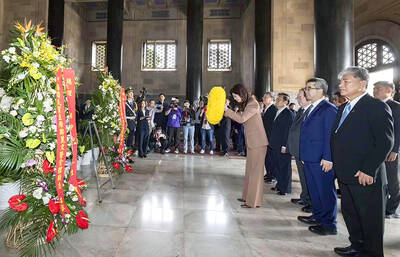
The problem with Marx’s famous remark that history repeats itself, first as tragedy, the second time as farce, is that the first time is usually farce as well. This week Chinese Nationalist Party (KMT) Chair Cheng Li-wun (鄭麗文) made a pilgrimage to the People’s Republic of China (PRC) “to confer, converse and otherwise hob-nob” with Chinese Communist Party (CCP) officials. The visit was an instant international media hit, with major media reporting almost entirely shorn of context. “Taiwan’s main opposition leader landed in China Tuesday for a rare visit aimed at cross-strait ‘peace’”, crowed Agence-France Presse (AFP) from Shanghai. Rare!

What is the importance within the Chinese Nationalist Party (KMT) of the meeting between Xi Jinping (習近平), the leader Chinese Communist Party (CCP), and Cheng Li-wun (鄭麗文), the leader of the KMT? Local media is an excellent guide to determine how important — or unimportant — a news event is to the public. Taiwan has a vast online media ecosystem, and if a news item is gaining traction among readers, editors shift resources in near real time to boost coverage to meet the demand and drive up traffic. Cheng’s China trip is among the top headlines, but by no means

Sunflower movement superstar Lin Fei-fan (林飛帆) once quipped that the Democratic Progressive Party (DPP) could nominate a watermelon to run for Tainan mayor and win. Conversely, the DPP could run a living saint for mayor in Taipei and still lose. In 2022, the DPP ran with the closest thing to a living saint they could find: former Minister of Health and Welfare Chen Shih-chung (陳時中). During the pandemic, his polling was astronomically high, with the approval of his performance reaching as high as 91 percent in one TVBS poll. He was such a phenomenon that people printed out pop-up cartoon


 RSS
RSS