


Enchanting Taiwan (台灣風土的魅力) is a retrospective on the life, painting and writing of prolific artist and art critic Lin Hsin-yueh (林惺嶽). The show seeks to illuminate an artist who dabbled in many styles, but always remained enchanted with Taiwan’s landscapes and local culture. It’s structured in three sections.
The first part presents 138 of his oil and watercolor paintings that were produced from the 1960s up to 2012. It provides an overview of his entire artistic career, from the early avant-garde and surreal works to his more recent vibrant landscapes. Four of the oil paintings — Returning Home (1998), Blessed Hualien (2010), Formosan Landlocked Salmon (2011) and Glory of the God Tree Forest (2012) — are shown to the public for the first time.
The other sections seek to contextualize Lin’s thought with documents by or about the artist, and includes a biographical timeline (in Chinese and English), several exhibition catalogs and art reviews (Chinese) written over his 50-year career, and rare articles such as hand-written drafts of his compositions. The exhibition also features a documentary, The Boundless River, on the artist’s life.

Photo Courtesy of TFAM
■ Taipei Fine Arts Museum (TFAM,台北市立美術館), 181, Zhongshan N Rd Sec 3, Taipei City (台北市中山北路三段181號), tel: (02) 2595-7656. Open Tuesdays to Sundays from 9:30am to 5:30pm and until 8:30pm on Saturdays. Admission: NT$30
■ Until May 5
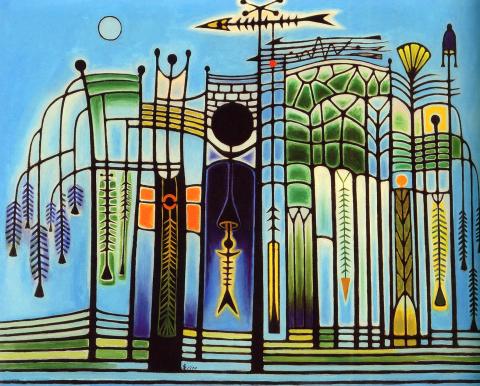
Photo Courtesy of TFAM
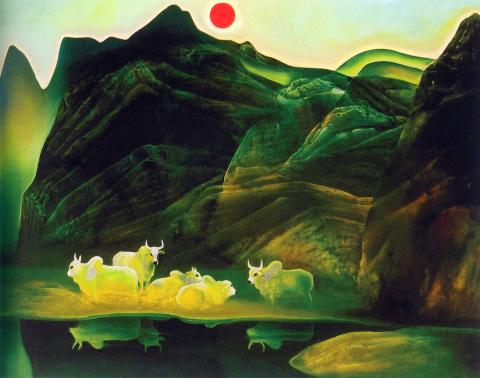
Photo Courtesy of TFAM
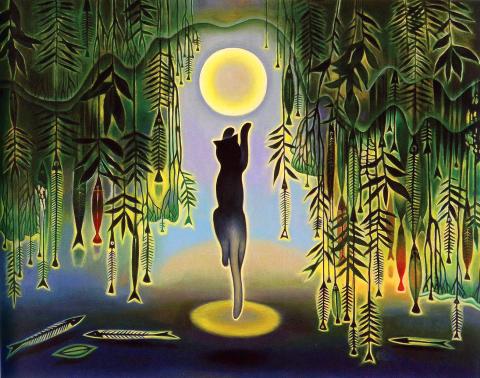
Photo Courtesy of TFAM
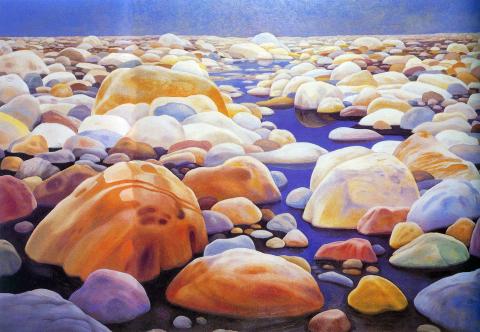
Photo Courtesy of TFAM

Photo Courtesy of TFAM
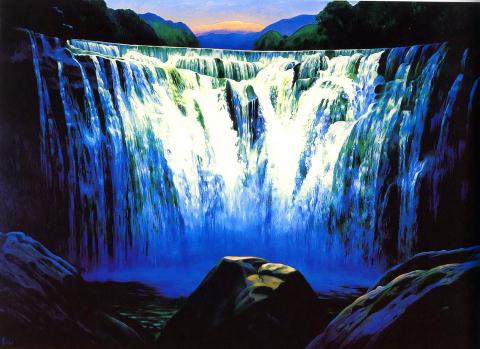
Photo Courtesy of TFAM

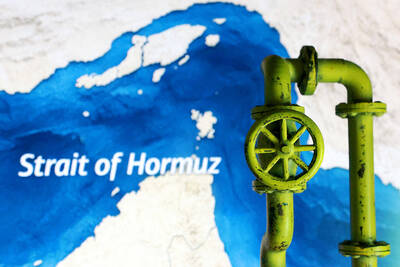
The US war on Iran has illuminated the deep interdependence of Asia on flows of oil and related items as raw materials that become the basis of modern human civilization. Australians and New Zealanders had a wake up call. The crisis also emphasizes how the Philippines is a swatch of islands linked by jet fuel. These revelations have deep implications for an invasion of Taiwan. Much of the commentary on the Taiwan scenario has looked at the disruptions to world trade, which will be in the trillions. However, the Iran war offers additional specific lessons for a Taiwan scenario. An insightful
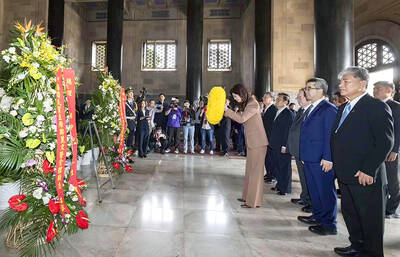
The problem with Marx’s famous remark that history repeats itself, first as tragedy, the second time as farce, is that the first time is usually farce as well. This week Chinese Nationalist Party (KMT) Chair Cheng Li-wun (鄭麗文) made a pilgrimage to the People’s Republic of China (PRC) “to confer, converse and otherwise hob-nob” with Chinese Communist Party (CCP) officials. The visit was an instant international media hit, with major media reporting almost entirely shorn of context. “Taiwan’s main opposition leader landed in China Tuesday for a rare visit aimed at cross-strait ‘peace’”, crowed Agence-France Presse (AFP) from Shanghai. Rare!
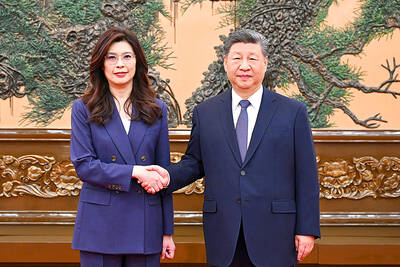
What is the importance within the Chinese Nationalist Party (KMT) of the meeting between Xi Jinping (習近平), the leader Chinese Communist Party (CCP), and Cheng Li-wun (鄭麗文), the leader of the KMT? Local media is an excellent guide to determine how important — or unimportant — a news event is to the public. Taiwan has a vast online media ecosystem, and if a news item is gaining traction among readers, editors shift resources in near real time to boost coverage to meet the demand and drive up traffic. Cheng’s China trip is among the top headlines, but by no means

Sunflower movement superstar Lin Fei-fan (林飛帆) once quipped that the Democratic Progressive Party (DPP) could nominate a watermelon to run for Tainan mayor and win. Conversely, the DPP could run a living saint for mayor in Taipei and still lose. In 2022, the DPP ran with the closest thing to a living saint they could find: former Minister of Health and Welfare Chen Shih-chung (陳時中). During the pandemic, his polling was astronomically high, with the approval of his performance reaching as high as 91 percent in one TVBS poll. He was such a phenomenon that people printed out pop-up cartoon


 RSS
RSS