


Kacaw was intent on leaving Talampo (達蘭埠), his ancestral village and the smallest Amis community in Fuli Township (富里鄉), Hualien County, to find construction work in Taichung. Faced with the collapse of the villages’ daylily flower industry and with three mouths to feed, he felt he had no other choice.
“Before the market crashed, we could expect NT$300 per kilo for dried daylily flowers,” Kacaw says of the village’s chief agricultural product. “But it went down to NT$90 per kilo within a year.”
Several factors gave rise to the steep decline in the value of daylily flowers, which are dried and commonly used in soups and, according to Chinese medical scripts, can be used to combat depression. In 2001, the Consumer Protection Agency reported that dry daylily flowers contained significant amounts of herbicides and that they were grown using excessive amounts of nitrogen fertilizer. News spread, and consumers panicked.
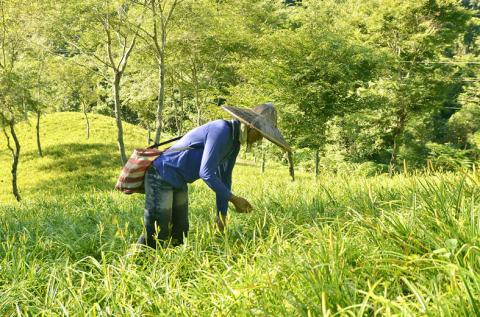
Photo: Lee Yi-tze, Taipei Times
Taiwan’s entry into the WTO further devastated the already weakened industry because it opened up the market to overseas competition, particularly from Chinese producers who flooded the Taiwanese market with daylily flowers. With little help from the government and consumers turning their back on the product, the Talampo daylily industry, and the village that depended on it for its survival, looked as though it would disappear.
The story of the Talampo Amis and the daylily flowers they’ve grown for generations are intimately tied up with the region’s post-World War II history, when Han Chinese settlers took control of the land from the Japanese, who had over-logged the area’s camphor trees.
These new settlers, after failing to grow tea, brought the flowers to the region and forced the Amis farmers to grow them.
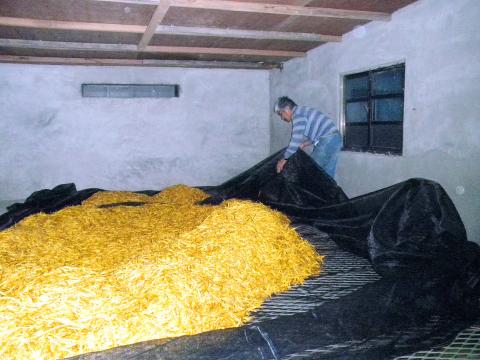
Photo: Lee Yi-tze, Taipei Times
After the crash, the region’s Chinese farmers survived by shifting their resources to tourism, particularly guest houses (民宿), and promoted the region as the “Little Switzerland of Taiwan” due to its spectacular mountain vws punctuated, during the autumn months, with fields of yellow daylily flowers. Amis farmers, however, with no savings for the sudden change, weren’t so lucky and found themselves working as laborers for the Han businessmen who could survive off tourism.
Tragedy averted
By the end of 2002, Kacaw and many of his fellow villagers had already left Talampo to find better working opportunities elsewhere. But they were soon enticed back when World Vision Taiwan offered them contract work. At the same time, Patal, a pastor in the village was discussing new ways to revitalize the daylily flower industry with Wu Mei-mao (吳美貌), a researcher at the Development Center of Biotechnology (財團法人生物技術發展中心), who wanted to collaborate with indigenous communities to grow organic produce.
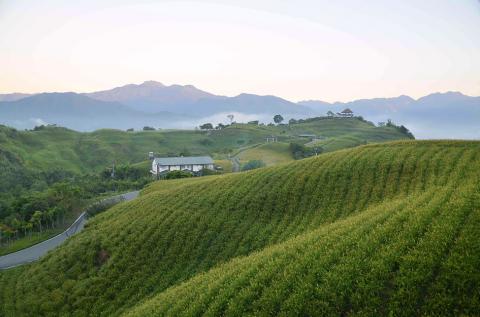
Photo: Lee Yi-tze, Taipei Times
Wu says indigenous communities are ideal for organic farming because they are less likely to be affected by chemical cross-contamination.
“Those with less income will benefit from the higher revenue afforded by organic products,” Wu adds.
Convinced of Talampo’s suitable location, Wu began teaching Talampo farmers the basic principles of organic farming — the way to make organic fertilizers from manure, for example, and how to substitute simple bioformulas for pesticides that can be harmful to the environment.
She also included Talampo as one of the five indigenous communities under the Tribal Organic Platform (原鄉有機平台), an organization that helps to promote organic agricultural products from Aboriginal communities.
Rebuilding a community
Responding to the help from Wu, Patal also encouraged Talampo farmers to organize their malabaliw, a traditional labor-exchange system, for all work such as weeding, fertilizing and harvesting Talampo’s 24 hectares of land.
They have also returned to a semi-traditional lifestyle during the weeding period that would be eminently understandable by their ancestors.
“We like the feeling of working together, singing, and joking with our neighbors. It is not just about cultivating the daylily,” Kacaw says. “It’s also a time when men flirt with women, elders pass on their knowledge of wild vegetables to the younger generation and men share their hunting stories.”
“We feel like a real community again,” Kacaw says.
In 2008 the Hualien Farmer’s Association invited the Institute of Marketecology (IMO), a Swiss organic certification agency, to certify their rice production. Wu convinced the IMO agent to stay an extra day in Talampo to see if their daylily operation could be certified organic. Surprisingly, the rice production site supported by the local Farmer’s Association failed to pass the inspection. The IMO inspector, however, granted the Talampo three-year organic certification.
Organic certification
The IMO certificate is still proudly displayed at the Talampo Signature Good Store.
“It was like getting a lifebuoy after a shipwreck,” Kacaw says.
With organic certification, Kacaw earns an average of NT$600 per kg of the flowers — all while remaining in the village of his ancestors, exerting more control over his land and being proud of a product he knows is of high quality.
Now that the Swiss certification has run out, the Talampo are currently working for organic certification from Tzu-Xin Organic Foundation (慈心有機基金會), which they hope will grant certification by the end of the year.
“Organic farming is like rolling a large stone down a hill. It is very difficult in the very beginning. But once you get it started, the movement is unstoppable.”
Ajay Verma, a consultant gastroenterologist at Kettering general hospital in Northamptonshire, says our gut is a “complex machine.” “It is constantly providing us with the nutrition we need, initially to grow and develop, and then for us to survive, thrive and repair from injury and illness.” How can we keep it functioning well? Put simply: “Make sure what you put into it is balanced, and that you clear out its waste products adequately,” Verma says. “In a general gastroenterology clinic, the most common conditions we see are irritable bowel syndrome (IBS), gastroesophageal reflux disease, inflammatory bowel disease and constipation,” says Nisha
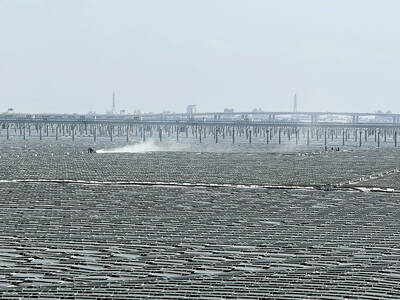
The arithmetic is straightforward and uncomfortable. By the end of 2025, Taiwan had committed itself to a 50-30-20 electricity mix — half natural gas, 30 per cent coal, 20 per cent renewables. The Ministry of Economic Affairs’s (MOEA) own monthly energy reports tell a different story. Natural gas reached 47.8 per cent of generation last year. Coal stood at 35.4 per cent, comfortably above its target ceiling. Renewables came in at 13.1 per cent, well short of the 20 per cent Taipei had pledged a decade earlier. Installed renewable capacity reached roughly half of the 12 gigawatts (GW) the government

Last week US President Donald Trump was asked by a reporter whether he would speak on the phone to the President of Taiwan. “l’ll speak to him. I speak to everybody. We have that situation very well in hand,” Trump said. This marked the second time in a couple of weeks he had said he would talk to the President of Taiwan. In 2016 he famously took a call from then-president Tsai Ing-wen (蔡英文), when he was president-elect. Despite warnings that the apocalypse was nigh because of a phone call, the world quickly forgot about the conversation between two democratically-elected presidents.

Taiwan’s drone exports are taking off, fuelled by the war in Ukraine, as Taiwanese companies seek a stake in the fast-growing global market for unmanned aerial vehicles (UAV). Low-cost drones used for reconnaissance and strikes are in high demand as governments around the world boost defense spending in the face of intensifying conflicts. A relative new player in the increasingly competitive industry, Taiwan’s pitch is to be an “Asian hub” for the production of UAVs and components free of Chinese materials, or “non-red.” That means its UAVs can be up to three times more expensive than their Chinese competitors, like the world’s biggest


 RSS
RSS