


The shark, which lands on the deck of the Coral Princess boat, is 2m of thrashing gray muscle and teeth, and the crew can’t wait to get their hands on him.
They slip a plastic breathing tube through rows of sharp serrated teeth to pump water over its gills, and get to work: measuring, taking blood and tissue samples, and drilling a small hole in its dorsal fin to attach a satellite transmitter. The device looks a bit like a bath toy.
Seven minutes later, the bull shark is back in the water. He’s got a new name (Ben), a corporate sponsor, and a Web site, which tracks his location every time his fin breaks the surface of the water. Neil Hammerschlag, who heads the RJ Dunlap marine conservation program at the University of Miami, is beaming. “He looked amazing,” he says.
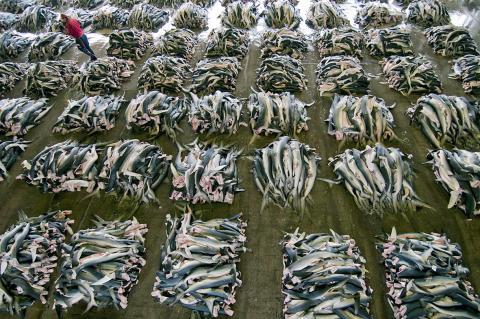
Photo: Bloomberg
It’s not the typical human-shark encounter but then the human relationship with sharks is at a tipping point — and just in time. Shark populations around the world are heading towards extinction. A creature once seen as a source of dread is now seen as a top priority for conservation.
“It’s starting to feel like the tide for sharks is turning. There is some really good momentum,” said Elizabeth Griffin Wilson, a marine scientist at conservation organization Oceana.
Even so, 2011 has been a particularly deadly year on both sides of the human-shark equation. This month alone, poachers killed 2,000 sharks at a marine sanctuary off Columbia. It may seem an implausible statistic but tens of millions of sharks are killed each year for their fins, used in shark fin soup.
On the human side, there have been 13 fatal shark attacks on humans this year, the latest victim being an American diver who was killed off the coast of Australia last weekend.
So far, the spike in shark attacks has not affected the campaign to save sharks. This month alone, California and the city of Toronto banned the sale of shark fins. Maryland said it was considering its own ban. Taiwan outlawed shark finning — the practice of slicing off fins at sea, then returning the animal to the water to drown. Florida is expected to ban the catch of tiger and hammerhead sharks.
There are moves to protect sharks in their own habitat: for example in July last year the Bahamas put 650,000km2 of its waters off-limits to fishing.
But the driving force has been an international campaign against shark finning. “People have reached the point where it is so clear you have one obvious driver of shark mortality so people feel compelled to do something,” said Julliet Eilperin, author of Demon Fish: Travels Through the Hidden World of Sharks.
One study estimated that the demand for shark fin — seen as a delicacy in China and Taiwan — killed between 26 million and 75 million sharks a year. The global trade is estimated at US$800 million a year. “To be honest, sharks are being slaughtered out here,” says Hammerschlag.
Conservation groups say existing anti-finning measures still do not go far enough. US law still allows sharks to be killed for their fins — just so long as the carcass is brought back to land intact. It merely stops the practice of cutting the fins off at sea.
“The amount of shark catch hasn’t decreased and populations are still declining. With the new rules, they are just bringing in the fins with the body,” said Matt Rand, director of shark conservation at the Pew Environment Group.
The protections are even flimsier in international waters. “It’s a free-for-all. You can catch as many as you want,” says Rand.
Hammerschlag argues that animals as in peril as some shark species need total protection. Shark populations have fallen by 85 percent, he says. “A species in that kind of decline can’t be harvested sustainably,” he says. “You can’t have industrial fishing.”
And without healthy sharks, there can be no healthy oceans.
As top predator, sharks are the master of the underwater universe. Take them out of the equation and the entire system falters, marine biologists say.
Sharks were not built for procreation, at least compared with other fish. Tuna reach maturity at age two and produce millions of eggs every year. A shark reaches maturity only in its late teens, and will then produce only a handful of pups at intervals of a few years.
And despite the Jaws lore, the majority of the 400 shark species pose no real threat to humans. Most are barely as long as an adult’s arm.
Hammerschlag and his team spend 80 days a year out on the water looking for sharks, cruising the Florida Keys with a cooler full of bloody chunks of barracuda. On this trip, he took a group from the Society of Environmental Journalists who pitched in on Ben’s “fitting.”
The scientists are trying to determine which sharks are most vulnerable — the finicky eaters, the ones most susceptible to stress — and, through the transmitters, to discover the mating grounds and other gathering points of the extremely migratory animal. The information, they hope, will help frame conservation policy.
They have tagged about 70 sharks to date, gradually building up a profile of their research subjects.
Hammerhead sharks, it seems, will fight for their life. “When it’s on the hook, it’s thrashing around,” says Austin Gallagher, who is doing his doctorate on shark responses to stress. “The hammerhead is by far the most sensitive species of shark.”
Tiger sharks, though there numbers are also severely depleted, exhibit a different response.
“Tiger sharks are super chilled. They are super relaxed,” says Gallagher. “The tiger shark can be on the hook for three hours and be looking at you when you get it into the boat and it’s like he’s saying, ‘Hi, how’s it going?’”
As a bull shark, Ben seems to fall into the second category — despite his species’ fearsome reputation. Bull sharks tend to swim closer to shore — and even upriver into fresh water — which brings them into more frequent contact with humans.
Gallagher’s blood readings show very low levels of chemicals indicating stress. Ben, it seems, has not had a lot to worry about during his seven minutes on deck. But it won’t be the same now he is back in the water.

Ajay Verma, a consultant gastroenterologist at Kettering general hospital in Northamptonshire, says our gut is a “complex machine.” “It is constantly providing us with the nutrition we need, initially to grow and develop, and then for us to survive, thrive and repair from injury and illness.” How can we keep it functioning well? Put simply: “Make sure what you put into it is balanced, and that you clear out its waste products adequately,” Verma says. “In a general gastroenterology clinic, the most common conditions we see are irritable bowel syndrome (IBS), gastroesophageal reflux disease, inflammatory bowel disease and constipation,” says Nisha
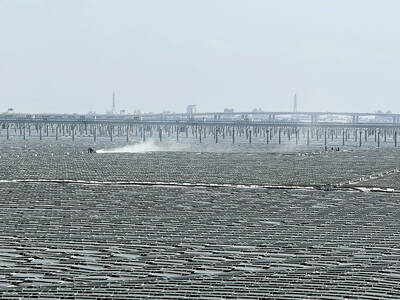
The arithmetic is straightforward and uncomfortable. By the end of 2025, Taiwan had committed itself to a 50-30-20 electricity mix — half natural gas, 30 per cent coal, 20 per cent renewables. The Ministry of Economic Affairs’s (MOEA) own monthly energy reports tell a different story. Natural gas reached 47.8 per cent of generation last year. Coal stood at 35.4 per cent, comfortably above its target ceiling. Renewables came in at 13.1 per cent, well short of the 20 per cent Taipei had pledged a decade earlier. Installed renewable capacity reached roughly half of the 12 gigawatts (GW) the government

Last week US President Donald Trump was asked by a reporter whether he would speak on the phone to the President of Taiwan. “l’ll speak to him. I speak to everybody. We have that situation very well in hand,” Trump said. This marked the second time in a couple of weeks he had said he would talk to the President of Taiwan. In 2016 he famously took a call from then-president Tsai Ing-wen (蔡英文), when he was president-elect. Despite warnings that the apocalypse was nigh because of a phone call, the world quickly forgot about the conversation between two democratically-elected presidents.
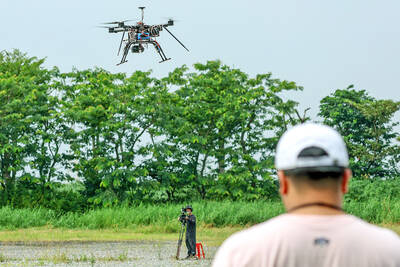
Taiwan’s drone exports are taking off, fuelled by the war in Ukraine, as Taiwanese companies seek a stake in the fast-growing global market for unmanned aerial vehicles (UAV). Low-cost drones used for reconnaissance and strikes are in high demand as governments around the world boost defense spending in the face of intensifying conflicts. A relative new player in the increasingly competitive industry, Taiwan’s pitch is to be an “Asian hub” for the production of UAVs and components free of Chinese materials, or “non-red.” That means its UAVs can be up to three times more expensive than their Chinese competitors, like the world’s biggest


 RSS
RSS