


Hsu Pu-liao (許不了) never lived to see the premiere of his most successful film, The Clown and the Swan (小丑與天鵝, 1985).
The movie, which starred Hsu, the “Taiwanese Charlie Chaplin,” outgrossed Jackie Chan’s Heart of Dragon (龍的心), earning NT$9.2 million at the local box office.

Photo: Billy Wu
Forty years after its premiere, the film has become the Taiwan Film and Audiovisual Institute’s (TFAI) 100th restoration.
“It is the only one of Hsu’s films whose original negative survived,” says director Kevin Chu (朱延平), one of Taiwan’s most commercially successful filmmakers. “We were lucky.”
For Taiwanese-language cinema, an estimated 1,000 to 2,000 films were produced between 1955 and 1981, according to TFAI. Fewer than 200 remain, though others might be rediscovered.
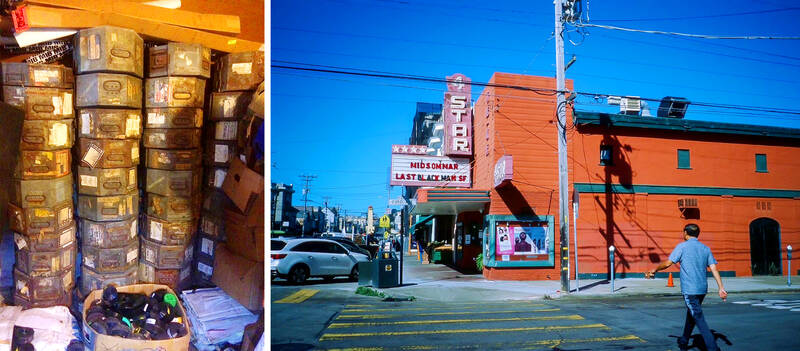
Photo courtesy of TFAI
HOW FILM WAS LOST
The Clown and the Swan survived only because its producer, gangster Wu Kung (吳功), loved cinema and kept the negatives. Indeed, according to Chu Taiwan’s film industry in the 1970s and 1980s was mostly controlled by organized crime.
“Theater owners paid NT$40 million for package deals,” he says. “Gangsters spent NT$10 million on production and pocketed the rest.”

Films were made by different gangs for the purposes of laundering money, and discarded them after theatrical runs.
Even when theaters didn’t return the prints, the negatives were used for other purposes — as shirt collar stays, for example, or padding for flip flops. Professor Robert Chen (陳儒修) of National Chengchi University’s Department of Radio and Television says that there was no awareness at the time of the importance of film preservation.
By the 1990s, the industry had collapsed. Taiwan loosened film import controls during trade talks tied to WTO accession and negotiations with the US, trading away protections for the film industry to safeguard agriculture.
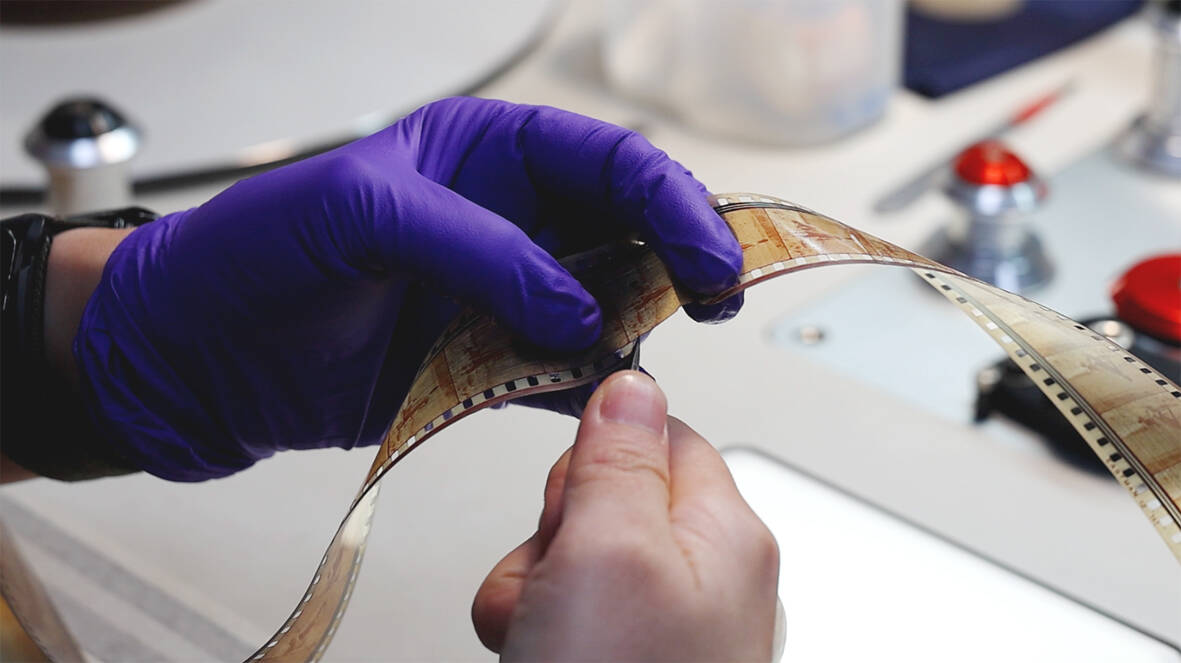
Photo courtesy of Chu Jhih-Jie
Local production fell from 81 films in 1990 to 16 in 1999, according to the Cinema Yearbook in the Republic of China: 1990–1999.
Data from the Taiwan Creative Content Agency (TAICCA) shows that today foreign films still account for 89 percent of theatrical releases.
TFAI Chairman Arthur Chu (褚明仁) says major rescue efforts in the 1990s laid the groundwork for today’s restorations.
But Taiwan’s lack of major studios and the absence of a legal mandate for film preservation meant that original negatives were scattered and difficult to trace.
Some materials were recovered by chance. The institute once found 200 reels in the basement of a San Francisco Chinatown theater, including Love in Ryukyu (琉球之戀), a Taiwanese-language color film that many believed had been lost.
RACE AGAINST TIME
TFAI today holds nearly 180,000 reels, but many are badly degraded after decades of improper storage.
In Taiwan’s humid climate, a major threat is vinegar syndrome, which causes the film base to become brittle and warp as it releases acetic acid.
Even in climate-controlled vaults, deterioration doesn’t stop. The result is a technical race against time, driven as much by patient human labor as by luck.
A badly damaged reel can take a month just to prepare for scanning.
Wang Yu-jen (王鈺禎), a digital restoration technician at TFAI, handles one of the most delicate stages: stabilizing footage and removing defects frame by frame.
“Ten minutes of footage can take a month to restore if you’re lucky,” Wang says.
She recalls spending more than half a year on a single 1980s Taiwanese classic, The Story of a Small Town (小城故事), because mold had damaged large sections of the print.
Ethics complicates the work. TFAI follows International Federation of Film Archives guidelines, prioritizing faithful restoration over “beautification.”
When the institute restored Tsai Ming-liang’s (蔡明亮) Vive L’Amour (愛情萬歲) in 4K, it asked the director to personally supervise color grading.
“The goal is always to return the film as close as possible to its original state,” says Watson Lee (李仲豪), supervisor of TFAI’s Division of Preservation and Restoration. “[Tsai’s] supervision ensured it matched what was intended at the time.”
Quality, however, is costly. Each restoration can cost millions per film, and TFAI has only six restoration technicians, few conservators and one sound restorer.
“We do our best within the time allowed,” Wang says. “Some films can only be restored so much.”
CULTURAL RESCUE
But restoration is not just technical repair. It is cultural rescue.
Wang once recognized footage from her hometown in Tainan while working on a project.
“It felt personal,” she says.
Every film also functions as a document. Beyond plot, it encodes the political, economic and cultural textures of its time.
The Story of a Small Town, for example, captures a Taiwan in transition: the completion of the Sun Yat-sen Freeway and the Taiwanization movement that emerged as the US broke diplomatic ties in the late 1970s.
“Film restoration and preservation are a vital part of safeguarding historical memory,” Chen says. “The work must go back to the negatives.”
Iris Du (杜麗琴), TFAI’s director, frames the institute’s mission as identity reconstruction.
She says that through films, documents and audiovisual records, we can reconstruct the answers to questions like who we are and how Taiwan became what it is today.
“Our mission is to reintroduce films to contemporary audiences and reinterpret them in today’s context,” Du says.
THE LIMITS OF REVIVAL
But even with the highest capacity in Asia, the current pace of 10 to 12 films a year means it will take decades to process the existing archive.
Taiwan’s talent pipeline remains narrow. Aside from Tainan National University of the Arts’ lone graduate program, there is no comprehensive training in film preservation.
Still, the cost of inaction is higher.
“If nothing is rescued, that memory disappears,” Chen says.
The institute’s work also restores the legacies of filmmakers and performers whose careers were nearly erased.
Golden Horse-winning actress Lu Hsiao-fen (陸小芬) still remembers seeing herself on screen again at a restoration screening.
“It brought back a rush of mixed emotions,” Lu says. “The long waits, the heartbreaks and the hard-won victories all resurfaced.”
Hsu Pu-liao never got that moment.
At the 40th anniversary screening of The Clown and the Swan, the audience laughed just as they did in 1985.
“Hsu gave me my career,” director Chu says. “I want the next generation to know Taiwan had this era, had this person.”

Taiwan’s overtaking of South Korea in GDP per capita is not a temporary anomaly, but the result of deeper structural problems in the South Korean economy says Chang Young-chul, the former CEO of Korea Asset Management Corp. Chang says that while it reflects Taiwan’s own gains, it also highlights weakening growth momentum in South Korea. As design and foundry capabilities become more important in the AI era, Seoul risks losing competitiveness if it relies too heavily on memory chips. IMF forecasts showing Taiwan widening its lead over South Korea have fueled debate in Seoul over memory chip dependence, industrial policy and

“China wants to unify with Taiwan at the lowest possible cost, and it currently believes that unification will become easier and less costly as time passes,” wrote Amanda Hsiao (蕭嫣然) and Bonnie Glaser in Foreign Affairs (“Why China Waits”) this month, describing how the People’s Republic of China (PRC) is playing the long game in its quest to seize Taiwan. This has been a favorite claim of many writers over the years, easy to argue because it is so trite. Very obviously, if the PRC isn’t attacking Taiwan, it is waiting. But for what? Hsiao and Glaser’s main point is trivial,
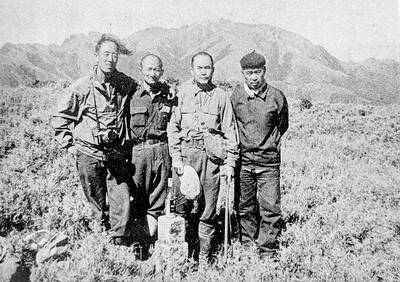
May 18 to May 24 Gathered on Yangtou Mountain (羊頭山) on Dec. 5, 1972, Taiwan’s hiking enthusiasts formally declared the formation of the “100 Peaks Club” (百岳俱樂部) and unveiled the final list of mountains. Famed mountaineer Lin Wen-an (林文安) led this effort for the Chinese Alpine Association (中華山岳協會). Working with other experienced climbers, he chose 100 peaks above 10,000 feet (3,048m) that featured triangulation points and varied in difficulty and character. The list sparked an alpine hiking craze, inspiring many to take up mountaineering and competing to “conquer” the summits. A common misconception is that the 100 Peaks represent Taiwan’s 100 tallest

The Chinese Nationalist Party (KMT), alongside their smaller allies the Taiwan People’s Party (TPP), are often accused of acting on behalf of the Chinese Communist Party (CCP). Some go so far as to call them “traitors.” It is not hard to see why. They regularly pass legislation to stymie the normal functioning of the ruling Democratic Progressive Party’s (DPP) administration, and they have yet to pass this year’s annual budget. They slashed key elements of the government’s proposed NT$1.25 trillion (US$40 billion) special military budget, and in the smaller NT$780 billion package they did pass, it is riddled with provisions that


 RSS
RSS