


Located in Taipei’s East District (東區), Even Select Shop specializes in avant-garde designs, with a focus on Japanese labels. It is Taiwan’s exclusive retailer of Japanese brand Frapbois; other offerings include T-shirts by Play, Comme Des Garcons’ sportswear label, platform shoes by Unbilical & Belly Button and a roster of emerging designers from Europe.
Owner Even Chen (陳儀文) began importing clothing from Japan in 1994, when she was a fashion-conscious 20-year-old, and sold her finds in Ximending, where Even Select Shop still has a store in Shinjuku Plaza (西門新宿) mall. The store opened its East District flagship boutique in July last year.
Chen says she has had a passion for wearing offbeat clothing since she was a little girl.
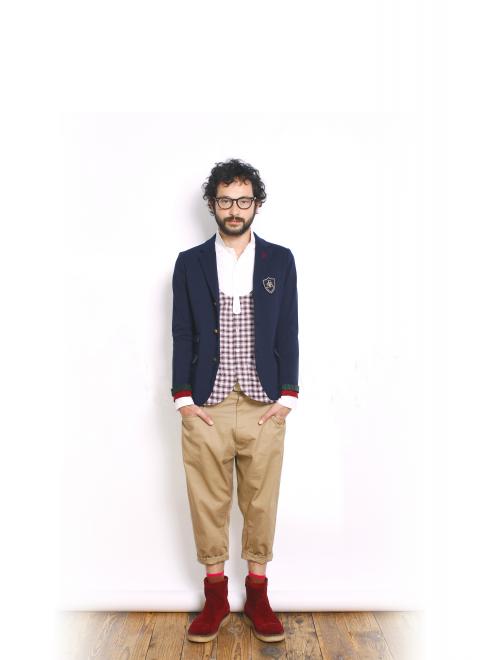
Photo:Courtesy of Even Select Shop
“I just liked dressing up. I was always very vain,” says Chen. She is fluent in Japanese and visits the country once a month to keep abreast of trends. One of her favorite Tokyo neighborhoods is Shinjuku, where Chen takes note of what young hipsters are wearing. She also reads Japanese magazines like So-en, Nylon and Fruits, which is devoted to street style. Current trends Chen likes include duffle coats, harem pants and oversized cardigans with dolman sleeves.
All of those styles are represented in Frapbois’ current line. The Japanese label is known for its fanciful shapes and unusual fabric combinations. Knitwear in Frapbois’ autumn-winter collection, called “Leprechaun Crossing,” include an oversized sweatshirt topped with a yoke knit from three yarns in different gauges. Dresses and jackets have flourishes like petal-shaped collars or appliques cut from fake fur. Scarves, cardigans and vests are pieced together from a patchwork of cabled knits in neutral hues like heather gray and oatmeal. Cozy fabrics like plaid flannel contrast with trendy silhouettes like a pair of flouncy “skorts” (a cross between shorts and a skirt) that feature a balloon hem and fleece lining.
Chen likes pairing her Frapbois dresses with platform shoes from Unbilical & Belly Button. The Japanese shoe brand’s current collection includes sleek ballet slippers with ladylike ankle straps perched on top of boat-like platforms that are 18cm to 23cm tall.
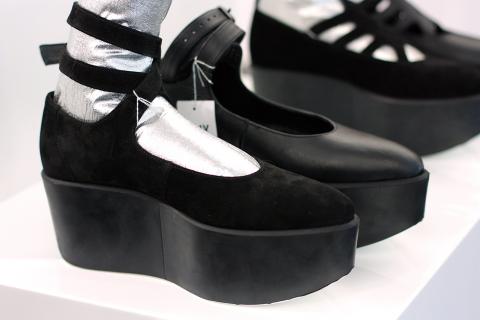
Photo: Catherine Shu, Taipei Times
Another one of Chen’s favorite designers is German-born, Belgium-based Bernhard Willhelm, whose latest collection shows off influences from Chinese and Japanese art.
“I love his use of color. It’s very exuberant and his cuts are also unique,” says Chen of Willhelm’s exaggerated silhouettes.
Willhelm’s prints are inspired by ink paintings or calligraphy, with bold splashes of color set against a contrasting background, while dresses and tops are cut to resemble kimonos. A dusk blue wool A-line coat is given a dash of flair with the Chinese characters for “now” (現在) silk-screened across the front.
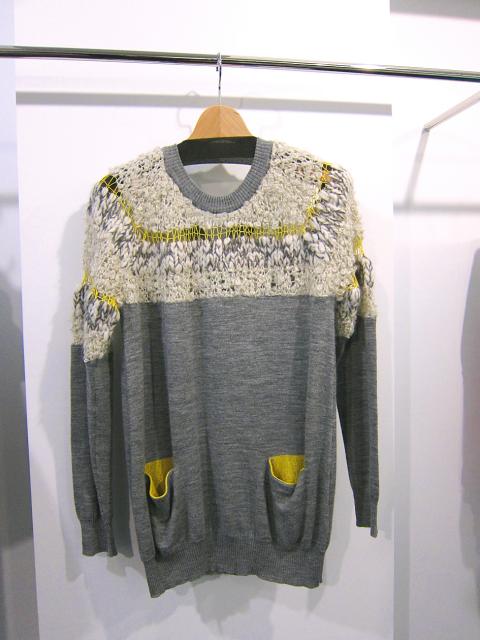
Photo: Catherine Shu, Taipei Times
A tunic with an asymmetrical, gathered hem seems to float above the wearer’s knees like a cloud, while a kelly green cardigan is covered with a lace-like network of holes and rips that make it look like a swarm of artistically minded moths converged on it.
Even Select Shop also carries several lines by emerging designers and independent labels. Despite its name, Japanese brand Bikini doesn’t sell swimwear, but accessories and clothing that show off heavy woolen cloth recycled from American and German military uniforms, like a sweeping double-breasted cape. “Their lines are simple, but they use the very best fabric and materials,” says Chen.
Blank X Marco, another Japanese line, takes a playful approach to avant-garde fashion. One oversized gray sweatshirt features an embroidered motif based on an illustration from a medieval manuscript, while another is covered with wild, freeform embroidery in crewel wools.
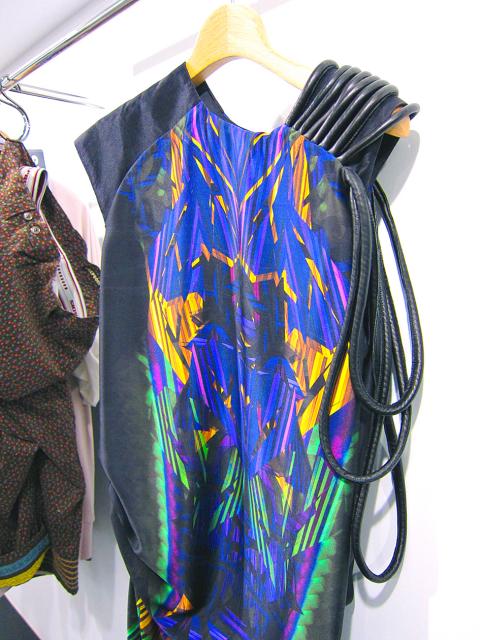
Photo: Catherine Shu, Taipei Times
In addition to Japan, Chen also makes regular buying trips to Europe. Labels she has discovered on those twice-yearly sojourns include London-based Belle Sauvage. Its designs feature crisp, kaleidoscopic digital prints in rich, jewel colors and sharp details, like shoulders sewn from quilted fake leather. German designer Esther Perbandt approaches fabric with a sculptor’s sensibility. Her pieces are mostly monochromatic, in black, white or shades of gray, but highly structured, with unusual tailoring on jackets: origami-like folds or chiffon draped gracefully like the chitons worn by figures in ancient Greek sculpture.
Items in Even Select Shop range in price from NT$2,000 to NT$30,000. Bernhard Willhelm’s line is NT$8,000 to NT$30,000, while Frapbois pieces are NT$3,000 to NT$20,000. Unbilical & Belly Button shoes sell for about NT$10,000 to NT$20,000 per pair.
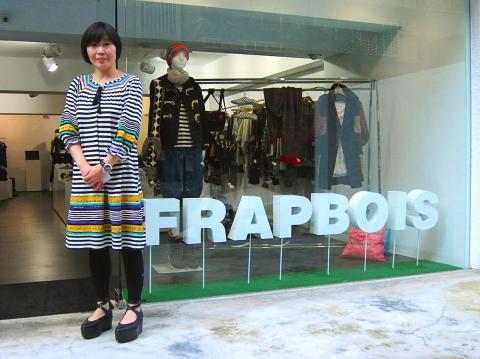
Photo: Catherine Shu, Taipei Times
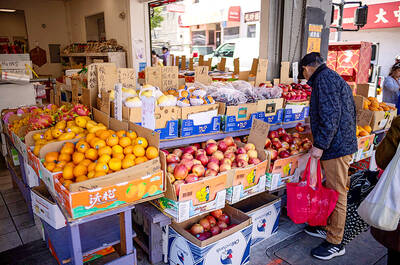
Ajay Verma, a consultant gastroenterologist at Kettering general hospital in Northamptonshire, says our gut is a “complex machine.” “It is constantly providing us with the nutrition we need, initially to grow and develop, and then for us to survive, thrive and repair from injury and illness.” How can we keep it functioning well? Put simply: “Make sure what you put into it is balanced, and that you clear out its waste products adequately,” Verma says. “In a general gastroenterology clinic, the most common conditions we see are irritable bowel syndrome (IBS), gastroesophageal reflux disease, inflammatory bowel disease and constipation,” says Nisha
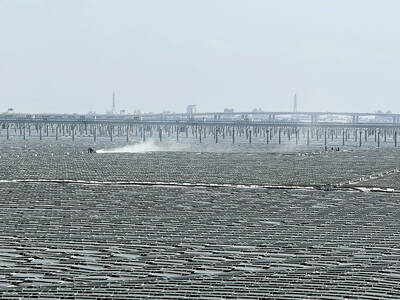
The arithmetic is straightforward and uncomfortable. By the end of 2025, Taiwan had committed itself to a 50-30-20 electricity mix — half natural gas, 30 per cent coal, 20 per cent renewables. The Ministry of Economic Affairs’s (MOEA) own monthly energy reports tell a different story. Natural gas reached 47.8 per cent of generation last year. Coal stood at 35.4 per cent, comfortably above its target ceiling. Renewables came in at 13.1 per cent, well short of the 20 per cent Taipei had pledged a decade earlier. Installed renewable capacity reached roughly half of the 12 gigawatts (GW) the government
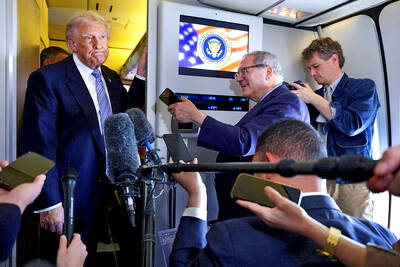
Last week US President Donald Trump was asked by a reporter whether he would speak on the phone to the President of Taiwan. “l’ll speak to him. I speak to everybody. We have that situation very well in hand,” Trump said. This marked the second time in a couple of weeks he had said he would talk to the President of Taiwan. In 2016 he famously took a call from then-president Tsai Ing-wen (蔡英文), when he was president-elect. Despite warnings that the apocalypse was nigh because of a phone call, the world quickly forgot about the conversation between two democratically-elected presidents.
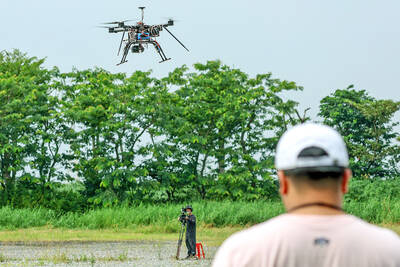
Taiwan’s drone exports are taking off, fuelled by the war in Ukraine, as Taiwanese companies seek a stake in the fast-growing global market for unmanned aerial vehicles (UAV). Low-cost drones used for reconnaissance and strikes are in high demand as governments around the world boost defense spending in the face of intensifying conflicts. A relative new player in the increasingly competitive industry, Taiwan’s pitch is to be an “Asian hub” for the production of UAVs and components free of Chinese materials, or “non-red.” That means its UAVs can be up to three times more expensive than their Chinese competitors, like the world’s biggest


 RSS
RSS