


As the pickup truck bounced toward a remote village deep in northeastern Afghanistan, the young woman was told by her companions that she could toss her burqa aside.
“It’s free here,” said the woman, Zarmina Nazaria, a 26-year-old nurse.
She slipped off her powder-blue burqa and laid it on the rear seat.
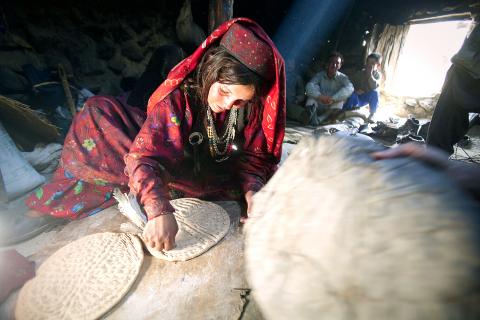
Photo: Bloomberg
The rules that apply to the rest of Afghanistan are often irrelevant in the Wakhan Corridor, a frigid, finger-shaped stretch of land squeezed between Tajikistan, Pakistan and China that is cut off from the Afghan heartland by the icy ramparts of the Hindu Kush. Here, the one constant of life for most Afghans — war — is as distant as a tropical wind.
From the Soviet invasion to the civil war to the Taliban takeover to the anti-Taliban resistance, the Wakhan has remained largely free of strife. No Taliban show their faces here, nor do US soldiers. Villagers train to be wildlife rangers, not army rangers. The prevalent brand of Islam, Ismailism, is moderate; its spiritual leader, the Aga Khan, is a billionaire society figure in Paris.
Foreign tourists are trickling in, about 200 during each of the past two summers. The trekkers and mountaineers are following in the footsteps of explorers like Marco Polo and Sir Aurel Stein. This year, British and Polish expeditions climbed 6,000m peaks in the area.
Long ignored by Kabul, the people lack the most basic services. But nongovernmental groups have a growing presence, finding it easier to work here than in more violent parts of Afghanistan. Greg Mortenson, co-author of Three Cups of Tea, has built 11 schools in the corridor through his nonprofit group, the Central Asia Institute. Foreign employees of the Wildlife Conservation Society track snow leopards and train local rangers.
“There has been no war and no violence in the Wakhan,” said Malang Daria, a local trekking guide who was part of a 2009 French-Afghan expedition that climbed Noshaq, at 7,500m Afghanistan’s highest peak. “The people here are very peaceful, very calm.”
More than 12,000 people live in the 350km corridor, a series of broad valleys and high-altitude plateaus carved by the Panj River. A vast majority are ethnic Wakhi. As Ismailis, they eschew some of the mainstream conventions of Islam. They do not fast during Ramadan, for example, which is unheard of elsewhere in Afghanistan, where conservative Sunnis predominate.
“Ismailis have a modernist outlook,” said John Mock, a scholar of South Asia at the University of California, Santa Cruz. “The Aga Khan promotes modernism.”
Wakhi villages dot Afghanistan, Pakistan, Tajikistan and China. The Wakhan Corridor should logically be part of Tajikistan or Pakistan, but an 1895 agreement between Britain and Russia made it an Afghan-controlled buffer zone to prevent their two empires from touching.
The corridor has remained a no-man’s-land. It is so remote that the people still live on a barter economy. During the summer, they trade sheep, goats and yaks, usually their only valuables, to merchants who arrive on horseback bearing clothing and other luxury items. Some are resentful of the outsiders, who resell the livestock at a substantial profit.
Wakhi herders tend flocks of sheep, and women in traditional red dresses work the wheat and barley fields. They don burqas only when going to Ishkashim, a village at the western mouth of the corridor where half the residents are Sunni Tajiks. Some Wakhi traders cross freely between Afghanistan and Pakistan over high passes.
In the eastern half, toward China, the corridor becomes a lunar bowl not unlike the Tibetan plateau. This is the Little Pamir, home to about 100 nomadic Kyrgyz families who live in felt yurts above 4,000m. Closer to Tajikistan, 140 Kyrgyz families live on a plateau called the Big Pamir. Blizzards are known to blow through in August.
At Bozai Gumbaz, in the heart of the Little Pamir, centuries-old beehive-shaped tombs built by the Kyrgyz sit next to rusted concertina wire left over from a Soviet military base. Beside the graves flow the waters of the Panj, better known elsewhere as the Amu Darya, born from a glacier near the Chinese border.
The Wakhan was not always sealed off from the currents of history. A branch of the Silk Road once ran through here, bringing influences from different civilizations. Outside the village of Sarhad-e Broghil, the ruins of an eighth-century Tibetan fort sit on a knoll.
“In terms of religious belief, Zoroastrianism, Buddhism and Islam have all been prevalent in the region at different times and have left their mark,” said Andy Miller, a heritage consultant in Kabul who wrote a book on folklore of the Wakhan.
Marco Polo wandered through the valley, as did Francis E. Younghusband, the British Great Game explorer whose surprise run-in with a Russian colonel at Bozai Gumbaz led to the negotiations that would create the borders of the modern Wakhan.
Nor are the people here today untouched by the political struggles and violence that rage outside the Wakhan. Malang, the mountaineer, said his half brother, Daulat Muhammad, 40, a policeman, was killed in August while taking part in a disastrous Afghan army battle against the Taliban around Kunduz.
Social problems endemic to other parts of Afghanistan also surface. Opium addiction is common among the Kyrgyz nomads. In the summer settlement of Kashch Goz, several Kyrgyz spend their days smoking in their yurts. With outside help, the Wakhi largely broke their addiction years ago.
The Kyrgyz complain about a lack of attention from Kabul. They say food, running water and electricity are scarce in the Pamirs. One Kyrgyz elder, Haji Osman, recently asked Afghan President Hamid Karzai for aid.
“We’re still waiting,” he said.
(Osman has less to complain about than most Kyrgyz, though: He has a satellite dish outside his yurt and a TV powered by solar electricity.)
When some locals discuss how the Wakhan might develop, they look east, toward the frontier with China. They say they hope that China and Afghanistan will one day open the border at the Wakhjir Pass and that China will build a road or railway through the corridor, perhaps to gain better access to Afghanistan’s rich mineral deposits. Afghan officials say they have pressed China on the question.
“The Chinese side says principally it is important, but practically it takes time and money,” said Sultan Baheen, the Afghan ambassador to China.
Until those doors open, the Wakhan and its people will probably remain cloistered in their world of wind and ice, as they have for centuries.

By global standards, the traffic congestion that afflicts Taiwan’s urban areas isn’t horrific. But nor is it something the country can be proud of. According to TomTom, a Dutch developer of location and navigation technologies, last year Taiwan was the sixth most congested country in Asia. Of the 492 towns and cities included in its rankings last year, Taipei was the 74th most congested. Taoyuan ranked 105th, while Hsinchu County (121st), Taichung (142nd), Tainan (173rd), New Taipei City (227th), Kaohsiung (241st) and Keelung (302nd) also featured on the list. Four Japanese cities have slower traffic than Taipei. (Seoul, which has some

In our discussions of tourism in Taiwan we often criticize the government’s addiction to promoting food and shopping, while ignoring Taiwan’s underdeveloped trekking and adventure travel opportunities. This discussion, however, is decidedly land-focused. When was the last time a port entered into it? Last week I encountered journalist and travel writer Cameron Dueck, who had sailed to Taiwan in 2023-24, and was full of tales. Like everyone who visits, he and his partner Fiona Ching loved our island nation and had nothing but wonderful experiences on land. But he had little positive to say about the way Taiwan has organized its

The entire Li Zhenxiu (李貞秀) saga has been an ugly, complicated mess. Born in China’s Hunan Province, she moved to work in Shenzhen, where she met her future Taiwanese husband. Most accounts have her arriving in Taiwan and marrying somewhere between 1993 and 1999. She built a successful career in Taiwan in the tech industry before founding her own company. She also served in high-ranking positions on various environmentally-focused tech associations. She says she was inspired by the founding of the Taiwan People’s Party (TPP) in 2019 by Ko Wen-je (柯文哲), and began volunteering for the party soon after. Ko
During her 2015 trip to Taiwan, Sophia J. Chang (張詠慧) got fewer answers than she’d hoped for, but more revelations than she could have imagined. “That was the year I last saw my grandmother. She was in hospice care in Tainan, and it was painful to see her in bed, barely able to open her eyes,” says Los Angeles-born Chang. “The grandma I’d known, a fantastic cook and incredibly kind, was already gone.” After their visit, Chang and her grandfather went back to his apartment. There she asked him how he’d met her grandmother. “He hesitated, then started talking a bit.


 RSS
RSS