


With newfound stardom comes heartbreak, at least for singer Hsu Chia-ying (徐佳瑩), aka Lala Shu, who became a household name after winning the third season of CTV’s One Million Star (超級星光大道) talent show. The 25-year-old split up with her beau of two years, fellow aspiring singer Born Lee (李伯恩), after seeing an incriminating text message from another woman on his mobile phone.
It wasn’t a case of snooping, though. The Apple Daily helpfully detailed her unceremonious discovery of Lee’s infidelity: The two were out having breakfast several weeks ago, fresh from celebrating her five nominations at this year’s Golden Melody Awards. Hsu’s cellphone ran out of power, so she borrowed Lee’s iPhone, whereupon she saw a “suspicious” text message from “Catherine,” an up-and-coming actress from a TV talk show for college students.
An Apple Daily reporter cornered Hsu after spotting her shopping at Taipei 101, where she denied the text message was the sole reason for the breakup, although “it was the last straw.” Asked if there was any chance of reconciliation with Lee, who was Hsu’s fellow contestant on One Million Star and once declared his love to her on the program, she answered, “Impossible.” But she said she has no regrets and the relationship has led to some “soul-searching.”
Perhaps Hsu should follow A-mei’s (張惠妹) example, after all, the diva well knows that celebrity romance isn’t easy, but the perks of stardom do offer some solace.
The pop star headed to Los Angeles earlier this week for three concerts and is making the most out of her trip: first-class air travel, five-star hotel, and a trip to Las Vegas during her two-week stay in the US. The Apple Daily reports that an American company, Amway, is spending a total of NT$13.5 million on bringing the Mando-pop queen to LA.
A-mei has set aside NT$330,000 for a road-trip to Las Vegas with her entourage, which Apple suggests is a good chance to heal after breaking up with basketball star Sam Ho (何守正).
Not letting the grass grow under her feet, A-mei already has a new crush, so says Chinese pop singer Na Ying (那英), who claims that her friend and labelmate at Warner Music is interested in a fellow acquaintance from Beijing. Na accidentally spilled the beans last week at press conference in Taipei, where she is slated to perform next month. Our sister paper the Liberty Times later pressed Na for more details, but she wouldn’t budge, except to add that the prospective Prince Charming is not a wealthy businessman or an athlete.
One story racking up hits on the Internet this week is the court battle between actress Alyssa Chia (賈靜雯) and her ex-husband Sun Chih-hao (孫志浩). Chia recently won custody of their five-year old daughter in the US, where she had been living with Sun’s family. Sun has retaliated in the Taiwanese courts by suing Chia for custody of “Sister Wutong” (梧桐妹), as their daughter is referred to in the press, her half of a shared apartment in Shanghai and NT$26 million in cash.
Sun says this hefty sum is to reclaim the NT$5 million he gave to the Chia family when they got married, as well as further monthly payments of NT$100,000. Chia and her lawyer have balked at the suit and countered that the money had already been returned several years ago, and that Sun has failed to pay any of their daughter’s living expenses. And it’s not as if Sun needs the cash. The Apple Daily says Sun rakes in NT$230,000 a month through his father’s cargo transport firm and his family holds over NT$100 million in real estate assets, which include properties in Shanghai, Los Angeles and Taipei.
Spectacular failure seems to go hand-in-hand with celebrity romances, at least on the gossip pages, but here’s a happy beginning: Selina Jen (任家萱) of the popular girl group S.H.E received a surprise marriage proposal from her boyfriend Richard Chang (張承中) on stage during a concert at Taipei Arena (台北小巨蛋).
The stunt, which Chang conceived after consulting with Jen’s bandmates and their record label, didn’t exactly go as planned, according to the China Times. After picking up a microphone and rambling on about his well wishes for the group in front of a cheering audience of 10,000, Chang became flustered. Instead of getting down on bended knee to ask for her hand in marriage, the lawyer blurted out “My wife, I love you.” Jen had already gotten the message anyway, and was in tears.


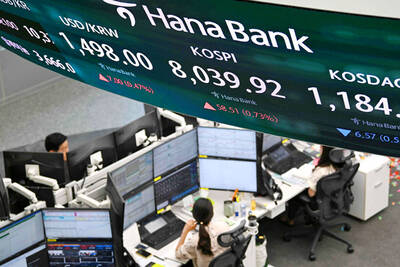
Taiwan’s overtaking of South Korea in GDP per capita is not a temporary anomaly, but the result of deeper structural problems in the South Korean economy says Chang Young-chul, the former CEO of Korea Asset Management Corp. Chang says that while it reflects Taiwan’s own gains, it also highlights weakening growth momentum in South Korea. As design and foundry capabilities become more important in the AI era, Seoul risks losing competitiveness if it relies too heavily on memory chips. IMF forecasts showing Taiwan widening its lead over South Korea have fueled debate in Seoul over memory chip dependence, industrial policy and
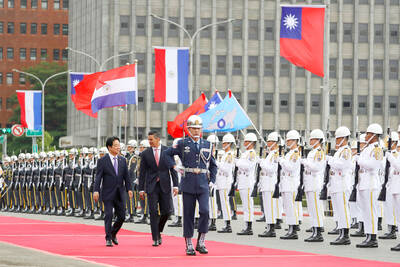
“China wants to unify with Taiwan at the lowest possible cost, and it currently believes that unification will become easier and less costly as time passes,” wrote Amanda Hsiao (蕭嫣然) and Bonnie Glaser in Foreign Affairs (“Why China Waits”) this month, describing how the People’s Republic of China (PRC) is playing the long game in its quest to seize Taiwan. This has been a favorite claim of many writers over the years, easy to argue because it is so trite. Very obviously, if the PRC isn’t attacking Taiwan, it is waiting. But for what? Hsiao and Glaser’s main point is trivial,
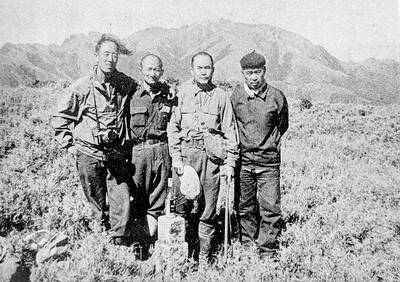
May 18 to May 24 Gathered on Yangtou Mountain (羊頭山) on Dec. 5, 1972, Taiwan’s hiking enthusiasts formally declared the formation of the “100 Peaks Club” (百岳俱樂部) and unveiled the final list of mountains. Famed mountaineer Lin Wen-an (林文安) led this effort for the Chinese Alpine Association (中華山岳協會). Working with other experienced climbers, he chose 100 peaks above 10,000 feet (3,048m) that featured triangulation points and varied in difficulty and character. The list sparked an alpine hiking craze, inspiring many to take up mountaineering and competing to “conquer” the summits. A common misconception is that the 100 Peaks represent Taiwan’s 100 tallest

In a sudden move last week, opposition lawmakers of the Chinese Nationalist Party (KMT) and Taiwan People’s Party (TPP) passed a NT$780 billion special defense budget as a preemptive measure to stop either Chinese leader Xi Jinping (習近平) or US President Donald Trump from blocking US arms sales to Taiwan at their summit in Beijing, said KMT heavyweight Jaw Shaw-kong (趙少康), speaking to the Taipei Foreign Correspondents Club on Wednesday night in Taipei. The 76-year-old Jaw, a political talk show host who ran as the KMT’s vice presidential candidate in 2024, says that he personally brokered the deal to resolve


 RSS
RSS