


Saw VI
Jigsaw is back — and he’s still dead. Never mind; there are plenty of flashbacks to keep the ghostly Tobin Bell cast as the moralist from hell for another year. This time he or his acolytes are after a deserving chap who deals in health insurance, and assorted other victims. Reliable reviewers thought this one stacked up pretty well given that the series is running out of scope and room for plot twists. Even so, it was ambushed at the US box office by a long-delayed, Blair Witch-style horror movie called Paranormal Activity. That film is due for release on Dec. 11.
The Devil’s Tomb
Cuba Gooding Jr, Ron Perlman and Ray Winstone head the cast of this underground action movie in which Cuba and badass military mercenary colleagues set out to rescue a group of archeologists from a most sinister location — and begin suffering hallucinations, Event Horizon-style, when they run into something not of this Earth. Not for the discerning film buff, perhaps, but it does star Henry Rollins as a priest and Bill Moseley (The Texas Chainsaw Massacre 2, The Devil’s Rejects) as an oddball professor. This directorial debut of actor Jason Connery (son of Sean) went straight to DVD in the US.
Old Fish (千鈞一髮)
An unusual Chinese police drama, to say the least. A Harbin cop is forced — and able — to defuse a time bomb thanks to his engineering background, only to find that more and more explosives are being planted in the area, and his superiors want him to keep doing the dirty work. Is Dennis Hopper on the loose? Ma Guowei (馬國偉) plays “Old Fish,” the put-upon policeman, in an award-winning turn. Directed by Gao Qunshu (高群書), who co-directed The Message (風聲), which is currently on release.
Plastic City (蕩寇)
A Chinese crook (Anthony Wong, 黃秋生) and his cooler-than-cool adopted Japanese son struggle to keep their enterprise afloat in Sao Paulo, Brazil, when rivals and the authorities turn on them, including a Taiwanese entrepreneur. Critics said the fascinating idea behind the film and its visual distinctiveness were undercut by avoidable technical problems (dubbing, for starters) and a stereotypically art house divergence from coherent narrative — not to mention stylistic lapses that verge on the silly.
Vengeance (復仇)
Johnnie To (杜琪峰) is a Hong Kong director who has kept pumping out solid action flicks over the years. He probably doesn’t have as much international exposure as he should, but this film may help to change that. The lead actor is legendary French singer Johnny Hallyday, who arrives in Macau after his daughter is nearly killed in a triad hit (the rest of her family is wiped out). Hallyday, now a chef, must draw on his unsavory past to accomplish his vengeful mission — but that past is disappearing as an old injury accelerates his amnesia. Co-stars include the formidable Anthony Wong (黃秋生) as a criminal (again) and Simon Yam (任達華) as a triad boss.
Chef’s Special
Chef’s Special throws together a bunch of funny characters centered around a restaurant in Spain whose chef is struggling to cope with life’s challenges, though vengeance plays no role this time. It’s a comedy, so things can only get more chaotic; in this case, the chef finds himself in a relationship with his new neighbor despite the fact that one of his female employees wants the man for herself — and that’s only one plot line. Vibrant and amusing, this is a crowd-pleaser that stands out in a busy week of releases.
The Song of Sparrows
Iranian filmmakers regularly deliver outstanding product, and while this award-winning drama from last year may not be in the top tier, it should please fans of Middle East cinema. A worker at an ostrich farm loses his job and travels to Tehran, where he struggles to maintain his sense of self as the urban environment closes in around him, leading to a tragedy — or so it seems. Salon.com called this visually handsome film “leisurely and lovely.” Directed by Majid Majidi, who has built a solid reputation over the years.
Where Are We Going?
The Japan Times praised this unusual romantic drama in which a taciturn, mistreated young gay man falls in love with a transsexual. Murder is the result, but the film violates any number of moralistic film conventions by being firmly on the side of the protagonists. Starts tomorrow at the Baixue theater in Ximending as part of a promotion for its DVD release.
Angels on a Pin (針尖上的天使)
Finally, a quick mention for a short (17-minute) film by Taiwanese director Wu Mi-sen (吳米森) at the Spot theater in Taipei. The three screenings have been changed from the original calendar to late tonight and early tomorrow and Sunday evening. Entry is free; tickets will be available on a first-come, first-served basis an hour before each session.
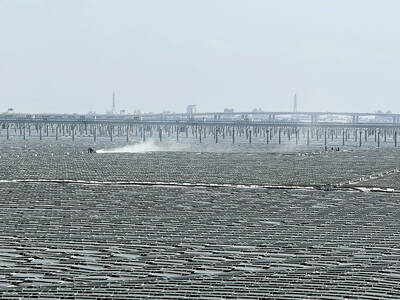
The arithmetic is straightforward and uncomfortable. By the end of 2025, Taiwan had committed itself to a 50-30-20 electricity mix — half natural gas, 30 per cent coal, 20 per cent renewables. The Ministry of Economic Affairs’s (MOEA) own monthly energy reports tell a different story. Natural gas reached 47.8 per cent of generation last year. Coal stood at 35.4 per cent, comfortably above its target ceiling. Renewables came in at 13.1 per cent, well short of the 20 per cent Taipei had pledged a decade earlier. Installed renewable capacity reached roughly half of the 12 gigawatts (GW) the government

There are shadowy cabals plotting to sell out Taiwan to be annexed by China, by invasion if necessary. Fortunately, they are buffoons. In 2019, former Bamboo Union gangster and founder of the China Unification Promotion Party (CUPP), Chang An-le (張安樂, colorfully known as “White Wolf”), led a protest at the Legislative Yuan against comments made by then-premier Su Tseng-chang (蘇貞昌) that in the event of an attack by China, he would never surrender, but would protect the nation by fighting to the end, even if he only had a broom. Chang had party members bring a wooden casket that they
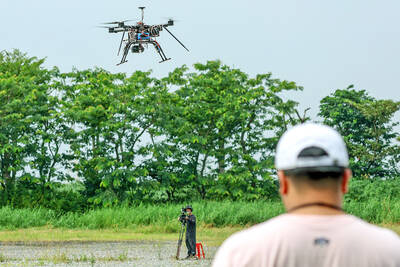
Taiwan’s drone exports are taking off, fuelled by the war in Ukraine, as Taiwanese companies seek a stake in the fast-growing global market for unmanned aerial vehicles (UAV). Low-cost drones used for reconnaissance and strikes are in high demand as governments around the world boost defense spending in the face of intensifying conflicts. A relative new player in the increasingly competitive industry, Taiwan’s pitch is to be an “Asian hub” for the production of UAVs and components free of Chinese materials, or “non-red.” That means its UAVs can be up to three times more expensive than their Chinese competitors, like the world’s biggest
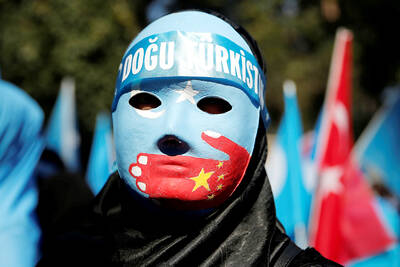
It seems every few days one bumps into one of those “real man” comments in which Taiwan is urged to “face reality” or similar, and “make a deal,” with the speaker implying that soon it will be too late. “Deal” advocates always present themselves as having a superior grip on reality, and the manly ability to make the “hard choice.” Their testosterone-laden language often echoes that of Taiwan sellout advocates. Note that such commentary always specifies a process (“make a deal, work with, make progress”), never the end state of what occupation by a violent authoritarian colonialist state will entail. In


 RSS
RSS