


It is the awkward fate of China, more than any other country, to be arriving late to any number of parties where most other revelers are either long gone or leaving, having declared the celebrations declasse. Such is the case with China’s booming smokestack economy and with its ardent new fling with the automobile, with its desire for a deep-water navy built around aircraft carriers, and with its ambition for a space program that will land on the Moon.
China is also just beginning to grapple with the creation of what most in the developed world would recognize as a modern legal system, and it is in much the same position with its cobbling efforts to reinvent the welfare state.
Most anachronistic of all, though, is the country’s treatment of its two largest minorities, the Tibetans and Uighurs, both old, non-Han indigenous civilizations that claim meaningful autonomy in China’s vast, resource-rich and sparsely populated west. Our Western legacy may give us little to cluck about, but in today’s world the rights and interests of native peoples have rightly won greater recognition.
In this memoir, Dragon Fighter, part defiant political tell-all, part engrossing personal saga, Rebiya Kadeer paints a vivid picture of her life as a mother of 11 and a businesswoman who spent nearly six years in prison on her way to becoming the Uighur people’s most prominent dissident.
Even Westerners who pay relatively little attention to China will be at least vaguely familiar with the plight of Tibetans.
Such is not the case with the Uighur, a central Asian people who are distant relatives of the Turks and native to what China calls the Xinjiang Uighur Autonomous Region, or the New Frontier, an area three and half times as large as California, whose indigenous people look all but set to join the ranks of history’s great, overrun losers.
One thing the Uighur, spelled Uyghur in this book, have never had is a leader with great recognition outside China, like the Dalai Lama, who has contributed a brief introduction for this memoir. Kadeer writes: “Politicians and human rights organizations from all over the world were active on behalf of Tibet. The conditions in the Uyghur nation were much the same. But interest from abroad in the two, though literally we were next-door neighbors sharing a common border and both under Chinese occupation, could not have been more dissimilar.”
Kadeer writes perceptively about the many humiliations imposed by Beijing on the Uighurs, including routine business harassment and forced abortions, massacres and barriers to trade and contact with other central Asian neighbors.
On one level, Kadeer’s book is a routine account of recent Chinese history. Much more interesting is its core autobiographical story: the remarkable rise from modest roots to a life as, the author claims, the wealthiest woman in China and a politically prominent member of the National People’s Congress.
Here, though, the book is marred by language that betrays limited modesty and perhaps even limited self-knowledge.
Through sheer force of personality Kadeer overcomes a bad marriage to an abusive husband, then seeks out and marries a former political prisoner and poet.
Years later, having built a fortune (and a big reputation) in department stores and real estate, Kadeer begins to attract the wooing calls of the party. Her big moment comes in a speech before the Congress in Beijing, in which she boldly switches the approved text to ask: “Is it our fault that the Chinese have occupied our land? That we live under such horrible conditions?”
If not the first time she had spoken truth to power, it was certainly the beginning of the end. Soon afterward Kadeer was arrested. She was tried, imprisoned for nearly six years and exiled to the US.
This remarkable life is now added to the saga of the Uighur people, a people without leaders.

Just after 6am, I walked up to the ticket gate at Taipei Main Station and entered the Taiwan Railway platform without scanning any ticket; instead, I flashed the Sanrio Fun Rail pass on my phone to the gate worker and was admitted. I found my train and prepared to board. My destination? This very same station. I was embarking on a 13-hour journey on one of two round-the-island trains operated by ezTravel. They run each day, one counterclockwise around the island and one clockwise. They differ in a number of ways from an ordinary Taiwan Railway train and can make for
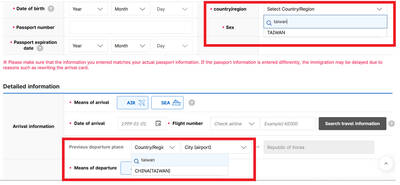
Jason Han says that the e-arrival card spat between South Korea and Taiwan shows that Seoul is signaling adherence to its “one-China” policy, while Taiwan’s response reflects a reciprocal approach. “Attempts to alter the diplomatic status quo often lead to tit-for-tat responses,” the analyst on international affairs tells the Taipei Times, adding that Taiwan may become more cautious in its dealings with South Korea going forward. Taipei has called on Seoul to correct its electronic entry system, which currently lists Taiwan as “China (Taiwan),” warning that reciprocal measures may follow if the wording is not changed before March 31. As of yesterday,

The Portuguese never established a presence on Taiwan, but they must have traded with the indigenous people because later traders reported that the locals referred to parts of deer using Portuguese words. What goods might the Portuguese have offered their indigenous trade partners? Among them must have been slaves, for the Portuguese dealt slaves across Asia. Though we often speak of “Portuguese” ships, imagining them as picturesque vessels manned by pointy-bearded Iberians, in Asia Portuguese shipping between local destinations was crewed by Asian seamen, with a handful of white or Eurasian officers. “Even the great carracks of 1,000-2,000 tons which plied

On Thursday, former Taipei mayor and founder of the Taiwan People’s Party (TPP) Ko Wen-je (柯文哲) was sentenced to 17 years in prison and had his civil rights suspended for six years over corruption, embezzlement and other charges. Seven others related to the case were also handed prison sentences, while two were found not guilty. It has been a bad week for the TPP. On Tuesday, prosecutors charged Chinese immigrant Xu Chunying (徐春鶯) with suspicion of taking part in Beijing-directed election interference. Xu has strong links to the TPP, which once offered her a party list legislator nomination. Tuesday also


 RSS
RSS