


Family reunions are fruitful material for meditations on life, death and love, and Still Walking (Aruitemo Aruitemo) follows in this long and well-worn tradition.
A simple story of a family reunion to commemorate the death of an older brother, the narrative brings together two aging parents and a brother and a sister, each with their own families. The action takes place in the family home. The setup could not be simpler, but from these simple ingredients, director Hirokazu Kore-eda has created a work of such nuance and depth that the first thing you want to do on leaving the cinema is to walk right back in and watch it all over again.
The film opens with a scene of Chinami (You) helping her mother Toshiko (Kirin Kiki) in the kitchen grating radishes for a family meal. Their inconsequential chatter opens up a window that overlooks a precipice separating the two generations. As we get to know the Yokoyama family, we find each of them inhabiting an isolated outpost on the shifting sands of their own memories and expectations, unable, except for the briefest moments, to cross over. When contact is made, the principals don’t always realize it.
The themes of memory and abandonment, explored in Kore-eda’s earlier and more experimental work, are all there, but they have been subsumed into a conventional form that serves to reduce the background noise to a minimum, allowing his beautifully crafted yet naturalistic screenplay to shine. The family eat and talk, the undercurrents of their thoughts occasionally bubble up to the surface, revealed by a word or gesture, then sink back down again. The beauty of the film is that everything is revealed through everyday actions, from grating radishes to eating sushi. Nobody shouts, nobody cries, yet there is a pervasive sadness about the simple fact that life goes on, whatever else may happen.
The single set piece within the drama is the arrival of an awkward young man to pay his respects to Junpei, the Yokoyama’s eldest son. In saving this young man, Junpei lost his life, and Toshiko never wants him to forget it. He sits uncomfortably as he is served with tea and cakes, each courtesy an indictment against his physical and living presence. Toshiko, brilliantly played by Kiki Kirin, admits that she feels obliged to put him through this ordeal every year, as some small compensation for her loss. Her bitterness is spine-tingling, for a brief second opening up a peephole into the darkness behind her simpering smiles and the elaborate courtesy of a Japanese matron.
Toshiko’s second son, Ryota, visits with his new wife, Yukari (Yui Natsukawa), a widow with a young son. Ryota is prepared for a day of bickering with his father about his career and his marriage. Yukari puts her best face on, not helped by her husband’s sullen refusal to engage with his parents. Ryota’s father (played by Yoshio Harada), a retired doctor missing the professional heyday of his past and endlessly comparing the son he still has with the one he lost, is too real a person to completely lose the viewer’s sympathy.
There is a pervasive humor that is both muted and rather dark in Still Walking, but Kore-eda steers clear of comedy just as assiduously as he keeps away from melodrama. The director’s view of life is one filled with what might be described as a life-affirming sorrow. He delights in the imperfect goodness of his characters and acknowledges their frailties without ever laughing at them. Each small step toward understanding one another is a major triumph, though these victories are transitory, quickly overtaken by life’s onward flow.
Kore-eda’s previous work in the highly acclaimed Nobody Knows (Dare mo Shiranai, 2004), about four children who survive in a Tokyo apartment for six months after being abandoned by their mother, revealed his enormous
skill at coaxing natural performances from his actors. In stepping away from the overtly dramatic situation and documentary-style treatment in favor of a highly crafted script (also written by Kore-eda) and conventional dramatic structure, the director is proving his credentials and is either consciously or unconsciously staking a claim to the inheritance of Yasujiro Ozu, the acknowledged master of the Japanese domestic drama.

Just after 6am, I walked up to the ticket gate at Taipei Main Station and entered the Taiwan Railway platform without scanning any ticket; instead, I flashed the Sanrio Fun Rail pass on my phone to the gate worker and was admitted. I found my train and prepared to board. My destination? This very same station. I was embarking on a 13-hour journey on one of two round-the-island trains operated by ezTravel. They run each day, one counterclockwise around the island and one clockwise. They differ in a number of ways from an ordinary Taiwan Railway train and can make for

Jason Han says that the e-arrival card spat between South Korea and Taiwan shows that Seoul is signaling adherence to its “one-China” policy, while Taiwan’s response reflects a reciprocal approach. “Attempts to alter the diplomatic status quo often lead to tit-for-tat responses,” the analyst on international affairs tells the Taipei Times, adding that Taiwan may become more cautious in its dealings with South Korea going forward. Taipei has called on Seoul to correct its electronic entry system, which currently lists Taiwan as “China (Taiwan),” warning that reciprocal measures may follow if the wording is not changed before March 31. As of yesterday,
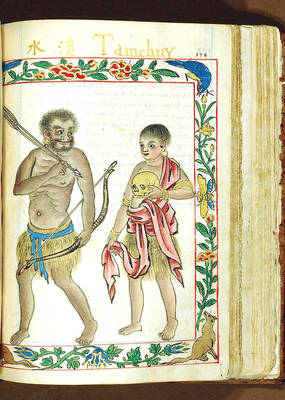
The Portuguese never established a presence on Taiwan, but they must have traded with the indigenous people because later traders reported that the locals referred to parts of deer using Portuguese words. What goods might the Portuguese have offered their indigenous trade partners? Among them must have been slaves, for the Portuguese dealt slaves across Asia. Though we often speak of “Portuguese” ships, imagining them as picturesque vessels manned by pointy-bearded Iberians, in Asia Portuguese shipping between local destinations was crewed by Asian seamen, with a handful of white or Eurasian officers. “Even the great carracks of 1,000-2,000 tons which plied

On Thursday, former Taipei mayor and founder of the Taiwan People’s Party (TPP) Ko Wen-je (柯文哲) was sentenced to 17 years in prison and had his civil rights suspended for six years over corruption, embezzlement and other charges. Seven others related to the case were also handed prison sentences, while two were found not guilty. It has been a bad week for the TPP. On Tuesday, prosecutors charged Chinese immigrant Xu Chunying (徐春鶯) with suspicion of taking part in Beijing-directed election interference. Xu has strong links to the TPP, which once offered her a party list legislator nomination. Tuesday also


 RSS
RSS