


There were two very different snowstorms that blanketed China in the run-up to Lunar New Year. The first, reported by the state media, was a natural disaster heroically battled by half a million troops and Communist Youth League volunteers. It left 5.8 million people stranded, but the people ultimately prevailed.
The second, reflected through the prism of Internet cynics, was a calamity exacerbated by official incompetence, indolence and optimistic weather fore-casts. While the old media have quoted “heartwarming words” of appreciation for the government’s response and praised its own “heroic” reporters, the Internet has been abuzz with furious denunciations of state broadcasters, forecasters and officials for getting the picture wrong.
Such competing public opinions — unheard of 10 years ago — are becoming familiar in China these days as the world’s biggest censor struggles to cope with the explosive growth of the Internet. With 200,000 new netizens every day, China’s online population is on the brink of overtaking the US as the biggest in the world.

ILLUSTRATION: TAIPEI TIMES
That landmark could come today, next week, or next month. According to the China Internet Network Information Center, there were 210 million Internet users at the end of last year, just 5 million behind the US. But China is adding 6 million new users a month — more than 10 times the pace of US growth.
PIRATES, HACKERS AND CYBER SPIES
In an Olympic year, and at a time of surging economic growth, the new figures are taken by some as proof of Beijing’s irresistible rise. Not everyone likes it. Free speech activists fear it will increase the influence of China’s censors in the virtual world. Foreign governments have raised concerns that the country has become a breeding ground for pirates, hackers and cyber spies.
It was not supposed to be like this. After the Internet was connected to China in 1987, civil rights campaigners hoped it would be a catalyst for political reform. But 21 years on, the Communist party is still in power and its model of a tightly controlled Internet is gaining ground, if only by force of numbers.
The world’s most popular blog? Lao Xu (老徐), written by the actor and director Xu Jinglei (徐靜蕾), which boasts 137 million visitors. The biggest distributor of online video? Tudou, which claims to have overtaken YouTube with over 1 billion megabytes of data transfers every day. Then there is Baidu (百度), which has trounced Google in the Mandarin search engine market, and Alibaba (阿里巴巴), whose boss Jack Ma (馬雲) is a national hero for humbling eBay and taking over Yahoo’s operations in China.
Language, culture and the Great Firewall of China — the state’s information shield — protect the government and big business players from competition. Instant messaging and social networking are dominated here by Tuscent’s QQ service. The game world is ruled by Shanda Entertainment and Giant Interactive rather than Nintendo and Sony. Sina and Sohu have a lock hold on the news. In every sector in China, domestic players are on top. Some are now starting to look overseas. Baidu recently launched a Japanese service.
Experts say that by overtaking the US as the world’s biggest user base, China will attract investment, commercial traffic and technology. With this will come influence.
“This is a big landmark. The US has almost reached the point where it has not much room to grow. China is the opposite. In terms of new connectivity and economic growth, China is definitely the place,” says Xiao Qiang (蕭強), the founder of the California-based China Digital Times.
Beijing is thought to have the planet’s most sophisticated blocking equipment, which is used to guard virtual walls against external threats. Internally, it relies on a system of official monitoring and corporate self-censorship. Most of the routers and other parts come from US companies, such as Cisco. Campaigners suspect China is passing its censorship know-how to Cuba, Vietnam and several African countries.
“China is exporting a model where the Internet is a tool for economical development, social networking, marketing business and propaganda, but not for free expression. China is very proud of this. They spent dozens of millions of euros to build firewalls, cyber-police and cyber-censors,” says Vincent Brossel of Reporters Without Borders.
He says China is lobbying at an international level for more state control of the Net, which is currently managed by a US-based independent organization. “If this happens, it will be the end of the freedom of expression on the Web.”
VIRTUAL PASSION
But the Internet is also changing China and taking on characteristics not seen elsewhere. Compared with their counterparts in the US, surveys suggest Chinese netizens are more passionate about the Web, three times more likely to feel freer in the virtual world than in reality, and more than twice as likely to consider themselves addicted.
With an average ago of 35 — seven years younger than in the US — they are primarily interested in entertainment, and believe the Net is more satisfying in this respect than TV, movies or meeting friends. Pornography, a key driver of the Internet elsewhere, is less of a factor in China, where the government routinely announces sweeps of online “spiritual pollution.” Last month, state media announced the closure of 44,000 Web sites and arrests of 868 people accused of providing “unhealthy” content.
The Web in China may be far from puritanical but while “sex” is the most popular search term in many countries, Google reports that in China the most sought-after themes are related to money and technology. “Stock” is in the top six, along with the names of three leading banks.
The means of access are different too. The fastest growth last year was in rural areas. A third of users go online at Net cafes.
The scene this week at a suburban Net cafe in Beijing was typical: scores of young people hunched in front of screens in a dimly lit room; the men in hoodies and parkas jabbing at their keyboards, blasting aliens and soldiers, while the women are transfixed by weepy South Korean soaps and Taiwanese game shows.
A few sleep at their consoles. One woman knits. There is an occasional grin, the odd laugh. But for the most part, the only sound is the clicking of mice and keyboards amid a motionless, expressionless multitude. However, the visitors say the cafe fills a hole in their lives.
“My life would be very boring without the Net,” said Yang Jing, a 19-year-old art student from Anhui, tearing herself away from a glitzy movie. “It’s just occupied with school and this — I watch films, play games and chat to friends. If we didn’t have the Net, I wouldn’t know what to do.”
The Yi You cafe opened only a year ago, the newest in a chain that boasts half a dozen branches in Beijing alone. In the evenings the 300 chairs are quickly claimed; other outlets have even more screens. “The Internet cafe business has developed very quickly in the last two years. They’re everywhere,” says the manager, Zong Cheng.
RINGING THE CHANGES
Jeremy Goldkorn, founder of the media blog Danwei.org, says the surge in users is changing China. “It is extremely significant that the Internet growing at this rate because it makes it easier for information to get out,” he says. “I believe Chinese society in general is opening up. The Internet is a cause of that, but it is also an effect. It won’t lead to revolution, but it will play a part in the evolution of public debate.”
Roland Soong, whose Zonaeuropa blog is one of the most respected sources of information about Chinese Web sites, believes people in China have higher expectations of the Internet.
“In other countries, there are other platforms for ordinary people to express themselves. In China, the internet is the sole platform for citizens to raise their voices.”
This enthusiasm sometimes manifests itself in alarming ways. Soong believes more stories are fabricated by people who want to promote themselves or their companies than in other countries. Online campaigns often turn into mob witch hunts, such as the recent targeting by BBS (bulletin board system) groups of a 13-year-old girl who was used by the authorities to justify tighter restrictions on online video content. In an interview with the state broadcaster CCTV she described it as “very yellow [pornographic], very violent,” which is fast becoming one of the slogans of the year.
But other cases suggest the Net is proving a positive social force, by making unelected local governments more accountable. The recent killing of Wei Wenhua (魏文華), who used his mobile phone to film a fight between municipal officials and villagers, rapidly became nationwide news thanks to the fury of Internet bloggers. The authorities had no choice but to arrest four suspects and fire a local official. A Guangdong newspaper reports the case of a judge being suspended after pictures were posted online of him chatting on his mobile phone during a court hearing. Forestry officials in Shaanxi face a furious backlash after releasing new pictures of the endangered South China tiger that later appear to be faked.
The proliferation of mobile phones, Internet messaging services and bulletin boards has been cited as a major factor in recent middle-class street protests. The biggest last year saw a demonstration of thousands in Xiamen, Fujian Province, against plans for a chemical factory. Mindful of public opinion, the authorities have backed down.
PLAYING WITH FIRE
At a national level, the State Council Information Office — which overseas the Internet — can still exert a tight grip. The recent detention of human rights campaigner Hu Jia (胡佳) and the house arrest of his wife and two-month-old daughter made headlines around the world. In China, it is as if it never happened. The two main news portals, Sina and Sohu, make no mention of the case. Searches on Baidu and Google produce a list of pages, many of which are blocked. Others are censored by the search engines themselves, but only Google admits this alongside the results. The authorities keep a permanent block on some sites, such as BBC news, Amnesty or non-government sources of information on Tibet, Taiwan, the Tiananmen Square massacre and Falun Gong. Propaganda officials send weekly lists of restricted topics to Web administrators, who are then expected to censor themselves.
But with the Internet expanding so fast, there is a limit to the number of blocking orders the government can send out or how widely it can impose its authority on small Web sites, such as blogs and bulletin boards. For that, it must rely on self-censorship, which is far from guaranteed.
Hong Bo, who blogs under the name Keso, says the opportunity to speak out online is cherished by a growing band of bloggers and BBS users.
“The Chinese Internet has a distinctive character. Its one of the most strictly controlled in the world, but netizens’ behavior still confounds the government’s expectations. They ban Web sites and delete posts, but they haven’t got everything under control.”
Isaac Mao, a pioneer blogger and researcher, says the number of users is less important than the quality of their online experience, where he says there is a big gap with the US.
His organization encourages netizens to connect their real and their virtual lives through blogs and discussions of social issues, including censorship.
“Rulers believe they can build a better system and get others to follow. But even though they want to change the Internet, it is part of a globalized world and nobody can afford to build an isolated system.
“I believe the Internet will change China more than China changes the Internet.”

Just after 6am, I walked up to the ticket gate at Taipei Main Station and entered the Taiwan Railway platform without scanning any ticket; instead, I flashed the Sanrio Fun Rail pass on my phone to the gate worker and was admitted. I found my train and prepared to board. My destination? This very same station. I was embarking on a 13-hour journey on one of two round-the-island trains operated by ezTravel. They run each day, one counterclockwise around the island and one clockwise. They differ in a number of ways from an ordinary Taiwan Railway train and can make for
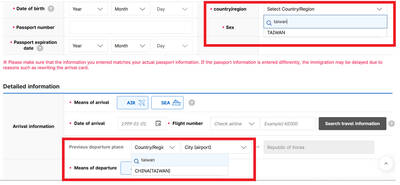
Jason Han says that the e-arrival card spat between South Korea and Taiwan shows that Seoul is signaling adherence to its “one-China” policy, while Taiwan’s response reflects a reciprocal approach. “Attempts to alter the diplomatic status quo often lead to tit-for-tat responses,” the analyst on international affairs tells the Taipei Times, adding that Taiwan may become more cautious in its dealings with South Korea going forward. Taipei has called on Seoul to correct its electronic entry system, which currently lists Taiwan as “China (Taiwan),” warning that reciprocal measures may follow if the wording is not changed before March 31. As of yesterday,

The Portuguese never established a presence on Taiwan, but they must have traded with the indigenous people because later traders reported that the locals referred to parts of deer using Portuguese words. What goods might the Portuguese have offered their indigenous trade partners? Among them must have been slaves, for the Portuguese dealt slaves across Asia. Though we often speak of “Portuguese” ships, imagining them as picturesque vessels manned by pointy-bearded Iberians, in Asia Portuguese shipping between local destinations was crewed by Asian seamen, with a handful of white or Eurasian officers. “Even the great carracks of 1,000-2,000 tons which plied

On Thursday, former Taipei mayor and founder of the Taiwan People’s Party (TPP) Ko Wen-je (柯文哲) was sentenced to 17 years in prison and had his civil rights suspended for six years over corruption, embezzlement and other charges. Seven others related to the case were also handed prison sentences, while two were found not guilty. It has been a bad week for the TPP. On Tuesday, prosecutors charged Chinese immigrant Xu Chunying (徐春鶯) with suspicion of taking part in Beijing-directed election interference. Xu has strong links to the TPP, which once offered her a party list legislator nomination. Tuesday also


 RSS
RSS