


When Genghis Khan's army ravaged Eurasia eight centuries ago, the formidable Mongolian worriers brought along not only swords and spears, but also chants and musical instruments. The morin khuur, a Mongolian horse-headed fiddle, has been one of the country's most adored folk-music instruments, playing out the sounds of the steppe even before the time of Khan. Now, this culturally significant instrument has been revived by the Mongolian State Morin Khuur Ensemble (蒙古國家馬頭琴大樂團), which will stage three performances in Taipei and Kaohsiung starting Thursday.
Identified by UNESCO as a masterpiece of oral heritage, the morin khuur has only two strings made of horsetail hairs. Despite this, its musical spectrum is wide enough to mimic everything from a soft breeze in the grasslands to horses galloping on the steppe. Playing it involves nimble manipulation of the finger pads, fingernails and the backs of the fingers. Its register is somewhere between a viola and cello.
Yet, unlike the mellow sounds produced by the Western arched instruments, the square sound box lends the music a feeling of hollowness. "The sound of the morin khuur has a sense of vastness and expansiveness, like going through all the vicissitudes of time but still holding pride and dignity,"said Hsu Po-yun (許博允) of the New Aspect Cultural and Educational Foundation (新象文教基金會), who has spent years studying and collecting ancient musical artifacts from Central Asia and has taken up the mission to introduce the sonic marvels from the little-known culture to local audiences.

For its Taiwan debut, the 30-member Mongolian ensemble will be joined by renowned vocalists of urtiin duu (folk long-song) and khoomii (overtone, throat singing), which are also native to Mongolia. Other artists will enrich the sonic portrait of mountains, rivers, animals and everything that is part of the nomadic way of life.
Commonly accompanied by morin khuur, urtiin duu is sung in verses, employing a wide vocal range, while khoomii features bi-tonal chanting soaring from penetrating low droning hums to sonorous high-pitched whistles.
Consisting of a morin khuur quartet, yatga, a Mongolian-zither quartet and percussion group, the ensemble will perform folk music and compositions by Natsagiin Jantsannorov.
Jantsannorov was a Mongolian cultural minister noted for his ingenious fusion of traditional Mongolian sounds with contemporary music. The author of the music to several films, Jantsannorov has more than 200 compositions to his name, many of which have traveled across the world with the ensemble that has performed in world-famous theaters such as the Bolshoi Theater of Russia, Carnegie Hall in the US and the Berlin Philharmonic Hall. Lauded as Mongolia's Mozart, Jantsannorov will hold a lecture on Mongolian music Tuesday at the National Recital Hall (國家演奏廳).
Apart from yatga, which was traditionally played for the pleasure of royal families, other Mongolian treasures will make their first appearances in Taiwan today, according to Hsu. These include the Tobshuur, or two-stringed lute, and an ancient harp-like instrument used to play melodies in the same style as "throat singing." Both instruments are a common feature of the tribal music of Central Asia and South America.
For their second performance in Taipei, the Mongolian ensemble will team up with the Youth Orchestra of the Taipei Chinese Orchestra (台北市立國樂團青年國樂團) to perform contemporary Han-Chinese and Taiwanese tunes, which have been adapted to the sounds of the morin khuur and yatga.
Free tickets are available at the service counter of the National Concert Hall.

Taiwan’s overtaking of South Korea in GDP per capita is not a temporary anomaly, but the result of deeper structural problems in the South Korean economy says Chang Young-chul, the former CEO of Korea Asset Management Corp. Chang says that while it reflects Taiwan’s own gains, it also highlights weakening growth momentum in South Korea. As design and foundry capabilities become more important in the AI era, Seoul risks losing competitiveness if it relies too heavily on memory chips. IMF forecasts showing Taiwan widening its lead over South Korea have fueled debate in Seoul over memory chip dependence, industrial policy and

“China wants to unify with Taiwan at the lowest possible cost, and it currently believes that unification will become easier and less costly as time passes,” wrote Amanda Hsiao (蕭嫣然) and Bonnie Glaser in Foreign Affairs (“Why China Waits”) this month, describing how the People’s Republic of China (PRC) is playing the long game in its quest to seize Taiwan. This has been a favorite claim of many writers over the years, easy to argue because it is so trite. Very obviously, if the PRC isn’t attacking Taiwan, it is waiting. But for what? Hsiao and Glaser’s main point is trivial,
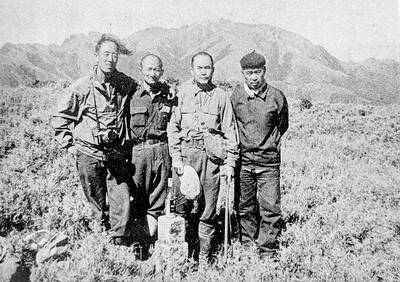
May 18 to May 24 Gathered on Yangtou Mountain (羊頭山) on Dec. 5, 1972, Taiwan’s hiking enthusiasts formally declared the formation of the “100 Peaks Club” (百岳俱樂部) and unveiled the final list of mountains. Famed mountaineer Lin Wen-an (林文安) led this effort for the Chinese Alpine Association (中華山岳協會). Working with other experienced climbers, he chose 100 peaks above 10,000 feet (3,048m) that featured triangulation points and varied in difficulty and character. The list sparked an alpine hiking craze, inspiring many to take up mountaineering and competing to “conquer” the summits. A common misconception is that the 100 Peaks represent Taiwan’s 100 tallest

In a sudden move last week, opposition lawmakers of the Chinese Nationalist Party (KMT) and Taiwan People’s Party (TPP) passed a NT$780 billion special defense budget as a preemptive measure to stop either Chinese leader Xi Jinping (習近平) or US President Donald Trump from blocking US arms sales to Taiwan at their summit in Beijing, said KMT heavyweight Jaw Shaw-kong (趙少康), speaking to the Taipei Foreign Correspondents Club on Wednesday night in Taipei. The 76-year-old Jaw, a political talk show host who ran as the KMT’s vice presidential candidate in 2024, says that he personally brokered the deal to resolve


 RSS
RSS