


It was only a matter of time. A half-century of intense cultural preoccupation with hyphenated American identity has been giving birth to the hyphenated American museum. Such institutions pay tribute to the hyphen, examining the ways Hispanic-Americans or Arab-Americans or African-Americans or other groups have been changed by the encounter of two worlds, and how, in turn, these groups have made their own indelible contributions.
But creating a hyphenated museum is not always a smooth enterprise, as can be sensed at the Museo Alameda, which opened here to great fanfare on April 13. This US$12 million Latino-American museum, built at the edge of the city's Market Square, suffers from conceptual problems that show just how difficult a challenge that hyphen can be.
The museum, its literature explains, intends to tell "the story of the Latino experience in America through art, history and culture." It is, the museum says, "an American story." And though it has no collection of its own, with its 3,700m2 (1,858 of which are devoted to exhibitions), the Alameda calls itself "the largest Latino museum in the country." It expects 400,000 visitors a year, which would make it "the most visited museum in the region." (At its opening weekend festivities, some 20,000 visitors were admitted.)
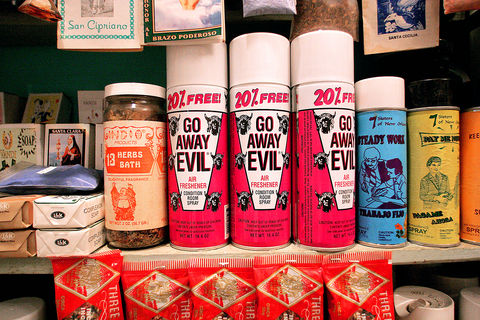
PHOTO: NY TIMES NEWS SERVICE
This is also the right place for an exploration of Latin American cultures and their impact. More than half of San Antonio's 1.2 million residents are Hispanic. San Antonio's history is itself tightly hyphenated, ranging from its embattled past — the Alamo is a 20-minute walk from the museum — to the complex resentments, reconciliations and intermingling cultures of the present.
Last month, the 10-day Fiesta San Antonio opened, at which some 200,000 revelers took part in a parade. Organized a century ago as a commemoration of the Alamo and eventual Anglo triumph, the fiesta now has an accent leaning to the left side of the hyphen.
Similar dynamic hyphenation lies at the museum's origin: It grew out of a continuing effort by the Alameda National Center for Latino Arts and Culture to restore the Alameda Theater. Not far from the museum, this stunning 2,400-seat 1949 movie palace was once a center of Latino-American life.
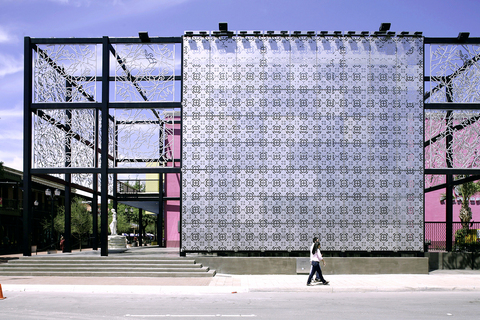
PHOTO: NY TIMES NEWS SERVICE
Two grand murals, inaccessible inside the still-closed theater, are condensed and replicated at the museum: one depicts the Hispanic past, invoking the Aztecs, the conquistadors and the influence of Spain; the other celebrates the American past, highlighted by the Lone Star of Texas and the building of the American West. Hyphenation, indeed.
So what is the museum's approach? Henry R. Munoz III, the museum's founding chairman, has said that despite the existence of other Hispanic and Mexican-American museums in the US, "there is really no museum presenting the American experience as seen through the eyes of the Latino."
Surely, though, the Hispanic experience is not unrepresented in museums; in fact, the nearby San Antonio Museum of Art has one of the nation's most important collections of ancient and contemporary Latin American art. But Munoz means that the Alameda would more closely resemble the Smithsonian's National Museum of the American Indian: It would be about identity, its shape and subject determined by the people concerned. Some criticism has been leveled at the Mexican dominance here, but Laura Esparza, the museum's director, says the focus is on the intermingling of varied Hispanic and American cultures.
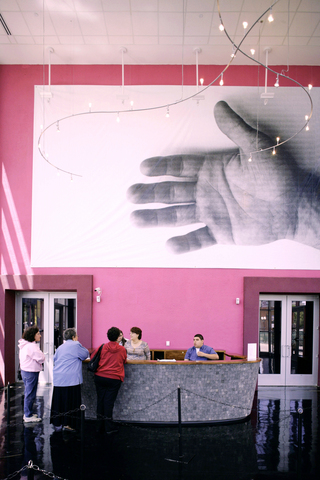
PHOTO: NY TIMES NEWS SERVICE
Accompanying this is an almost opposing influence. Munoz explained that the museum grew out of conversations he had more than a decade ago with the Smithsonian Institution, which had been deemed insufficiently attentive to the contributions of Hispanic culture. The Museo Alameda — at the time lacking a home — thus became the first Smithsonian affiliate. For an annual fee of US$2,500, affiliates may borrow from the Smithsonian collections.
Though that status is now shared with more than 150 other museums, the affiliation is crucial for the Alameda. The Smithsonian looms so large here that its logo was incorporated into the museum's outside display. The first major exhibition is called The Smithsonian in San Antonio and shows objects lent from 10 Smithsonian museums. Munoz is also chairman of the Smithsonian National Latino Board, which oversees the Smithsonian Latino Center in Washington.
So these are the impulses at work: Tell your own story (celebrating one side of the hyphen) and highlight the Smithsonian relationship (celebrating the other side). Unfortunately, there are problems with each.
The first ambition — that this should be a people's museum telling stories by the people themselves — is as fraught with weakness here as it is elsewhere. The risk is indulgence and lack of perspective; folk celebration becomes the dominant note.
This may be why the introductory gallery does not include video from, say, the History Channel, pointing out how diverse Latin American cultures were combined into an idea of Hispanic culture in the US. There is no summary of the knotty history of Mexico and Texas, no glimpse of the difficulties Mexicans and other Hispanics have had in being welcomed into the southern Texas mainstream and no attempt to survey the American celebrities, scientists or writers who might credit Hispanic culture as a major influence. These kinds of historical accounts, almost required for a visitor trying to gain some understanding, are nowhere to be found.
Instead, there is an eight-minute video collage by George Cisneros that tries to "interpret Latino history, dreams and aspirations" with shifting colors, religious icons, family photos and images of war veterans. There are no explanations, identifications or history: this is internal fantasy without public context.
The context is no clearer in the main gallery. One display pays tribute to Hispanic immigrants by presenting various pop-cultural artifacts (from pink balloons to plastic snakes — no explanations offered). But the rest of the objects in The Smithsonian in San Antonio, which are meant to "tell the bicultural story of Latino communities in the United States," actually tell no story at all other than of the museum's impatient, Smithsonianesque aspiration.
One central object on display is the Smithsonian's ceremonial mace. Each of the 10 contributing Smithsonian museums gets more descriptive wall space than any other object or idea. Contributions from the American Indian museum — ranging from an Aztec figure to a beautiful Peruvian Huari jar — stand without commentary.
Worse, with many of these Smithsonian objects, even the Latino connection seems tenuous. Why display a rubber date-stamp from the USS Oklahoma lent by the National Postal Museum? It bears the scars of the Pearl Harbor attack, but what does it have to do with Hispanic culture? And why, too, should Lady Bird Johnson's brooch and Laura Bush's purse be displayed, even if they are two first ladies from Texas?
And while the National Air and Space Museum's loans of name tags of Hispanic astronauts may make some sense, why is Deke Slayton's space suit here, even though he apparently had no Hispanic background? Esparza explained that the suit was displayed "to animate the story."
Meanwhile, a 1958 Vanguard satellite is shown, according to a wall note, because it "reflects the ancient Maya's fascination with the cosmos" — a fascination that as far as a viewer can tell had nothing to do with the satellite's design or purpose. How does all this "tell the story of the Latino experience in America"?
Other parts of the museum, including the second floor's main exhibition with its photographs of Conjunto singers by John Dyer, provide a more direct connection with the museum's themes. Conjunto — a spirited mingling of Mexican styles with local German immigrant styles — is intriguing in its own right, though the sheer number of photographs and the relics of singers will have resonance mainly for fans.
As a curatorial enterprise — let alone one that is meant to live up to declared ambitions (and a claim on national attention) — the overall effect is strange indeed. But two items stand out in contrast. The only vivid sense of Latino history and life in the main exhibition is in a video having nothing to do with the museum itself, accompanying a National Portrait Gallery bust of the choreographer Jose Limon. The video — an abridged version of the documentary Limon: A Life Beyond Words — uses Limon's own words to tell about his childhood in Mexico and his family's immigration to the US. For a short while, the idea of Hispanic voices telling their stories makes sense; so do the artistic ambitions of the documentarians (Ann Vachon and Malachi Roth).
The other item is the gift shop. It is the creation of a San Antonio artist, Franco Mondini-Ruiz, and is meant to double as a kind of performance art. Here, in a carefully mounted miscellany, are gathered for sale the passions of Hispanic-American life, combining Dada and devotion, high-camp sensation and solemn figurines, kitsch and art — traditions clashing and mingling with enthusiastic glee. The gift shop, meant to invoke folk botanica storefronts with their arrays of herbal cures and icons, seems more authentic and celebratory than many of the shops in the Market Square here and more suggestive about the vibrancy of Hispanic-American culture than much of the Museo Alameda itself.
Since exhibitions will change at least every six months or so, perhaps over time the museum will grow more expert in hyphenation and explanation. Something derived from this botanica might also help.
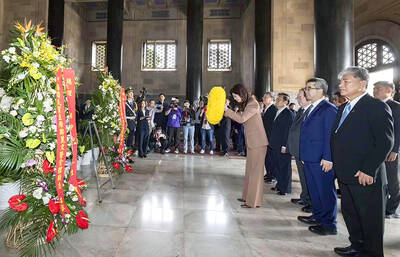
The problem with Marx’s famous remark that history repeats itself, first as tragedy, the second time as farce, is that the first time is usually farce as well. This week Chinese Nationalist Party (KMT) Chair Cheng Li-wun (鄭麗文) made a pilgrimage to the People’s Republic of China (PRC) “to confer, converse and otherwise hob-nob” with Chinese Communist Party (CCP) officials. The visit was an instant international media hit, with major media reporting almost entirely shorn of context. “Taiwan’s main opposition leader landed in China Tuesday for a rare visit aimed at cross-strait ‘peace’”, crowed Agence-France Presse (AFP) from Shanghai. Rare!

What is the importance within the Chinese Nationalist Party (KMT) of the meeting between Xi Jinping (習近平), the leader Chinese Communist Party (CCP), and Cheng Li-wun (鄭麗文), the leader of the KMT? Local media is an excellent guide to determine how important — or unimportant — a news event is to the public. Taiwan has a vast online media ecosystem, and if a news item is gaining traction among readers, editors shift resources in near real time to boost coverage to meet the demand and drive up traffic. Cheng’s China trip is among the top headlines, but by no means
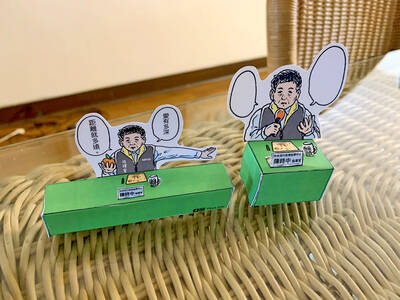
Sunflower movement superstar Lin Fei-fan (林飛帆) once quipped that the Democratic Progressive Party (DPP) could nominate a watermelon to run for Tainan mayor and win. Conversely, the DPP could run a living saint for mayor in Taipei and still lose. In 2022, the DPP ran with the closest thing to a living saint they could find: former Minister of Health and Welfare Chen Shih-chung (陳時中). During the pandemic, his polling was astronomically high, with the approval of his performance reaching as high as 91 percent in one TVBS poll. He was such a phenomenon that people printed out pop-up cartoon
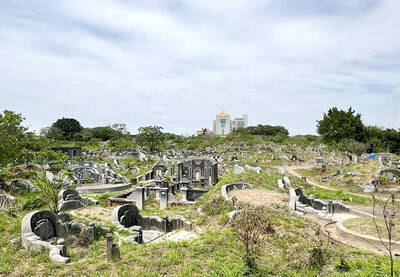
Apr. 13 to Apr. 19 From 17th-century royalty and Presbyterian missionaries to White Terror victims, cultural figures and industrialists, Nanshan Public Cemetery (南山公墓) sprawls across 95 hectares, guarding four centuries of Taiwan’s history. Current estimates show more than 60,000 graves, the earliest dating to 1642. Besides individual tombs, there are also hundreds of family plots, one of which is said to contain around 1,000 remains. As the cemetery occupies valuable land in the heart of Tainan, the government in 2018 began asking families to relocate the graves to make way for development. That


 RSS
RSS