


In a small Berlin laboratory, Robert Hermes is testing instruments that would do credit to a James Bond villain. He has metal probes, giant syringes and a set of electrodes that would embarrass an Abu Ghraib jailer.
This fearsome collection has a benign purpose, however, for Hermes intends to use it to save the world's most endangered large mammal: the northern white rhino, whose breeding population has been wiped out in the wild and consists, in captivity, of just two females in a Czech zoo.
A program that includes artificial insemination, in vitro fertilization and sex-selection of embryos is to be launched this year, led by Hermes, a zoologist at Berlin's Leibniz Institute for Zoo and Wildlife Research, and his colleagues Frank Goritz and Thomas Hildebrandt. If this team, working with other groups in several European zoos, succeed, they will have pulled off one of the most extraordinary feats in wildlife conservation. Most experts assume the northern white is doomed and will join the dodo, passenger pigeon, quagga and Tasmanian wolf as victims of the predations of modern humans.
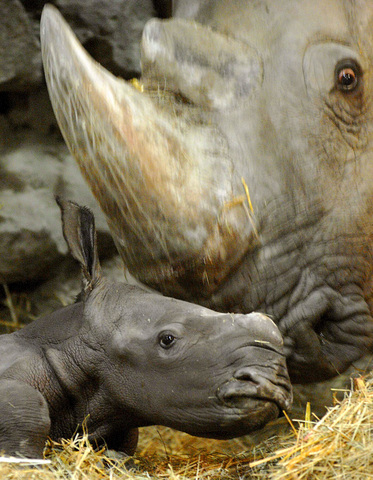
PHOTOS: AGENCIES
"The northern white is now in a desperate situation," said Hermes. "It is in the tightest possible population bottleneck from which it may bounce back or simply die out. I still believe there is hope, however."
The fate of the northern white is tied to that of its cousin, the southern white. The two are hard to distinguish: the southern has slightly smoother skin, the northern slightly longer legs. Thousands of both subspecies roamed Africa's savannah until game hunters and poachers cut the population of each to around 100 animals. In the 1960s, South Africa launched a major program aimed at preserving the southern white. Guards were sent to protect reserves, and poachers were pursued relentlessly. Today there are more than 11,000 southern white rhinos.
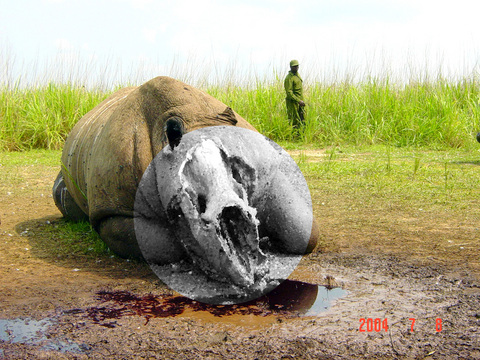
By contrast, numbers of the northern white, which once roamed across Uganda, Sudan and Congo, continued to drop, its territory suffering continued outbreaks of civil instability and war. By 2000 the species had been reduced to 30 animals in the Democratic Republic of Congo's Garamba National Park. By last year there were only four left.
There are a further 10 in zoos, however: seven in Dvur Kralove in the Czech Republic and three in San Diego. Of these, only two are fertile females: Najin and her daughter Fatu, in Dvur. "The issue is simple: how we can best use these animals to maximize numbers of northern whites as quickly as possible," said Hermes. "The obvious answer is captive breeding, though this has proved to be very difficult with white rhinos. They are very reluctant to breed in zoos."
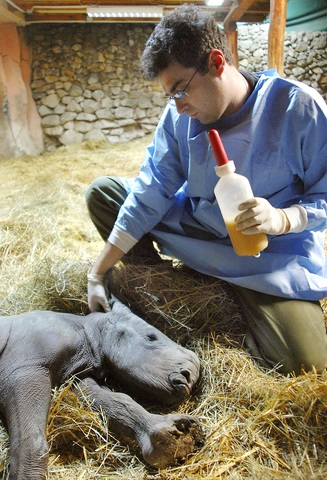
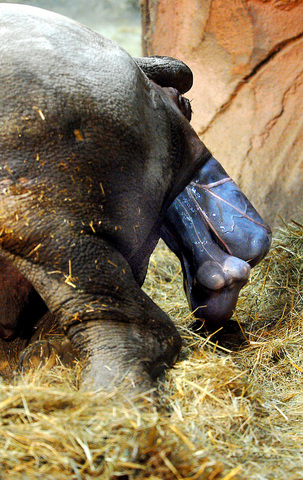
The next step has been to intervene with artificial insemination: not easy with a very large, bad-tempered, armored herbivore whose reproductive system has been a mystery to veterinary science. But using modern medical aids, including ultrasound scanners and instruments such as those employed by Hermes and his colleagues, scientists recently succeeded in breeding the first white rhino calf using artificial insemination. The calf, a southern white and still unnamed, was born at Budapest zoo three weeks ago. "That was a real breakthrough," said Hermes. "Everything we learn from the southern white, we can then use on the northern once we have established the proper protocols."
Later this year scientists will attempt the first artificial insemination of either Najin or Fatu at Dvur. "Even if that works, it will still only be a start," said Hermes. As he pointed out, rhinos produce a single calf every two years at best, which greatly limits numbers that these two females might produce.
Scientists have a couple of other tricks up their sleeves, however. The first exploits the similarity between the southern and northern white. Researchers are learning how to remove eggs from ageing rhinos, allowing them to build up stocks of northern white eggs, which could then be fertilized. The resulting embryos could be implanted in southern whites, which would act as surrogate mothers for the species.
Scientists are also planning to use separation techniques to split female-producing sperm from the male-producing version. "That way we can ensure we produce only female northern calves. From those we can breed even more northern whites. In the end, we might just save the northern white rhino," said Hermes.

Just after 6am, I walked up to the ticket gate at Taipei Main Station and entered the Taiwan Railway platform without scanning any ticket; instead, I flashed the Sanrio Fun Rail pass on my phone to the gate worker and was admitted. I found my train and prepared to board. My destination? This very same station. I was embarking on a 13-hour journey on one of two round-the-island trains operated by ezTravel. They run each day, one counterclockwise around the island and one clockwise. They differ in a number of ways from an ordinary Taiwan Railway train and can make for
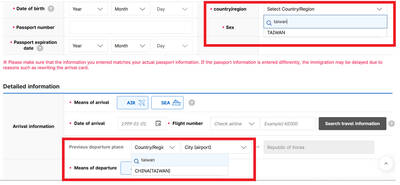
Jason Han says that the e-arrival card spat between South Korea and Taiwan shows that Seoul is signaling adherence to its “one-China” policy, while Taiwan’s response reflects a reciprocal approach. “Attempts to alter the diplomatic status quo often lead to tit-for-tat responses,” the analyst on international affairs tells the Taipei Times, adding that Taiwan may become more cautious in its dealings with South Korea going forward. Taipei has called on Seoul to correct its electronic entry system, which currently lists Taiwan as “China (Taiwan),” warning that reciprocal measures may follow if the wording is not changed before March 31. As of yesterday,
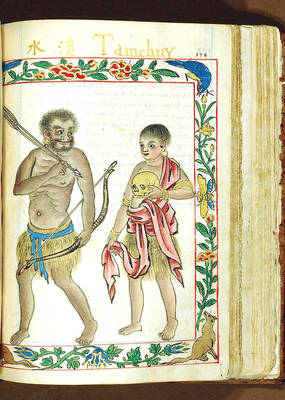
The Portuguese never established a presence on Taiwan, but they must have traded with the indigenous people because later traders reported that the locals referred to parts of deer using Portuguese words. What goods might the Portuguese have offered their indigenous trade partners? Among them must have been slaves, for the Portuguese dealt slaves across Asia. Though we often speak of “Portuguese” ships, imagining them as picturesque vessels manned by pointy-bearded Iberians, in Asia Portuguese shipping between local destinations was crewed by Asian seamen, with a handful of white or Eurasian officers. “Even the great carracks of 1,000-2,000 tons which plied

On Thursday, former Taipei mayor and founder of the Taiwan People’s Party (TPP) Ko Wen-je (柯文哲) was sentenced to 17 years in prison and had his civil rights suspended for six years over corruption, embezzlement and other charges. Seven others related to the case were also handed prison sentences, while two were found not guilty. It has been a bad week for the TPP. On Tuesday, prosecutors charged Chinese immigrant Xu Chunying (徐春鶯) with suspicion of taking part in Beijing-directed election interference. Xu has strong links to the TPP, which once offered her a party list legislator nomination. Tuesday also


 RSS
RSS