


Anyone who has traveled outside Taipei City will have noticed betel-nut beauties (檳榔西施) brightening the roadsides. Like brightly-plumed birds they flit in and out of their neon-framed stalls to serve drinks, cigarettes and the addictive nut that keeps truck drivers awake as they careen down the country's highways.
A couple of years ago a club promoter left the capital city in a convoy of three cars for a party in Kaohsiung. The goal was to stop at every betel-nut stand on the way and take pictures of the girls. It took them two days but at the end of a drunken journey they had assembled a selection of portraits for their PowerPoint presentations that ranged from "really stunning model look-alikes to skinny crack-ho messes with just two teeth."
South African documentary maker Tobie Openshaw took a different route and has compressed seven years of interviewing, filming and photographing betel-nut girls for a sensitive and decorous exhibition of 30 prints, which opened last weekend at the Hung Chong Gallery (恆昶藝廊) in Taipei.
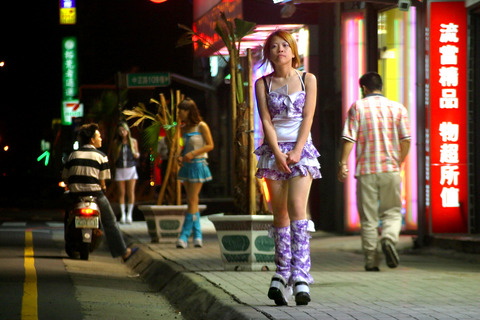
PHOTOS COURTESY OF TOBIE OPENSHAW
Betel-Nut Beauty: Exploring the Art, the Beauty and Heart aims to shine new light on the subject. The oft-held thesis is betel-nut girls are young and abused. The truth is they are adults who make a reasonably well-paid choice to sell the nuts, Openshaw said.
Another thesis is betel-nut beauties are low class because they expose their bodies. As a result the occasional legislator will charge betel-nut girls with destroying the moral fabric of the nation. This is why the beauties are banned from Taipei City and told to cover up elsewhere. The truth, according to Openshaw, is singers and actresses like Jolin Tsai (蔡依林) also show off their bodies but they are looked up to for it.
"The reasons quoted for fighting this phenomenon are always wrong, always about the morals of Taiwan rather than the health of its people. I don't understand what the fuss over scantily clad women is about. The real problem is the bad effects of betel nuts, which should carry health warnings," Openshaw said, adding he had never tried one because they are cancerous, habit forming and look disgusting.

Instead, Openshaw buys coffee and cigarettes from the roadside parlors near his home in Taoyuan City before starting work in the morning at a software company. "It's a pick-me-up. I get a nice smile and that's how I got to know the girls," he said on a tour last week of his city's betel-nut hotspots.
Along with his production manager, Joy Hsieh, who interviews the women while Openshaw films or shoots, we were introduced to a number of betel-nut beauties. Petite and tattooed Hsiao Juan (小娟) wobbled around on white platform shoes as she served and talked. "I'm proud of the exhibition, it will help people get to know us,” she said.
The more conservatively dressed Hsuan Hsuan (瑄瑄), 24, is from Vietnam and came here to marry a taxi driver, with whom she has two children. She runs the betel-nut stall on her own and said business was good but she wanted to do something else.
Hsiao Ching (小晴) has the cute doll look and is in her early 20s. She said the work was not too demanding and she earned about NT$30,000 a month. Customers irritated her sometimes, she said, because they interrupted her when she was talking on the phone and Japanese tourists sometimes hung around gawping. She pointed out the TV surveillance cameras and a stun gun when we asked about security. Her problem, she said, was meeting “nice guys” who could accept her job.
Openshaw said most of the girls he interviewed were happy with their lot and others worked for a short time and moved on. He countered rumors of prostitution by saying he had heard of cases but didn't see how it could work practically. “It's just not the same kind of business. This is about selling nuts.”
And sex sells nuts. This much is obvious from a quick tour of the exhibition. A girl in a skimpy pink ensemble and towering heels stares into the camera, arms crossed, leaning against her glass-fronted booth. In the next picture two girls patrol the areas in front of their betel-nut stands. Their attitudes appear to be bashful, playful and come-hither. Outside the same stand, in another image, one girl is seated while another balances on one leg and we can see panties under her skirt.
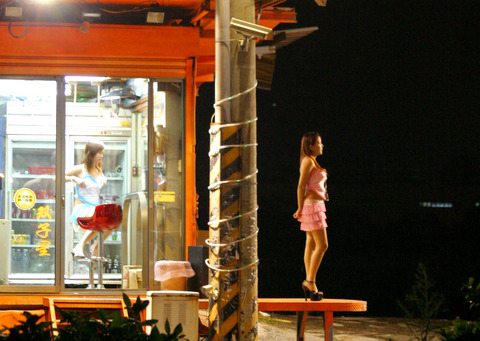
These kinds of pictures are eye candy, like flicking through a lifestyle magazine and finding the occasional titillating shot. They are not pornographic because they do not “cross the line,” according to Kloie Picot, a Canadian photojournalist and videographer. “These girls offer the illusion of sex.”
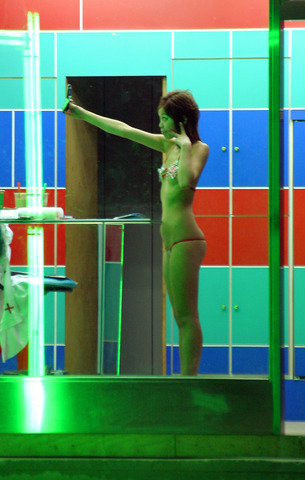
There was one picture, however, which she objected to. It was of a young woman dressed in a practically non-existent bikini, taking a picture of herself with a mobile phone. “She's crossed the line, she's feeding herself to the guys and making it so the other girls have to keep up [by wearing less],” Picot said.
Point taken, but it was one of the most interesting shots, more documentary than lifestyle. It offers a different insight into the mind of the betel-nut beauty and the business she is in. Pretty shots of young women framed in mirrors and posing by the roadside in nurse costumes do not reveal any more than we see in a car passing by a betel nut stand.
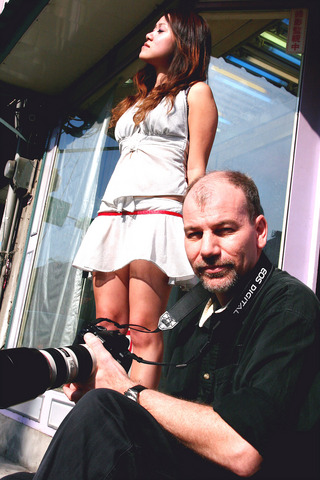
PHOTO: JULES QUARTLY, TAIPEI TIMES
This is not necessarily a criticism as Openshaw's stated intention is to shine a light on the “art, the beauty and heart” of the business. The exhibition does not look behind the smiles, even if they are fake. As a result the girls look like models or pop singers.
Unlike the club promoter and his convoy of amateur photographers, Openshaw has focused on the aesthetically and morally pleasing facets of the betel nut girl business. “Skinny crack-ho messes with just two teeth” and child brides from Vietnam selling betel nut have no place here.
The Hung Chong Gallery (恆昶藝廊) is at 1F, 396-1 Renai Rd Sec 4, Taipei (台北市仁愛路四段396-1號1樓). It is open daily 10am to 6pm and the exhibition is until March 8.
Also see www.youtube.com/watch?v=HJo7ZkLwkng&mode=related&search=betelnut and www.youtube.com/watch?v=LJWxs6eRNvY&mode=related&search=betelnut


Taiwan’s English education system is being pulled apart by three opposing forces. Bilingual Nation 2030 pulls students toward English and global communication. Artificial Intelligence (AI) readiness pulls them toward digital judgment, verification and AI-mediated work. But Taiwan’s old exam culture pulls them back toward memorization, grammar drills, timed reading and correct answers. If the education system keeps using old exams to define success, it risks producing graduates who are neither genuinely bilingual nor genuinely AI-ready, but trained for tasks machines can already perform. The first force is Bilingual Nation 2030. Launched in 2018, the policy aimed to “help Taiwan’s workforce connect

“Taiwan’s Opposition Leader Comes to US With a Message Straight Out of Beijing” read a May 31 headline in the Wall Street Journal. Top US administration officials and members of Congress almost certainly read the WSJ, and if there was a bullet point takeaway that people in Washington should absorb ahead of Chinese Nationalist Party (KMT) Chair Cheng Li-wun’s (鄭麗文) arrival in DC on June 9, that headline is it. The last few columns have discussed this very topic, and the timing is not coincidental. While those top officials likely do not read the Taipei Times, judging by the number

With weighty, anxiety-inducing geopolitical topics dominating the headlines, checking in on the wild and weird state of local politics can take some of the edge off. This November’s elections will determine who will be in charge of fixing potholes in your neighborhood, not the potholes in Taiwan’s complicated geopolitical space. Recently, after an online interview with a Taipei-based journalist, I commented that Taipei journalists never go further than the MRT can take them. He laughed and agreed. Naturally, the Taipei mayoral race is eating up much of the press attention. TAIPEI CITY Democratic Progressive Party (DPP) candidate Puma Shen (沈伯洋) has
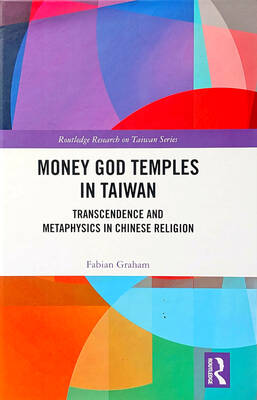
As someone who normally steers clear of books with “transcendence” or “metaphysics” in their subtitles, this reviewer — a casual observer of local belief systems since the 1990s — found Fabian Graham’s Money God Temples in Taiwan a challenging read. Those who’ve only dipped their toes into temple culture will likely need to parse several sections with special care if they’re to keep up with the author, a British ethnographic researcher whose previous books have investigated religious practices among ethnic Chinese in Southeast Asia. This scholarly volume examines a facet of Taiwan’s religious landscape that didn’t exist a century ago, and


 RSS
RSS