


She dazzled in a royal-blue diamante dress, framed by lights and wreathed in smoke, warbling a song popular in Shanghai 60 years ago. Only after she fluttered down to our table for a red envelope containing money could one see time's lines etched under the heavy makeup.
Most of the customers at the red envelope club (紅包場) called Red Top Artists Theater (紅頂藝人劇場) on Wuchang Street (武昌街), in Ximending (西門町), Taipei, were old men. There was a group of Japanese businessman in suits and a few middle-aged guys sitting on their own who looked lonely. At a couple of tables small groups of men and women chatted and laughed.
It was a touching scene, in some ways. Waitresses tended to the tables, offering plates of fruit, bottles of red wine and Johnny Walker whisky. A flower seller went around the tables hawking roses for the nightingales on stage. There was the illusion of love, but desperation and frustration too.
During a break in the performances, while the amps hummed, a singer in a clingy white dress, with heart-shaped earrings and matching buckles on her belt and high-heeled shoes, introduced herself to a gentleman by presenting her name card.
"Welcome, my name is Sunny. I hope you are enjoying the show. What's your name?" She sat down by the man and playfully touched him on the elbow. They small-talked for a while before the woman got up to leave. "Sorry I can't stay long because I have to sing. What songs do you like? Can I come back after I finish?"
Walk around storied Ximending on any weekday afternoon and you will see old men sitting around watching the world go by. They have been the subject of various unsavory rumors, but the reality is more prosaic. There is a pensioner's association on Hanchung Street (漢中街) , where old ladies also visit. There are many veterans because there used to be a Chinese Nationalist Party (KMT) army base nearby. Some of these people would go to a karaoke parlor, or red envelope club, when they open mid-afternoon.
For an entrance fee of around NT$300 and the disbursement of red envelopes to favored singers containing a minimum of NT$100, these veterans, businessmen and civil service retirees while away their free time in a nostalgic haze created by smoke and mirrors, song and fairy lights.
XIMENDING'S ATTRACTIONS
Ximending is part of Wanhua district (萬華區), one of the oldest areas of Taipei. Chinese immigrants from Fujian came here in the early 18th century to trade and established a bustling port dealing in tea and fabrics. When the Japanese arrived in 1895 they transformed the area into an entertainment zone.
The first theater was opened on Neijiang Street (內江街) in 1896 and showed Japanese kabuki opera. Many other theaters, restaurants, coffee houses and shops followed and the area became a center for cinema when the 2,000-seat Big World Theater opened on Chengde Road in 1927.
At the end of World War II the streets of Ximending emptied as the Japanese fled and an estimated 2 million KMT followers settled in their place. Tsao Chi-kuang (曹志光) of the Fong Da Coffee House on Chengdu Road (成都路), which was established in 1956, said the new immigrants were from all over China.
"They came from everywhere [in China], not like before when most immigrants came from Fujian. They took over the businesses in Ximending. In the Japanese period it was quite high class, but the newcomers had no money so the entertainments and atmosphere were different," Cao said.
Restaurants offering live entertainment were established in the 1950s and 1960s, Cao said. Some of them were places where former mainlanders could hang out for the price of a cup of tea and listen to Chinese classics such as You Smiled at Me Last Night (昨夜你對我一笑), By Suzhou River (蘇州河邊) and Autumn Night (秋夜).
"But just singing was of no interest to many of the customers who went there, they were lonely, that's why the red envelope club developed. You gave a red envelope so that you could establish a relationship with a woman, maybe eat together, or something else," Cao said.
ALL CHANGE
National Chengchi University professor Hsueh Hua-yuan (薛化元) said red envelope clubs developed in the 1970s and local vocalists singing Taiwanese songs became popular. Some clubs diversified by putting on variety shows, magic acts, comedy routines and cabaret-style entertainments.
Though red envelope clubs are peculiar to Ximending, they spread across the country when they were most popular in the mid-1980s. Newspapers at the time reported red envelope clubs and restaurants with live entertainment were hosting around 300,000 clients a day. There were an estimated 20 clubs in Ximending alone.
The biggest red envelope clubs seated around 500 people and the sets and lighting were often outstanding, as the club owners competed with each other. Television actors and movie stars moved in for a piece of the action and fees rocketed. The Hong Kong movie actress Cherie Cheung (鍾楚紅) performed at a singing hall for one week in 1989 and picked up a cool NT$4 million.
But it was also TV and cinema that were partly responsible for the decline in popularity of live entertainment in general and red envelope clubs in particular, as punters tuned in and dropped out. The artists priced themselves out of the market and videos of performances were sold cheaply in night markets.
In 1987 Taiwan allowed its residents to visit China and many of the former soldiers who were the red envelope clubs' principal patrons either left or remitted money to their families instead of spending on entertainment.
"The red envelope club was originally quite a traditional form of entertainment and relatively innocent, a kind of repository of Chinese culture," Hsueh said. "But they changed over time into something else. After the mid-1980s, because there were fewer customers and social problems, red envelope clubs became more complicated and organized crime moved in."
In fact many of these red envelope clubs simply became fronts for prostitution and as such their reputation became mired in the business of selling sex and other gangster activities such as extortion, gambling and drugs. There were also gangland shootings. As a result there were police raids and they became even less popular.
According to one red envelope club owner, there are now only three red envelope clubs in Ximending and one in Kaohsiung worthy of the name. The situation is complicated by the fact that there are many other similar establishments where guests pay the "artists" red envelopes — though the entertainment is secondary to the social aspect of the operation. Hence the close proximity of hotels offering rates by the hour.
RED TOP ARTISTS THEATER
Red Top Artists Theater is a high-end red envelope club and offers a clean environment. Its performances have good production values (including laser lighting) and recently featured a lady-boy show that ran for four months. This included cross-dressing Aboriginal princesses, and nuns singing I Will Follow Him. It was highly entertaining.
During rehearsals one afternoon a few weeks ago at Red Top, a male choreographer directed three women miming songs and practicing a veil dance. There was a relaxed atmosphere and it looked like a scene at any other theater.
Then there was a buzz as two brightly painted ladies walked in, carrying parasols. One of them, Wu Jin-hsian (吳靜嫻) is a star on the local stage and screen. She was there to speak to the owner of Red Top, Wei Li-li (韋麗麗), about some upcoming performances. But when asked if Wu considered herself a red envelope club singer, she bridled and said no.
"Taiwanese have some bad ideas about red envelope clubs. They think they are places for games between men and women. They say a singer who works there is not a real singer, they just have a microphone but no voice," Wei complained.
"Actually, I try to correct people's opinions. I think of my business more as a theater than a red envelope club though it's true the singers are paid by tips from customers — but they have to sing well."
ON THE OTHER HAND
At the other end of the red envelope club scale is the Golden Dynasty Nightclub (金朝代歌廳夜總會) on Hankou Street (漢口街), which has faded photos of the artists on a billboard outside and a badly maintained elevator to the sixth floor. It is like a 1980s time warp and Christmas decorations from years ago are still claiming a happy Xmas and New Year.
According to singer/hostess Xi Zhen (席真) — who was tipsy and kept repeating, "Oooh! What lovely blue eyes" — we were only the second Westerners to have set foot in the establishment. She said Japanese, South Koreans and overseas Chinese occasionally visited. We asked for a traditional Chinese song but were told they only covered contemporary Taiwanese ballads, such as You Loved me Before (你曾經愛過我), I Wouldn't Want You Even if You Came Back (再回頭我也不要你) and Savoring Our Sweet Past (往事只能回味).
After 10 minutes and one red envelope she left to dance with a painfully thin man who was at least 70 years old. They looked pretty good on the dance floor, however, and the atmosphere was lively. Some of the VIP rooms had visitors from the anti-President Chen Shui-bian (陳水扁) "siege" held that morning. We asked one of them why he had come and he responded with words to the effect, "Mind your own business."
A stereotypical gangster (crew cut and tattoos) was at a nearby table, drinking beer with whisbee chasers, spitting betel nut into a cup and leering at us. He waved us over, so we humored him. He pointed out the singers — including a guy with makeup — and then shoved his finger in and out of the palm of his hand indicating, "Do you want to fuck?"
It was an unpleasant experience, seedy and expensive. Beers were NT$300 and the entertainers had a voracious appetite for red envelopes. It was a rat trap and we'd been caught.
THE FINAL CURTAIN
A Ximending restaurant owner and former gang member, Xiao Ge (小哥), said he had witnessed the decline in popularity of red envelope clubs and reckoned it was a natural process as society and technology changed.
He said he knew people who used to run red envelope clubs that were relocating their businesses to Singapore or China, where there were better opportunities. But the traditional red envelope club was a thing of the past, he said.
"The red envelope club is not the same today as it used to be. There used to be a lot of them, but now there are just a few left. Many of them run under-the-table businesses where the social side is more important than entertainment. Red Top is traditional but even that has had to change. It is not the same as it used to be and struggles to make money," Xiao Ge said.
"I think all the red envelope clubs will die out. In fact, most of their customers have already died. If you want to find company there are much more convenient places to go and you don't have to listen to singers, buy drinks and hand out red envelopes. That is history. If you want to watch old singers then you can buy videos, watch the TV or download their performances on a computer. We cannot live in the past."

Taiwan’s overtaking of South Korea in GDP per capita is not a temporary anomaly, but the result of deeper structural problems in the South Korean economy says Chang Young-chul, the former CEO of Korea Asset Management Corp. Chang says that while it reflects Taiwan’s own gains, it also highlights weakening growth momentum in South Korea. As design and foundry capabilities become more important in the AI era, Seoul risks losing competitiveness if it relies too heavily on memory chips. IMF forecasts showing Taiwan widening its lead over South Korea have fueled debate in Seoul over memory chip dependence, industrial policy and

“China wants to unify with Taiwan at the lowest possible cost, and it currently believes that unification will become easier and less costly as time passes,” wrote Amanda Hsiao (蕭嫣然) and Bonnie Glaser in Foreign Affairs (“Why China Waits”) this month, describing how the People’s Republic of China (PRC) is playing the long game in its quest to seize Taiwan. This has been a favorite claim of many writers over the years, easy to argue because it is so trite. Very obviously, if the PRC isn’t attacking Taiwan, it is waiting. But for what? Hsiao and Glaser’s main point is trivial,
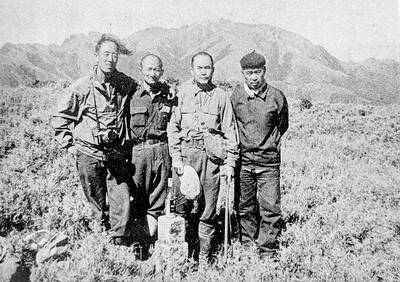
May 18 to May 24 Gathered on Yangtou Mountain (羊頭山) on Dec. 5, 1972, Taiwan’s hiking enthusiasts formally declared the formation of the “100 Peaks Club” (百岳俱樂部) and unveiled the final list of mountains. Famed mountaineer Lin Wen-an (林文安) led this effort for the Chinese Alpine Association (中華山岳協會). Working with other experienced climbers, he chose 100 peaks above 10,000 feet (3,048m) that featured triangulation points and varied in difficulty and character. The list sparked an alpine hiking craze, inspiring many to take up mountaineering and competing to “conquer” the summits. A common misconception is that the 100 Peaks represent Taiwan’s 100 tallest

In a sudden move last week, opposition lawmakers of the Chinese Nationalist Party (KMT) and Taiwan People’s Party (TPP) passed a NT$780 billion special defense budget as a preemptive measure to stop either Chinese leader Xi Jinping (習近平) or US President Donald Trump from blocking US arms sales to Taiwan at their summit in Beijing, said KMT heavyweight Jaw Shaw-kong (趙少康), speaking to the Taipei Foreign Correspondents Club on Wednesday night in Taipei. The 76-year-old Jaw, a political talk show host who ran as the KMT’s vice presidential candidate in 2024, says that he personally brokered the deal to resolve


 RSS
RSS