


Kaohsiung City Ballet (KCB) is putting on a treat for ballet lovers around Taiwan. On a mini tour of southern Taiwan, it will perform an adapted version of classical ballet Paquita and two newly choreographed contemporary ballets, Blossom (綻) and Moonlight Sonata (月光奏鳴曲) by Lee Chung-chun (李靜君), Cloud Gate Dance Theater associate artistic director and recipient of the 2004 National Culture and Arts Foundation Literary and Arts Award.
This year marks KCB's 15th anniversary. Under the guidance of Artistic Director Chang Hsiu-ru (張秀如), the company has been recognized for its versatility and excellence in performing classical and contemporary ballet works. It has been selected as a distinguished performing arts group by the Executive Yuan's Council of Cultural Affairs in six consecutive years from 2001.
In last year's production of a literary ballet Love in Cities (傾城之戀), based on Eileen Chang's (張愛玲) novel, Chang Hsiu-ru invited Lee to choreograph “When Wind Blows” (起風的時候) — one of the eight segments of Love in Cities — which explores the state of loneliness. This year, Lee has been once again invited to work with KCB to create two new works, Blossom and Moonlight Sonata, based on her own appreciation of nature and life.
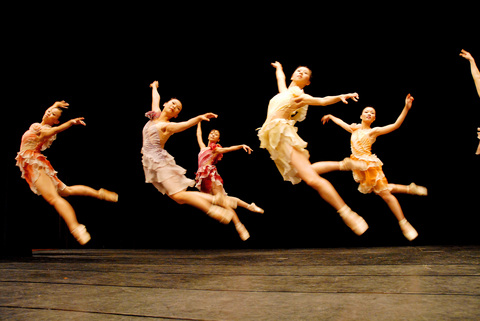
PHOTO COURTESY OF KAOHSIUNG CITY BALLET
Moonlight Sonata, which is danced to Beethoven's music of the same name, was choreographed in memory of dancers and choreographers Wu Kuo-chu (伍國柱) and Lo Man-fei (羅曼菲), who passed away earlier this year. Lee's choice of the first movement of Beethoven's music — so languidly beautiful and heart-wrenching — is perfect for the expression of sorrow for those departed. Lee created this solo work for Cloud Gate II dancer and rehearsal director Chen Chiu-yin (陳秋吟), as Chen also felt great sorrow at the death of these luminaries of Taiwan's dance scene.
In a telephone interview with Lee on Monday, she said, “Chen and I developed a deep and wonderful choreographer-dancer relationship. Chen could get a grip on the idea I wanted to convey without having to be too explicit. Chen is the kind of dancer who possesses great [technical and expressive] precision.” Chen's captivating solo movements will reflect both the choreographer's and her own psychological states.
Lee's other work, Blossom, is composed of four segments set to Bach's solo and double violin concertos. When asked why Blossom and why Bach, Lee replied, “I have an intimate appreciation for American artist Georgia O'Keeffe's dramatic painting of gigantic flowers. I was inspired by O'Keeffe's “metaphoric” portrait of flowers and the overwhelming size of the bloom.” O'Keeffe once said plainly, “Nobody sees a flower really; it is so small. We haven't time, and to see takes time — in the same way as to have a friend takes time.”
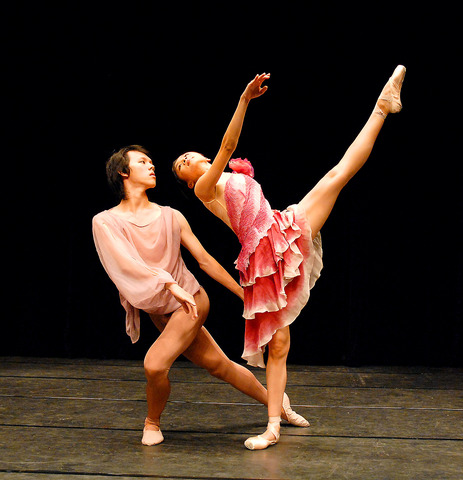
Accompanied by Lee's favorite baroque score for violins, the choice of music seems to echo O'Keeffe's personal experience since the artist used to play violin as another way of expressing her innermost feelings. Lee said this 11-dancer piece constructed in solo, duo, trio, and other combinations can be viewed as “pure” movement depicting nature, just as sound and rhythm are the language of musicians. Walking through the dance and breathing with Bach's score, which goes from allegro to largo and back again, seems to make up a life cycle and connote the renewal of the living creature.
Among Taiwan's ballet troupes, KCB stands out as one of the best ballet companies with annual classical ballet productions.
KCB will also stage the two best known dances in Paquita — the “Pas de Trois” and “Grand Pas.” Originally a two-act ballet, created in 1846 at the Paris Opera in a choreography by Joseph Mazilier and set to music by Edouard-Marie-Ernest Deldevez, the story tells of a young girl of noble birth carried off by gypsies while only a child. After endless adventures, the story ends with a joyful reunion. In Paquita, one of the exciting moments is the 32 fouette turns in one of Paquita's variations. For those with balletomania, try not to lose count!
The Spanish subject of this ballet provides exotic passion, counter-balancing the relatively inward journey of healing presented in Lee's works.
Performance notes:
What: Kaohsiung City Ballet — Blossom and Paquita
Venues:
* 7:30pm, tomorrow, at the Chi-Teh Hall, National Chiang Kai-shek Cultural Center, Kaohsiung City (高雄中正文化中心至德堂), 67 Wufu 1st Rd, Kaohsiung City (高雄市五福一路67號)
* 7:30pm, Sunday, at the Gangshan Performing Arts Hall, Cultural Affairs Bureau of Kaohsiung County (高雄縣政府文化局岡山演藝廳), 42 Gangshan S Rd, Kaohsiung County (高雄縣岡山南路42號)
* 7:30pm, Aug. 19 at the Chungli Arts Center (中壢藝術館音樂廳), 16 Chungmei Rd, Chungli City (中壢市中美路16號)
* 2:30pm, Aug. 27 at the Chunjcheng Art Center, Cultural Affairs Bureau of Pingtung County (屏東縣文化局中正藝術館), 69 Dalian Rd, Pingtung City (屏東市大連路69號)
* 7:30pm, Sept. 2 at the Tainan Municipal Cultural Center Performance Hall (台南市立文化中心演藝廳), 332 Chunghua E Rd Sec 3, Tainan City (台南市中華東路三段332號)
Ticketing: Free admission at the Chungli Arts Center. For other performances, tickets are NT$200 to NT$500, available online at www.artstickets.com.tw
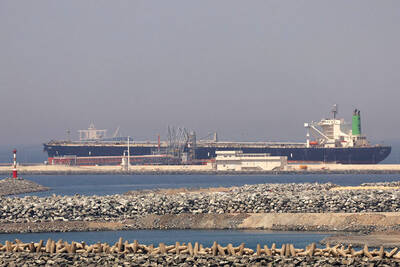
The breakwater stretches out to sea from the sprawling Kaohsiung port in southern Taiwan. Normally, it’s crowded with massive tankers ferrying liquefied natural gas from Qatar to be stored in the bulbous white tanks that dot the shoreline. These are not normal times, though, and not a single shipment from Qatar has docked at the Yongan terminal since early March after the Strait of Hormuz was shuttered. The suspension has provided a realistic preview of a potential Chinese blockade, a move that would throttle an economy anchored by the world’s most advanced and power-hungry semiconductor industry. It is a stark reminder of
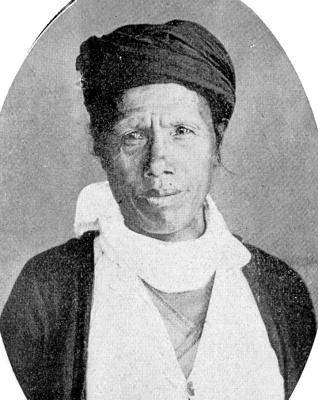
May 11 to May 17 Traversing the southern slopes of the Yushan Range in 1931, Japanese naturalist Tadao Kano knew he was approaching the last swath of Taiwan still beyond colonial control. The “vast, unknown territory,” protected by the “fierce” Bunun headman Dahu Ali, was “filled with an utterly endless jungle that choked the mountains and valleys,” Kano wrote. He noted how the group had “refused to submit to the measures of our authorities and entrenched themselves deep in these mountains … living a free existence spent chasing deer in the morning and seeking serow in the evening,” even describing them as
The last couple of weeks spectators in Taiwan and abroad have been treated to a remarkable display of infighting in the Chinese Nationalist Party (KMT) over the supplementary defense budget. The party has split into two camps, one supporting an NT$800 billion special defense budget and one supporting an NT$380 billion budget with additional funding contingent on receiving letters of acceptance (LOA) from the US. Recent media reports have said that the Taiwan People’s Party (TPP) is leaning toward the latter position. President William Lai (賴清德) has proposed NT$1.25 trillion for purchases of US arms and for development of domestic weapons
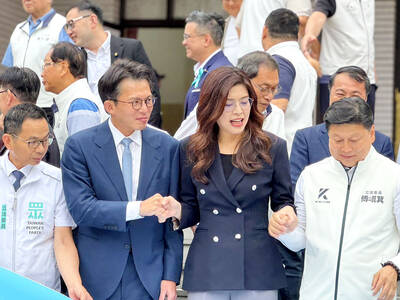
As a different column was being written, the big news dropped that Chinese Nationalist Party (KMT) caucus whip Fu Kun-chi (傅?萁) announced that negotiations within his caucus, with legislative speaker Han Kuo-yu (韓國瑜) of the KMT, party Chair Cheng Li-wun (鄭麗文), Taichung Mayor Lu Shiow-yen (盧秀燕) and Taiwan People’s Party (TPP) Chair Huang Kuo-chang (黃國昌) had produced a compromise special military budget proposal. On Thursday morning, prior to meeting with Cheng over a lunch of beef noodles, Lu reiterated her support for a budget of NT$800 or NT$900 billion — but refused to comment after the meeting. Right after Fu’s


 RSS
RSS