


With the exception of top-flight baseball games few sporting events in Taiwan attract large crowds. Whether it's a qualifying match for the FIFA World Cup in which Taiwan is pitched against Uzbekistan or a basketball game in the annual Jones Cup, crowds rarely exceed a thousand.
Despite the number of scooters racing around the streets of Taiwan, even motorcycle racing is not a popular sport. On any given weekend at Taiwan's sole motor sport circuit at Longtan (
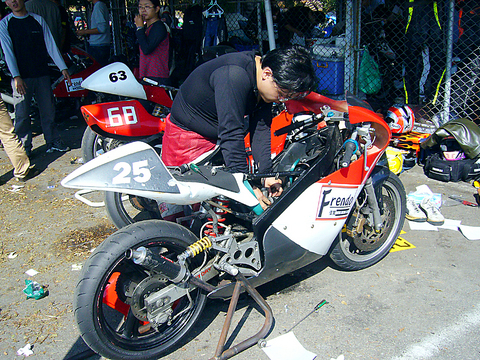
Compared to national motor sport circuits in other countries the 1.85km Longtan track makes for rather a sad picture and not simply because of the lack of spectators. Most amenities commonly associated with racing circuits the world over are non-existent.
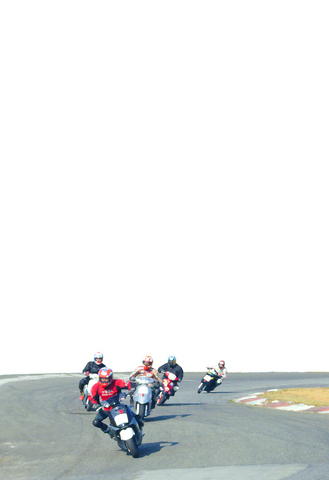
"Yeah, it's pretty bad, but it's all we've got," said Lin Yung-yi (
The few spectators who do turn out have to sit on concrete terracing and are protected from the fast moving vehicles by a rusting fence made of chicken wire. There are no pits for teams to repair their machines and talk tactics -- this all takes place in a parking lot.
There's no digitized lap counter -- these laps are counted off manually on a stainless steel board. There's no glitzy souvenir shop -- instant noodles and canned drinks are available at a small kiosk. And, with the exception of a single ambulance, the circuit is deficient in even the most basic of emergency fire and rescue equipment.
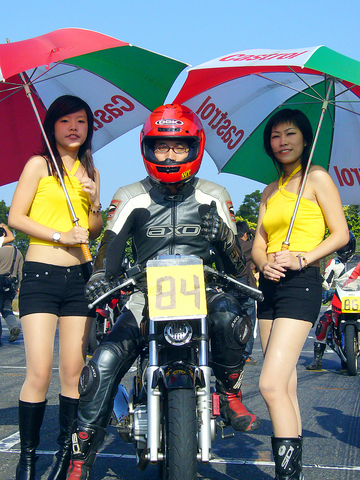
PHOTOS: GAVIN PHIPPS, TAIPEI TIMES
It might sound like a disaster waiting to happen, but since the track's inception in 1993 there hasn't been a fatality. Sure, there's been plenty of broken bones, bruised ribs and damaged egos, but the fact that the circuit is so run down has united Taiwan's motorcycle racers. Camaraderie is as an important part of any race day as winning.
"It's a very friendly atmosphere and everyone talks to everyone else regardless of what team they ride for. You wouldn't see this anywhere else at a competitive level," said Huang Chun-shih (
Managed by the Chinese Taipei Motor Sport Association (CTMSA, 中華賽車會), the nation's official autosport association, Longtan may lack the fancy technology of Japan's Suzuki Circuit, but it has managed to weather dismal spectator turnouts. The track has successfully served as the base for Taiwan's small, but enthusiastic motorcycle racing community for the past 12 years.
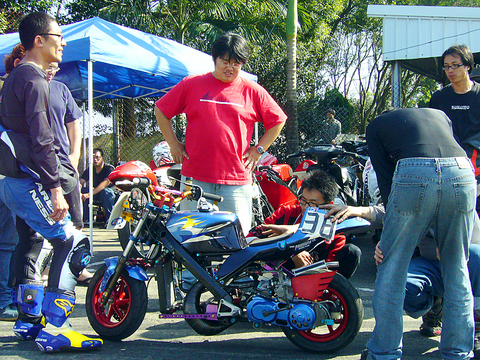
"It was slow to begin with and the first year we held [motorcycle] races we only had about 200 entrants," said Yeung Kwong-wing (
The CTMSA was forced to scrap non-team scooter racing at the beginning of the 1999/2000 season due to safety concerns.
According to Yeung, the riders were getting younger and the two-stroke 50cc engines and scooter frames, which were not designed for racing, meant that scooter racing was becoming increasingly dangerous.
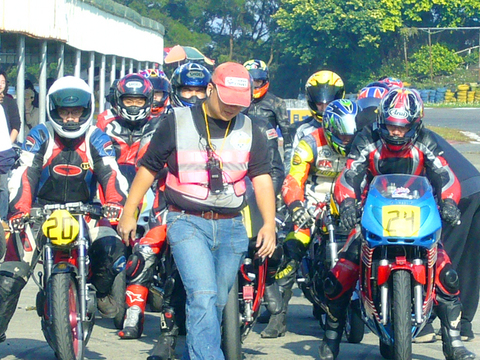
"It was a popular feature, but the riders in the teams were getting really young and we figured that it was only matter of time before there was a [major] accident," Yeung said. "It resulted in a radical drop in numbers, but we felt that by scrapping [scooter racing] we could instead concentrate on promoting bigger, more powerful bikes that were designed for speed."
Today the number of regular racers stands at between 300 and 400 and races are now held once a month. The racers are still fanatical, however, and while the number of teams has dropped to an all-time low of 15, the number of individual racers has increased. The only scooters currently allowed to ply the circuit are those in the individual riders class, as teams are no longer allowed to compete using scooters.
The league is divided into categories. The 125cc and 150cc unlimited modifications category is the most competitive and attracts the most teams while the second and third categories -- the 125cc and 150cc unmodified road bikes -- revolve around time-trials rather than flat out racing and are popular with individual non-team racers like Leo Lin (
"Sure, the team events are more competitive but just being able to beat my own previous lap time is good enough for me," said the teenage motorcycle racer. "It's great that there is a place I can pay NT$800 and get to compete in a time trial. I don't need to modify my bike all I have to do is tape a number to the headlight, pay my money and I'm away."
The teams are predominantly operated by motorcycle repair shops and dominate the more competitive classes on the specially modified 125cc and 150cc bikes. Costing from between NT$75,000 to NT$100,000 for the basic bike, the teams spend anywhere from NT$50,000 to NT$100,000 on modifications that transform the road bikes into lean, mean racing machines.
Basic frames are replaced with specially designed racing versions in order to allow the bikes to withstand greater pressures. Engines are toyed with and seats and other accessories either removed or stripped down to the bare essentials. A well tuned racing bike, like the one Lin rides for his HRMS Team, can reach speeds in excess of 170kph. The average lap times for the modified bikes stands at roughly one minute 20 seconds.
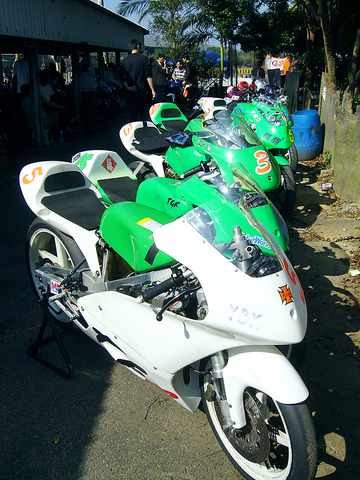
"The bikes have to be completely modified and you have to start from scratch," Lin said. "There's no way I'd get on a road bike and attempt to participate in a race because it would be dangerous, the bike wouldn't last long and it would be really slow."
Sadly for Lin and his fellow racers, who have put time and money into the sport, this season's motorcycle championship could be the last, as the owner of the land on which the Longtan circuit is located is not expected to renew the lease in January. The CTMSA has asked the government for assistance in finding and funding a new circuit, but little has come of the talks.
"The government doesn't care about motor sports. Without knowing anything or trying to learn anything about [motor sports] they think its dangerous, so it should be stopped," Huang said. "What can we do? It's not as if we can drive our bikes to the Presidential Office and hold a demonstration. The bikes are designed for racing and are illegal on the road, so the cops would simply confiscate them."
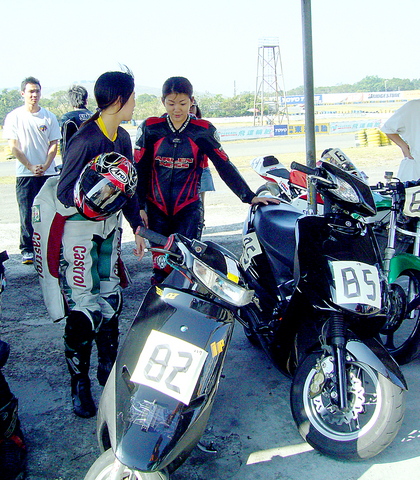
And it's not only the boys and their toys that fear being left without a place to race if the track closes in January. The riders of the nation's sole all-female motorcycle racing team, Team Wutien (
"It's a shame and it could see the sport either disappear completely or go underground. Either way it will be devastating," said Chang Hao-ling (
It's not all bad news for Taiwan's racers, however, as come December the CTMSA is expected to announce plans for a multi-million dollar circuit. The Taiwan motor sport association's CEO is keeping tight-lipped about the possible whereabouts of the track, but according to Yeung the circuit could put Taiwan on the global motor sports map.
The track will likely not meet Formula 1 requirements, but it could meet international standards, and be built in cooperation with established race circuit developers from Europe. And it could hold events like the Superbike World Championship.
"It's a question of making a new circuit pay. Over the years we've managed to make Longtan pay, even though we've never made a huge profit," Yeung said. "Building a race track capable of hosting international events is very different. I can't say too much at the moment, but if we build it, then it will be more than just a concrete oval with a few bends."
Ajay Verma, a consultant gastroenterologist at Kettering general hospital in Northamptonshire, says our gut is a “complex machine.” “It is constantly providing us with the nutrition we need, initially to grow and develop, and then for us to survive, thrive and repair from injury and illness.” How can we keep it functioning well? Put simply: “Make sure what you put into it is balanced, and that you clear out its waste products adequately,” Verma says. “In a general gastroenterology clinic, the most common conditions we see are irritable bowel syndrome (IBS), gastroesophageal reflux disease, inflammatory bowel disease and constipation,” says Nisha
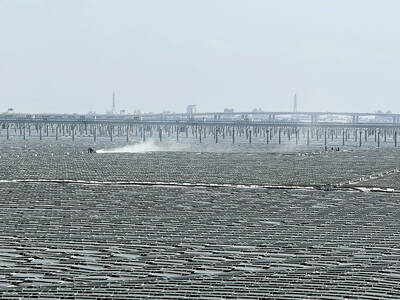
The arithmetic is straightforward and uncomfortable. By the end of 2025, Taiwan had committed itself to a 50-30-20 electricity mix — half natural gas, 30 per cent coal, 20 per cent renewables. The Ministry of Economic Affairs’s (MOEA) own monthly energy reports tell a different story. Natural gas reached 47.8 per cent of generation last year. Coal stood at 35.4 per cent, comfortably above its target ceiling. Renewables came in at 13.1 per cent, well short of the 20 per cent Taipei had pledged a decade earlier. Installed renewable capacity reached roughly half of the 12 gigawatts (GW) the government

Last week US President Donald Trump was asked by a reporter whether he would speak on the phone to the President of Taiwan. “l’ll speak to him. I speak to everybody. We have that situation very well in hand,” Trump said. This marked the second time in a couple of weeks he had said he would talk to the President of Taiwan. In 2016 he famously took a call from then-president Tsai Ing-wen (蔡英文), when he was president-elect. Despite warnings that the apocalypse was nigh because of a phone call, the world quickly forgot about the conversation between two democratically-elected presidents.
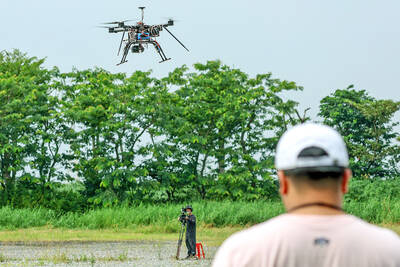
Taiwan’s drone exports are taking off, fuelled by the war in Ukraine, as Taiwanese companies seek a stake in the fast-growing global market for unmanned aerial vehicles (UAV). Low-cost drones used for reconnaissance and strikes are in high demand as governments around the world boost defense spending in the face of intensifying conflicts. A relative new player in the increasingly competitive industry, Taiwan’s pitch is to be an “Asian hub” for the production of UAVs and components free of Chinese materials, or “non-red.” That means its UAVs can be up to three times more expensive than their Chinese competitors, like the world’s biggest


 RSS
RSS